
The Hot Spot Rating
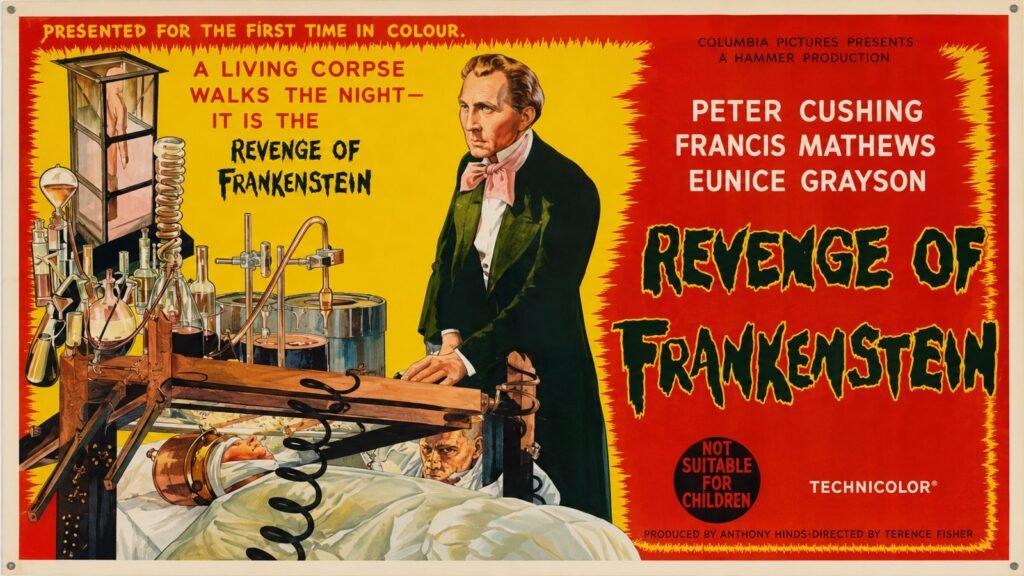
Revenge of Frankenstein, The (1958)
Starring: Peter Cushing, Michael Gwynn, Francis Matthews, Eunice Gayson
Director: Terence Fisher
Synopsis: Hammer’s first and best sequel to the Curse of Frankenstein
Reviewed by: Ali Khan
“One of the best” Creature Features
“Strange black comedy reworking….extraordinary climax” Time Out
“Thoughtprovoking, effective…fine atmosphere” Maltin’s
“Excellent sequel” Blockbuster Video
“This is a high grade horror film.” — Variety
“Rich production values” and “a script that was well-plotted, peopled with interesting characters.” — Variety
“A horror picture turned out with creative skill and imagination.” — Motion Picture Daily
“Hammer have demolished once and for all the theory that horror films should always be in black-and-white.” — Motion Picture Daily
“A first-rate picture of its kind.” — Harrison’s Reports
“A strange, blackly comic reworking of the Frankenstein myth.” — Time Out
“In one of his best performances, Cushing plays on the ambiguity of the central character.” — Time Out
“Cushing’s cool demeanour and grace were ideally suited to his role… he gives a chillingly subtle performance.” — Film4
“Expertly executed example of a golden time in British cinema—one to savour.” — Empire Magazine
The Revenge of Frankenstein was Hammer’s first attempt at following up the enormous success of The Curse of Frankenstein, and fortunately it proved that lightning could indeed strike twice. Once again Peter Cushing returns as the obsessively driven Baron Frankenstein, delivering another superb performance that further cements his place as Hammer’s definitive mad scientist.
The story picks up exactly where The Curse of Frankenstein left off, with the Baron apparently facing execution beneath the guillotine. Naturally, things are not quite as straightforward as they appear. Frankenstein escapes his fate and resurfaces in another town under the assumed identity of Dr. Victor Stein. Establishing himself as a gifted physician, he rapidly builds a flourishing medical practice, much to the annoyance of the local medical fraternity.
Three years later his true identity is uncovered by a fellow doctor. Rather than exposing the infamous Baron, however, the young physician becomes fascinated by Frankenstein’s genius and eagerly joins him in his forbidden experiments. Together they resume the work abandoned at the conclusion of the previous film.
This time Frankenstein attempts something even more ambitious: transplanting a living brain into an entirely new body painstakingly assembled from donated body parts. The operation itself is a triumph, but there is one crucial condition—the transplanted brain must be allowed sufficient time to heal before suffering any trauma. Inevitably fate intervenes. The unfortunate patient is brutally assaulted before his recovery is complete, the damaged brain degenerates, and once again Frankenstein’s greatest triumph becomes his greatest nightmare as another tortured creature is unleashed upon an unsuspecting public.
The Revenge of Frankenstein had an unenviable task following one of Hammer’s greatest successes, yet director Terence Fisher proves once again why he remains the studio’s master craftsman. Although the film contains fewer outright shocks than its predecessor, it compensates with a far stronger and more sophisticated screenplay.
Gone is Christopher Lee’s grotesquely scarred monster. In its place is a far more refined and tragic creation, making the horror less visceral and considerably more psychological. Fisher wisely allows much of the gruesome detail to remain off-screen, often suggesting horrors rather than showing them outright. We are told, for example, that damage to the transplanted brain could reduce the creature to cannibalism—a disturbing possibility that proves all too real.
The screenplay is tightly constructed from beginning to end and laced with an understated wit that distinguishes it from many horror films of the period. The opening sequence, in particular, cleverly orchestrates Frankenstein’s apparent execution and miraculous reappearance, immediately drawing the audience back into the Baron’s extraordinary world.
Visually, the film retains all the sumptuous Technicolor splendour that distinguished The Curse of Frankenstein. Much of the credit belongs to Hammer’s gifted cinematographer Jack Asher, whose masterful use of rich colours, dramatic lighting and shadow once again transforms modest studio sets into a convincing Gothic nightmare.
Above all, however, the film belongs to Peter Cushing. Remarkably, no matter how many times he returned to the role of Baron Frankenstein, he always managed to reveal some new facet of the character. He never allowed the performance to become routine, approaching every appearance with the same meticulous seriousness and absolute conviction.
Here the Baron emerges as a considerably more rounded figure. His obsessive pursuit of forbidden knowledge remains undiminished, yet Cushing also allows us to glimpse a more compassionate, almost humanitarian side beneath the scientific fanaticism. The result is one of horror cinema’s earliest and finest anti-heroes—a man whose brilliance is equalled only by his moral blindness.
The Revenge of Frankenstein may not possess quite the shock value of Hammer’s groundbreaking original, but as a sequel it succeeds admirably. Intelligent, beautifully directed and graced by another magnificent Peter Cushing performance, it remains one of the finest entries in Hammer’s celebrated Frankenstein series.