
The Hot Spot Rating
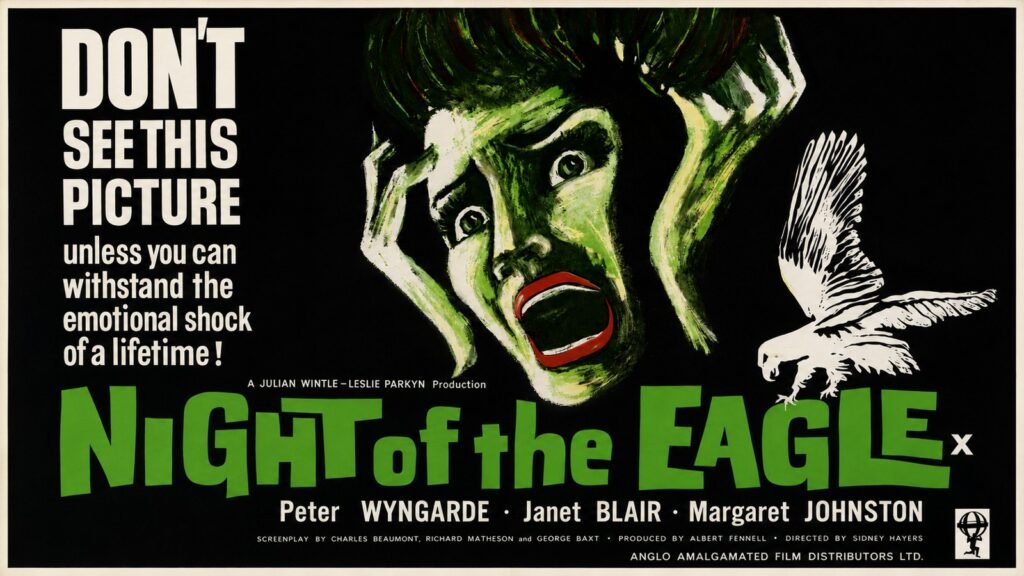
Burn Witch Burn AKA Night Of The Eagle (1962)
Cast: Peter Wyngarde, Janet Blair, Margaret Johnston, Colin Gordon
Director: Sidney Hayers
Synopsis: Stylish and beautifully cinematographed, an uneven tale of sorcery, scepticism and belief.
Reviewed by: Omar Khan
“Quite the most effective supernatural thriller since Village of the Damned.” — The New York Times
“The best outright goose-pimpler dealing specifically with witchcraft since I Walked with a Zombie.” — The New York Times
“Atmospheric and underplayed in the tradition of Val Lewton.” — Chicago Reader (Jonathan Rosenbaum)
“Sidney Hayers shoots the whole thing with an almost Wellesian flourish.” — Time Out
“The script… is structured with incredible tightness.” — Time Out
“Lovers of classic supernatural cinema should appreciate this underrated gem.” — IONCINEMA
“It’s like a full-length episode of Boris Karloff’s Thriller TV series, very stylishly done.” — PopMatters
“It’s a real smack in the face of the skeptical male ego.” — Boston Movie News
“A superlative witchcraft shocker.” — Movies and Drinks
“Remarkable… for its sustained level of tension.” — Movies and Drinks
Burn, Witch, Burn (AKA Night of the Eagle) is an elegant and beautifully photographed tale of sorcery, scepticism and belief that remains one of British horror’s more intelligent and understated achievements.
Norman Taylor (Peter Wyngarde) is a university lecturer in rural England who dismisses witchcraft and superstition as little more than psychological crutches for those unable to face reality. Academic politics simmer beneath the surface of the university, where jealousy and resentment fester among both the faculty and their wives. Early on, Norman discovers that his wife Tansy has secretly been practising witchcraft. Horrified, he confronts her, only to learn that she has done so solely to protect him and to safeguard his academic career. Scornful of such irrational beliefs, Norman insists that she destroy every trace of her charms and talismans.
Almost immediately, his ordered world begins to collapse.
One misfortune follows another. Norman is accused of rape, violent threats begin to surround the couple, someone attempts to break into their home, and finally Tansy mysteriously disappears before being found attempting to drown herself in circumstances she cannot explain. Increasingly shaken, Norman’s steadfast rationalism begins to crumble as events become stranger and more sinister. Matters reach a terrifying climax when Tansy, seemingly in a trance, attacks her husband with a kitchen knife, only afterwards having no recollection of what she has done. A seemingly insignificant clue—her pronounced limp during the attack—sets Norman on a path that forces him to question everything he has always believed.
Director Sidney Hayers handles the material with considerable assurance, and the film contains several exquisitely composed sequences. The black-and-white photography is magnificent throughout, creating an atmosphere of quiet unease through elegant lighting and beautifully judged compositions rather than overt shocks. The cinematography is unquestionably the film’s greatest strength.
The supporting cast acquit themselves well, with Peter Wyngarde bringing quiet intelligence and conviction to Norman’s gradual transformation from sceptic to reluctant believer. Janet Blair, however, proves rather less convincing. Her performance frequently slips into melodrama, recalling Olivia de Havilland at her most theatrical, and she occasionally becomes the weakest link in an otherwise capable ensemble.
The climax is imaginative and visually striking, bringing the story to a satisfying conclusion despite one or two moments that verge on the overblown. Hayers directs with considerable skill throughout, although the pacing occasionally slackens and there are stretches where the narrative threatens to lose momentum.
One cannot help wondering how Peter Cushing, originally intended for the role of Norman Taylor, might have elevated the film still further. Cushing possessed an unmatched ability to convey intellectual authority while simultaneously suggesting deep emotional conflict, and the role would have suited him perfectly.
If Burn, Witch, Burn falls short of greatness, it is because it never quite generates the level of fear or sustained tension its premise promises. It is more intriguing than frightening, more elegant than unsettling. Even so, its handsome cinematography, intelligent screenplay and confident direction make it one of the more distinguished British supernatural thrillers of the early 1960s.