
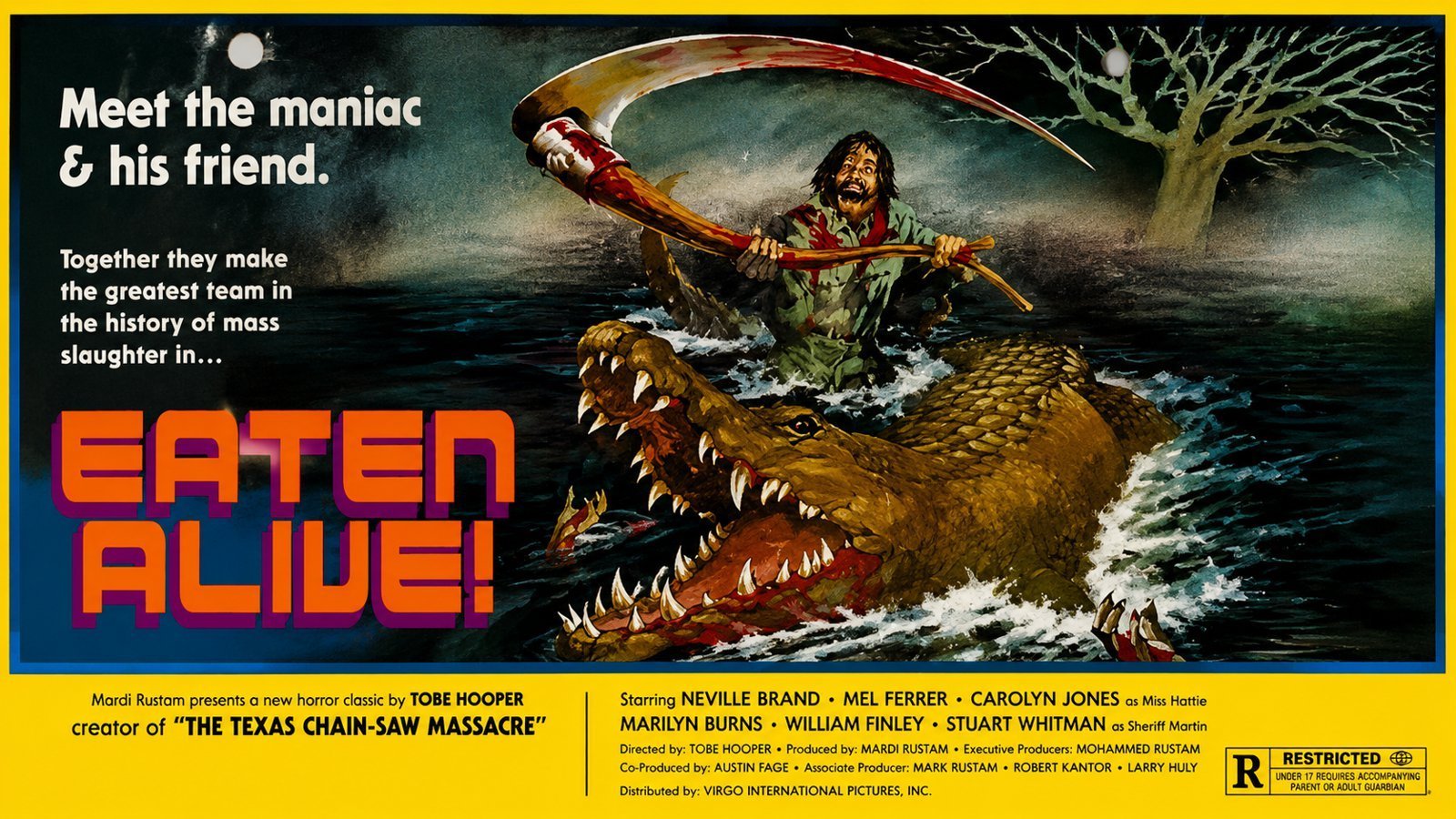
Eaten Alive AKA DEATH TRAP (1976)
Starring: Neville Brand, Mel Ferrer, Carolyn Jones, Marilyn Burns, Robert Englund
Director: Tobe Hooper
Synopsis: Demented Hotel proprietor keeps his pet Alligator well fed with diet of local lunatics
Reviewed by: Omar Khan
"trite and unconvincing" Time Out
"garishly stylized " Maltin's
"gruesome with black humor" Blockbuster Video
"compellingly sick excercise based on a true life story" Video Nasties
"sickining misfire...unwatchable unless you're a sadist" Creature Features
"An ugly, overheated, often fascinating horror film." — Time Out Film Guide
"A bizarre, sweaty nightmare." — Empire Magazine
"One of Hooper's most underrated films." — Kim Newman, Empire Magazine
"Less coherent than The Texas Chain Saw Massacre, but no less disturbing." — Slant Magazine
"A delirious fever dream of Southern Gothic horror." — DVD Talk
"Neville Brand gives one of the great unhinged performances of 1970s horror." — AllMovie (Jason Buchanan)
"An atmospheric slice of backwoods terror." — TV Guide
"Hooper creates an oppressive atmosphere of madness and decay." — The Spinning Image
"A grimy, unsettling exploitation film that has steadily grown in reputation." — The Digital Fix
"A fascinating companion piece to The Texas Chain Saw Massacre." — Senses of Cinema
According to the blurb on the DVD cover, this is "long considered the lost Tobe Hooper film." It's hardly surprising it got lost; Hooper probably buried it himself in the nearest swamp to salvage his reputation after The Texas Chain Saw Massacre and before Poltergeist came calling.
Another clue to the film's dubious pedigree is the astonishing number of titles under which it has been released. Depending on where you happen to find it, it may be called Death Trap, Brutes and Savages, Horror Hotel, Horror Hotel Massacre, Legend of the Bayou, Murder on the Bayou or Starlight Slaughter. Whenever distributors start handing out new titles like confetti, it is usually a desperate attempt to convince unsuspecting audiences that the latest reissue might somehow be a different film. More often than not, it's simply the same turkey wearing a different hat.
Strangely enough, despite every indication that it should be completely dreadful, the film develops an oddly hypnotic quality. Its bizarre red and green lighting, bargain-basement sets and gloriously eccentric performances combine to create an atmosphere that is almost surreal.
Neville Brand stars as Judd, proprietor of the ramshackle Starlight Hotel—a place that makes the Bates Motel resemble a luxury five-star resort. Everything about the establishment appears on the verge of collapse, from the rotting wooden buildings to Judd himself. Yet for reasons known only to the screenplay, practically every lowlife in Louisiana seems determined to spend the night there.
The only thing in prime condition is Judd's pet alligator, lounging contentedly in the neighbouring swamp while performing an astonishingly convincing impression of a floating log until mealtime arrives.
Among the first unfortunate victims is a lively little dog named Snoopy, who becomes a tasty appetiser for the resident reptile. Before long an assortment of drifters, criminals and assorted misfits begin disappearing into the marshes, including poor Marilyn Burns, who had only just escaped the horrors of The Texas Chain Saw Massacre before finding herself once again tied up, terrorised and screaming hysterically. One gets the impression she simply carried on where the previous film left off.
Carolyn Jones, forever immortalised as Morticia Addams, makes a memorable appearance as Aunt Hattie despite limited screen time, while a very young Robert Englund turns up looking wonderfully sleazy some years before becoming Freddy Krueger.
The film desperately attempts to recreate the grimy atmosphere of The Texas Chain Saw Massacre and, visually at least, comes surprisingly close. It possesses the same raw, grubby texture and oppressive rural decay. The crucial difference is that Hooper's masterpiece was genuinely terrifying. This often feels like an accidental parody of itself—and not an entirely unsuccessful one.
Viewed as black comedy, it works remarkably well. The violence is plentiful but so wildly excessive that it becomes more amusing than disturbing, while the soundtrack alternates between unsettling electronic squawks and some of the most excruciating country music ever committed to film.
Neville Brand is unquestionably the picture's greatest asset. His portrayal of Judd is wonderfully deranged without ever descending into outright caricature, and he creates a villain who feels like a distant cousin of the murderous Sawyer clan. He is strange, unpredictable and oddly fascinating to watch.
It's a thoroughly dreadful little film, yet one possessed of undeniable charm. The bizarre premise, the wonderfully ramshackle production and Brand's eccentric central performance somehow combine to create a cult oddity that becomes more enjoyable with repeated viewings. Against all logic, this weird little Z-grade swamp horror has grown on me considerably over the years.
N.B. The story was loosely inspired by the real-life crimes of Texas murderer Joe Ball, the notorious tavern owner who was reputed to have disposed of victims by feeding them to his pet alligators.
0 Comments
Leave a Comment