
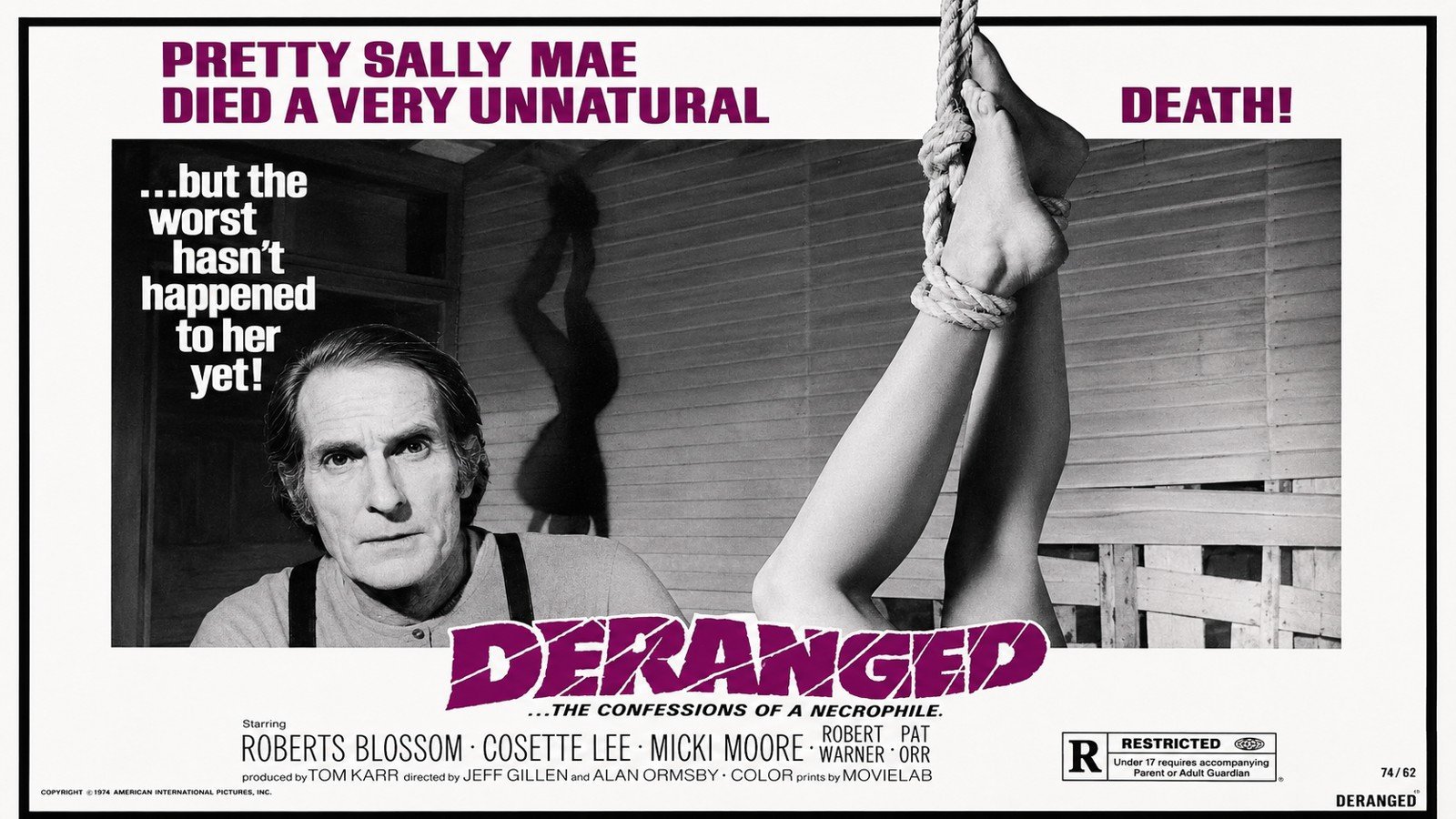
Deranged (1974)
Starring: Roberts Blossom, Cosette Lee, Micki Moore
Directors: Jeff Gillen, Alan Ormsby
Synopsis: Ed Gein inspired Psycho, Texas Chainsaw, Hannibal ...This is about him!
Reviewed by: Omar Khan
"dark, stark account impresses" Time
"a ghoulish horror classic" Psychotronic Movies
"a true gem" Video Movie Guide
"okay thriller" Blockbuster Video
"predictable shocker" Maltin's
1974 arrived fifteen years after Norman Bates first terrorised audiences in Hitchcock's immortal Psycho. It was also the year The Texas Chain Saw Massacre shocked cinema-goers with its raw, uncompromising brutality, and a full twelve years before Hannibal Lecter first chilled audiences in Thomas Harris's Red Dragon before achieving worldwide fame in The Silence of the Lambs. Remarkably, all three owe an enormous debt to one man: Ed Gein, whose appalling crimes came to light in the sleepy farming community of Plainfield, Wisconsin, in 1957.
Gein has the dubious distinction of being the real-life inspiration behind some of horror cinema's most enduring monsters. To neighbours he appeared to be a harmless, quiet bachelor—an odd but inoffensive loner. Behind that deceptively meek exterior, however, lurked one of the most grotesquely disturbed murderers in American criminal history.
Deranged remains one of the lesser-seen films inspired by Gein, only really finding a wider audience in recent years thanks to renewed interest in The Texas Chain Saw Massacre. Unlike Hooper's film, Deranged adopts an almost documentary approach, presenting Gein's crimes with a cold detachment that lends the proceedings a deeply unsettling realism. For such a modest independent production, the acting is uniformly impressive and the direction admirably restrained.
The events depicted are extraordinarily grim, with considerably more explicit gore than appeared in the infinitely better-known Texas Chain Saw Massacre. Ironically, Hooper's masterpiece probably benefited enormously from its unforgettable title alone. The Texas Chain Saw Massacre instantly conjures terrifying images before a frame has even been seen, whereas Deranged sounds like just another routine horror picture.
In many respects, however, it is the grimmer film.
Ed Gein was the man whose farmhouse yielded lampshades fashioned from human skin, bowls made from human skulls, furniture upholstered with flesh and severed heads decorating the walls. He became the template for Norman Bates' unhealthy devotion to his mother, Leatherface's grotesque fascination with human skin and, to a lesser extent, Hannibal Lecter's macabre relationship with the human body. Gein fashioned an entire bodysuit from human skin, complete with breasts and genitalia, which he wore while dancing beneath the moonlight in a grotesque attempt to become his dead mother.
The film succeeds because it wisely resists the temptation to sensationalise material that scarcely requires embellishment. The real story is horrifying enough. Instead, Deranged unfolds with an almost clinical detachment, anticipating later serial killer films such as Henry: Portrait of a Serial Killer, where the horror stems less from elaborate set-pieces than from the mundane presentation of extraordinary evil.
Its low-budget grittiness becomes one of its greatest strengths, lending an uncomfortable authenticity to the proceedings. Another particularly effective device is the recurring presence of a television reporter who periodically updates the audience as Gein's madness steadily escalates, giving the film the feel of a grim true-crime reconstruction.
Considering how uncompromisingly the film approaches its subject, it is perhaps understandable that it only briefly touches upon Gein's necrophilia rather than attempting to depict it directly. Even so, the resulting portrait remains profoundly disturbing. Horror fans will also note that the film represents one of the earliest screen credits for legendary effects artist Tom Savini.
On the whole, Deranged is an effective, unsettling chronicle of one of America's most infamous murderers and deserves a far wider audience than it has ever managed to attract. It remains curious that The Texas Chain Saw Massacre became an international sensation while this equally grim, and arguably even more disturbing, companion piece largely disappeared into obscurity. Perhaps it simply proved too bleak, too uncompromising and too rooted in the chilling reality of the crimes themselves. Then again, Texas Chain Saw Massacre was hardly a day at the seaside either.

0 Comments
Leave a Comment