
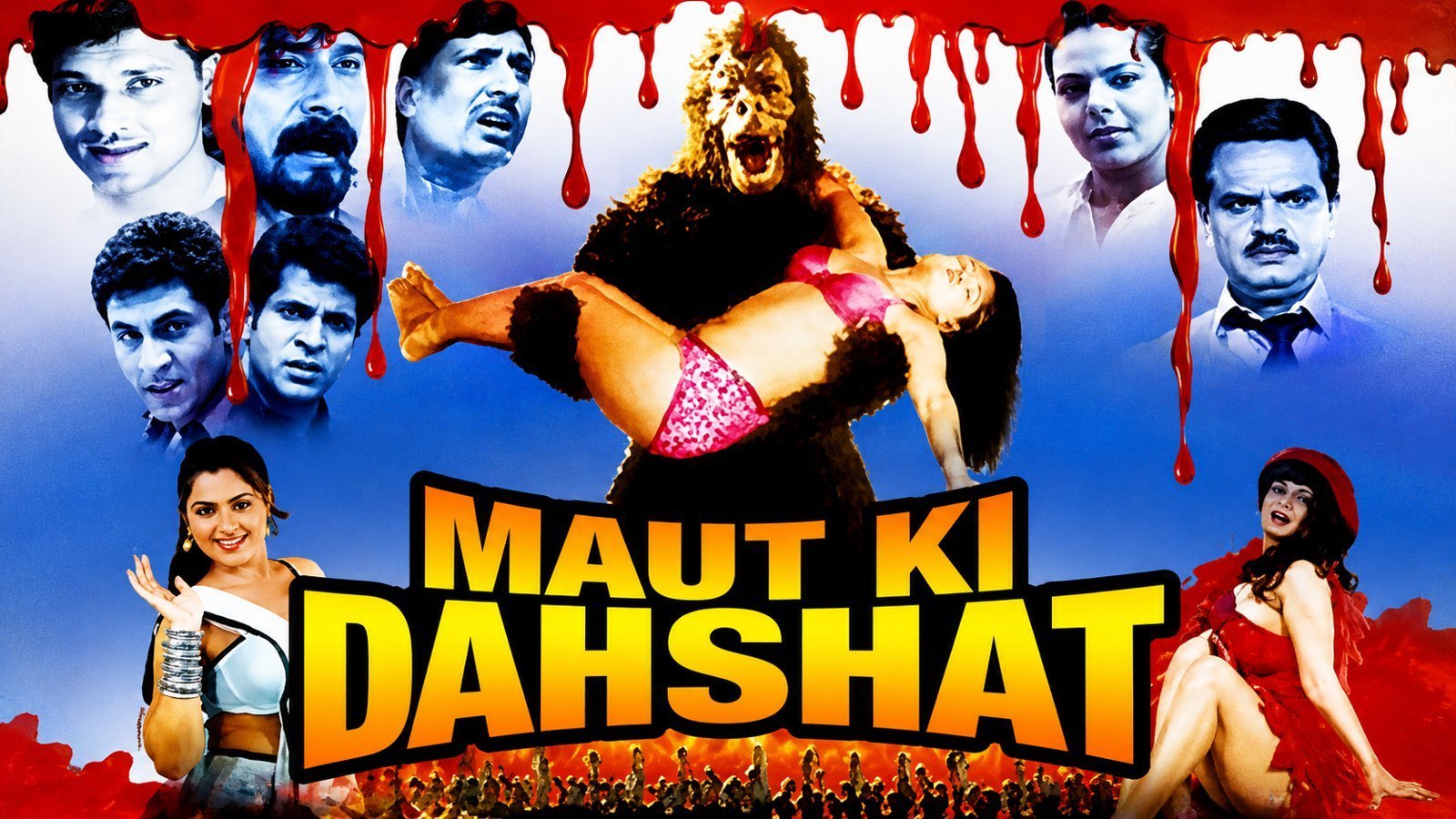
Maut Ki Dahshat (The Horror of Death) (2004)
Cast: Aman Sagar, Shabnam, Rajesh Sabharwal, Rajiv Raj, Poonam Das Gupta, Brij Gopal, Rupal, Dimple, Shiva, K.K. Goswami, Seema, Jamura, Rohit Raj, Bhupat Patel, Gautam, Bhakti Kapoor
Director: J. Neelam
Synopsis: An elicit potion turns a young man into a diabolical Ape with rape and murder on the agenda.
Reeviewed by: Omar Ali Khan
I first encountered Maut Ki Dahshat over a decade ago and found it strangely mesmerising for a variety of reasons. The plot is hardly original, revolving around the familiar horror staple of a secret potion promising eternal youth. Those of us versed in horror cinema (The Wasp Woman, Countess Dracula, The Rejuvenator and countless others) already know that such miraculous concoctions invariably lead to mayhem and disaster.
Maut Ki Dahshat, however, remained firmly lodged in the memory for its wonderfully deadpan dialogue, much of which was so gloriously bizarre that it found its way into the equally ridiculous "Mondo Bizarro" radio shows we used to produce for The City FM89. One immortal exchange has Inspector Seema, with her superiors breathing down her neck, trying to solve the rape of a young woman apparently assaulted by a man resembling an ape.
"Aik Bandar ne aisi harkat ki?"
Poor Seema herself soon suffers the same fate, although she is fortunately rescued just in time from the rather rubbery ape during one particularly enthusiastic attack.
It soon transpires that a miraculous potion guaranteeing eternal male potency possesses the unfortunate side effect of transforming perfectly healthy young men into hulking beasts endowed with superhuman strength and an equally superhuman sexual appetite. Sadly, the formula also produces excessive hair growth and an appearance remarkably similar to that of an escaped gorilla.
As Seema's family struggle to come to terms with her ordeal, Inspector Rekha gradually begins piecing together the mystery, although not before several more women are attacked, enthusiastically groped and, on occasion, raped by the Horrible Hairy Thing during its relentless crime spree.
The opening sequence wastes no time demonstrating the serum's remarkable side effects. A healthy young volunteer swallows the miraculous potion before immediately sprouting alarming quantities of hair—and what appears to be strips of Scotch tape—all over his body. Within seconds he has transformed into a deranged rubber ape with a libido entirely beyond his own control, forcing him to prowl the city in search of fresh victims.
The situation becomes so dire that the entire city fears for the safety of its mothers, wives and daughters as Inspector Rekha races against time to stop the murderous serial rapist before the body count climbs even higher.
Stopping the Rubbery Ape proves no easy task. Sporting a jaw that appears to have been spectacularly dislocated, the creature proceeds to attack a bevy of beauties, many of whom seem to be rubbed and squeezed to death rather than subjected to anything so mundane as conventional murder.
The film even throws in a pleasingly Hitchcockian twist when the apparent heroine herself falls victim to the marauding ape, leaving the investigation in the capable hands of the dashing Inspector Khan.
Meanwhile, the creature develops an unhealthy fascination with scientist Vipin Rai's daughter, Seema, repeatedly returning to torment her. Vipin Rai is, of course, the brilliant scientist responsible for developing the miraculous serum designed to preserve a man's masculinity, virility and physique indefinitely. Better still, the potion apparently prevents homosexuality and helps ensure that a man remains, in the film's own words, a "true man."
Vipin Rai's groundbreaking formula is jealously guarded by his devoted protégé Ajay, who has spent years assisting his mentor and takes immense pride in their revolutionary discovery. But who has stolen the precious serum and transformed an otherwise respectable young man into a marauding, sex-crazed Rubber Ape?
Following several more entirely bloodless deaths—the victims continuing to be rubbed and pressed into oblivion rather than actually murdered—the mystery slowly unravels until, during the climactic scenes, the ape's true identity is finally revealed as the effects of the potion wear off and he gradually resumes human form.
It is a riotously awful film, relying almost entirely upon a man staggering around in an exceedingly rubbery ape suit to generate whatever misplaced horror it can muster. Yet the film ultimately redeems itself through its unexpectedly worthy moral message.
The lesson is perfectly clear.
Attempt to preserve your youth, vanity and virility through unnatural substances and you will almost certainly transform into a psychotic, sex-starved Rubber Ape with a badly displaced jaw.
Take drugs to enhance your masculinity, physique and strength, and they will inevitably rebound upon you with deadly consequences.
Steroids and cosmetic surgery are the true villains of this remarkable horror film. Maut Ki Dahshat therefore serves as an invaluable warning to anyone tempted to interfere with nature rather than age gracefully, as most of us sensibly choose to do.
Indeed, this searing indictment of aesthetic surgery and steroid abuse deserves to be screened worldwide, particularly in gymnasiums where impressionable youngsters spend their days injecting mysterious substances that may one day transform them into homicidal Rubber Apes.
The world needs more socially relevant horror films such as Maut Ki Dahshat. A triumph for producer-director J. Neelam.
Amazingly, entire songs have been lifted wholesale from other films, including Asha Bhosle's sizzling cabaret number from Johnny Mera Naam, which appears in full and is arguably the movie's single greatest pleasure.
There are certainly enough ape attacks to satisfy most horror devotees, although the level of nudity is surprisingly restrained for this particular brand of bargain-basement exploitation. Fortunately, the unexpectedly weighty moral dimension lends the proceedings an entirely undeserved sense of gravitas.
Dreadful, dire and padded with comedy sequences that qualify as horror in their own right, Maut Ki Dahshat nevertheless rewards the determined viewer who somehow reaches the closing credits.
A potent indictment of steroids, cosmetic surgery and the dangers of eternal youth.
A surprisingly relevant and topical film.

0 Comments
Leave a Comment