
The Hot Spot Rating
Mr. Sardonicus (1961)
Cast: Oscar Homulka, Ronald Lewis, Audrey Dalton, Guy Rolfe
Director: William Castle
Nutshell: deliciously typical macabre fable from Castle’s impressive House of Horrors.
“Enjoyable” – Creature Features
“minor fare despite good ending” – Maltin’s
“Creepy, effective “Sleeper” – Blockbuster Video
“Castle is not Edgar Allan Poe. Anybody naive enough to attend… will find painful proof.”— The New York Times review by Howard Thompson (1961)
“An elaborately produced [film]… that evokes disgust as well as macabre thrills.”— PTA Magazine (1961)
“May leave some craving for more blood.”— Variety (1961)
“A rather brilliant horror film out of the 60’s.”— HorrorNews.net retrospective review
“The makeup for 1961 is jarring enough to put this film in the horror history books.”— HorrorNews.net
“Compelling, with a creepy vibe… and a memorable, menacingly scary villain.”— Rotten Tomatoes user review
“One of Castle’s best works.”— AllMovie retrospective assessment
William Castle emerges from a swirling blanket of thick old-fashioned London fog to solemnly read us the dictionary definition of the word “ghoul” — just to set the mood for what is about to unfold in Mr. Sardonicus.
It was never unusual for Castle to introduce his wonderfully theatrical horror hokums personally, easing audiences into precisely the right frame of mind before the story began. Here he warns us ominously about ghoulish activity and unspeakable horrors before transporting us back to fogbound London in 1880.
We are introduced to the celebrated Dr. Robert Carver, recently knighted for his miraculous work curing paralysis and wasted limbs. In an early scene designed to establish him as a compassionate miracle worker, we watch admiringly as the kindly doctor restores movement to a young paralysed girl.
Soon afterwards, a mysterious and rather bumptious one-eyed stranger arrives at the surgery carrying an urgent handwritten note, insisting that “his master” demanded it be delivered personally into Dr. Carver’s hands.
The contents visibly disturb the doctor.
Cancelling all of his appointments immediately, Carver departs for some remote and forbidding village deep in Central Europe. Upon arrival, he discovers the terrified villagers recoiling in horror at the mere mention of the name of his host: Baron Sardonicus.
One particularly unnerving villager ominously warns him:
“You would not understand. You are not old enough to have daughters.”
Undeterred, Carver presses onward toward the imposing castle manor of the enormously wealthy and reclusive Baron Sardonicus.
Awaiting him there is Krull — the same strange messenger who earlier appeared in London — and soon the doctor is reunited with the Baron’s wife, Maude, once his former lover before she abandoned him in favour of marrying the wealthy nobleman.
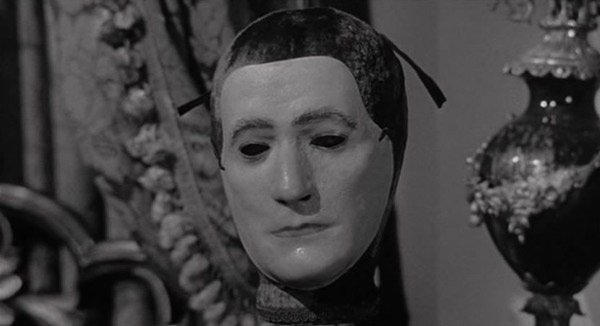
At last, Carver finally encounters the Baron himself, who appears concealed beneath a hideous white mask intended to shield others from the ghastly deformity lurking beneath.
As Carver settles uneasily into the castle, he begins witnessing increasingly disturbing events. Most memorably, he stumbles upon the maid Anna being subjected to one of the film’s most unpleasantly effective scenes as Krull unleashes dozens of ravenous leeches across her terrified face.
He also senses immediately that Maude is living under some dreadful unspoken threat, even if she refuses to explain her situation openly.
Sardonicus himself proves intelligent, cold, ruthless, and utterly obsessed with finding a cure for his grotesque affliction. Eventually he recounts the terrible story of how he became the monstrous figure he is today.
Once merely a poor peasant named Marek, he endured a life of grinding poverty alongside a beautiful but relentlessly dissatisfied wife who constantly yearned for wealth and status. One day his father wins a lottery ticket but dies suddenly before claiming the prize, the winning ticket buried alongside him.
Driven by greed and pushed mercilessly by his wife, Marek returns to the graveyard to exhume the corpse and retrieve the ticket from his dead father’s pocket.
It is at that dreadful moment — when he first lays eyes upon the grotesquely decayed face of the corpse — that Marek’s own features become permanently twisted into a horrifying death grin stretching grotesquely across his face.
“A gargoyle shunned by everyone.”
At first the audience may feel a flicker of sympathy for Sardonicus and his hideous curse, but any compassion soon evaporates once his sadistic behaviour becomes apparent. The ghastly leech torture scene alone is enough to expose the depths of his cruelty.
We gradually realise that Sardonicus will stop at absolutely nothing — blackmail, torture, mutilation, even murder — in his obsessive quest to regain his former appearance.
Perhaps the most chilling sign of his insanity is his horrifying plan to surgically mutilate his wife’s face so that she will resemble him and therefore never recoil from him again.
Though Castle had already scored major successes with gleefully macabre crowd-pleasers such as House on Haunted Hill, The Tingler, and Homicidal, Mr. Sardonicus may well represent him operating at the absolute peak of his wonderfully eccentric powers.
The film resembles a traditional gothic Dracula tale in many respects, with an English outsider summoned to a mysterious castle in Central Europe to confront a feared and despised aristocratic monster.
Despite its modest budget, the film is beautifully photographed throughout. Castle and cinematographer Burnett Guffey absolutely revel in the atmosphere, filling the screen with rolling fog so thick it practically invades the interiors of the castle itself.
The story unfolds very much like a dark moral fable — greed unleashing a terrible curse that may or may not ever truly be lifted.
The performances are excellent across the board. Guy Rolfe is superb as the tortured and terrifying Sardonicus, while Oscar Homolka steals numerous scenes as the bizarre and oddly lovable Krull.
This is classic William Castle — perhaps even superior to many of his better-known productions.
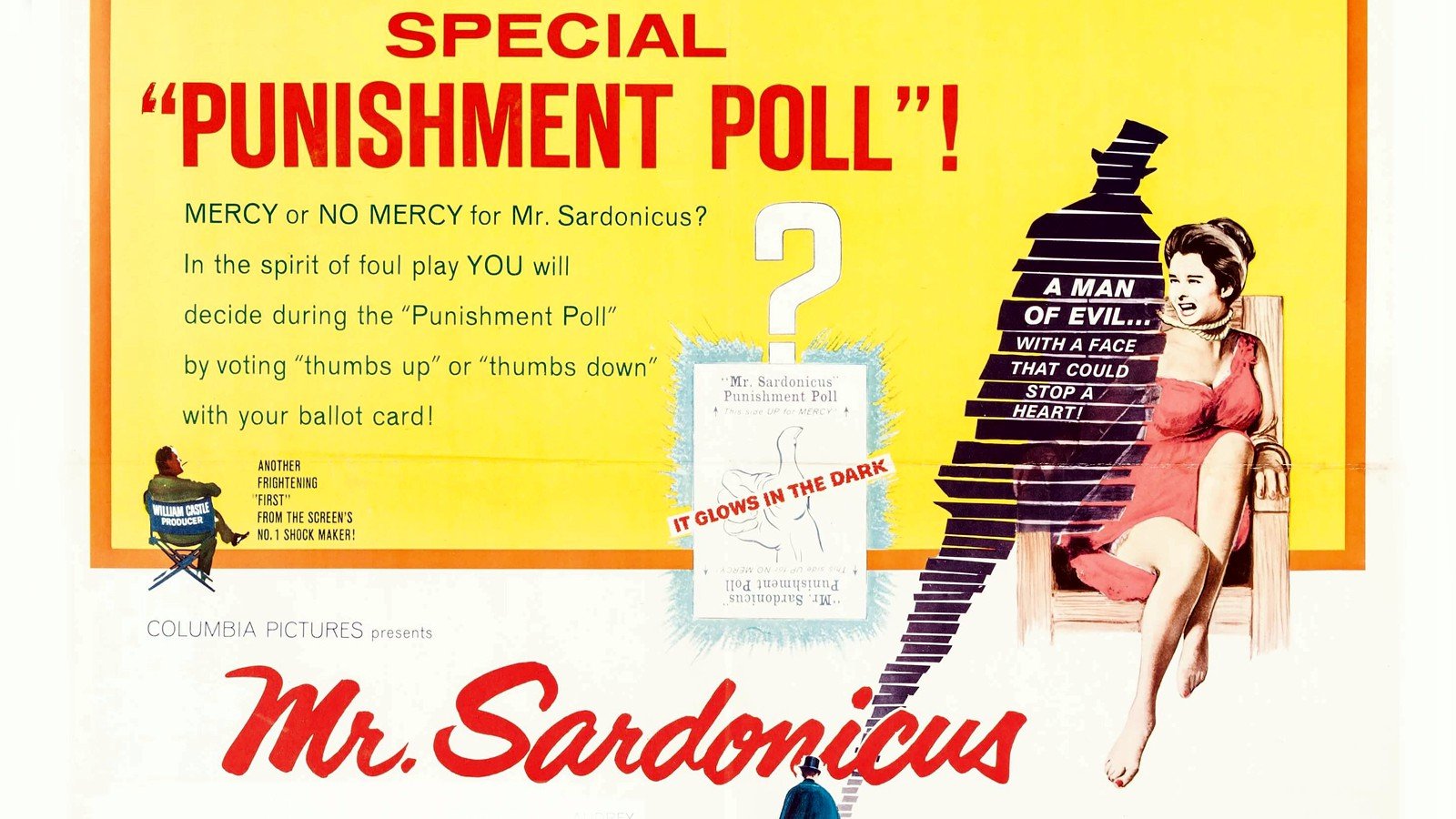
And naturally, Castle being Castle, the film also featured one of his trademark promotional gimmicks. Before the conclusion, the film actually pauses while Castle himself appears onscreen and asks the audience to vote — thumbs up or thumbs down — to determine the Baron’s fate.
Of course, the whole thing was complete nonsense, as Castle had only filmed one ending anyway, but that hardly matters. The gimmick itself was part of the fun.
And really, nobody sold horror movies with more cheerful shamelessness than William Castle.
For all his famously dubious credentials and carnival-barker instincts, Castle carved out a unique and hugely lovable place in horror history, delivering wonderfully cheesy and enormously entertaining gothic thrillers before eventually producing one of the greatest horror films ever made in Rosemary’s Baby.
There can be little doubt that William Castle fully deserves his place in horror cinema’s Hall of Fame.