
The Hot Spot Rating
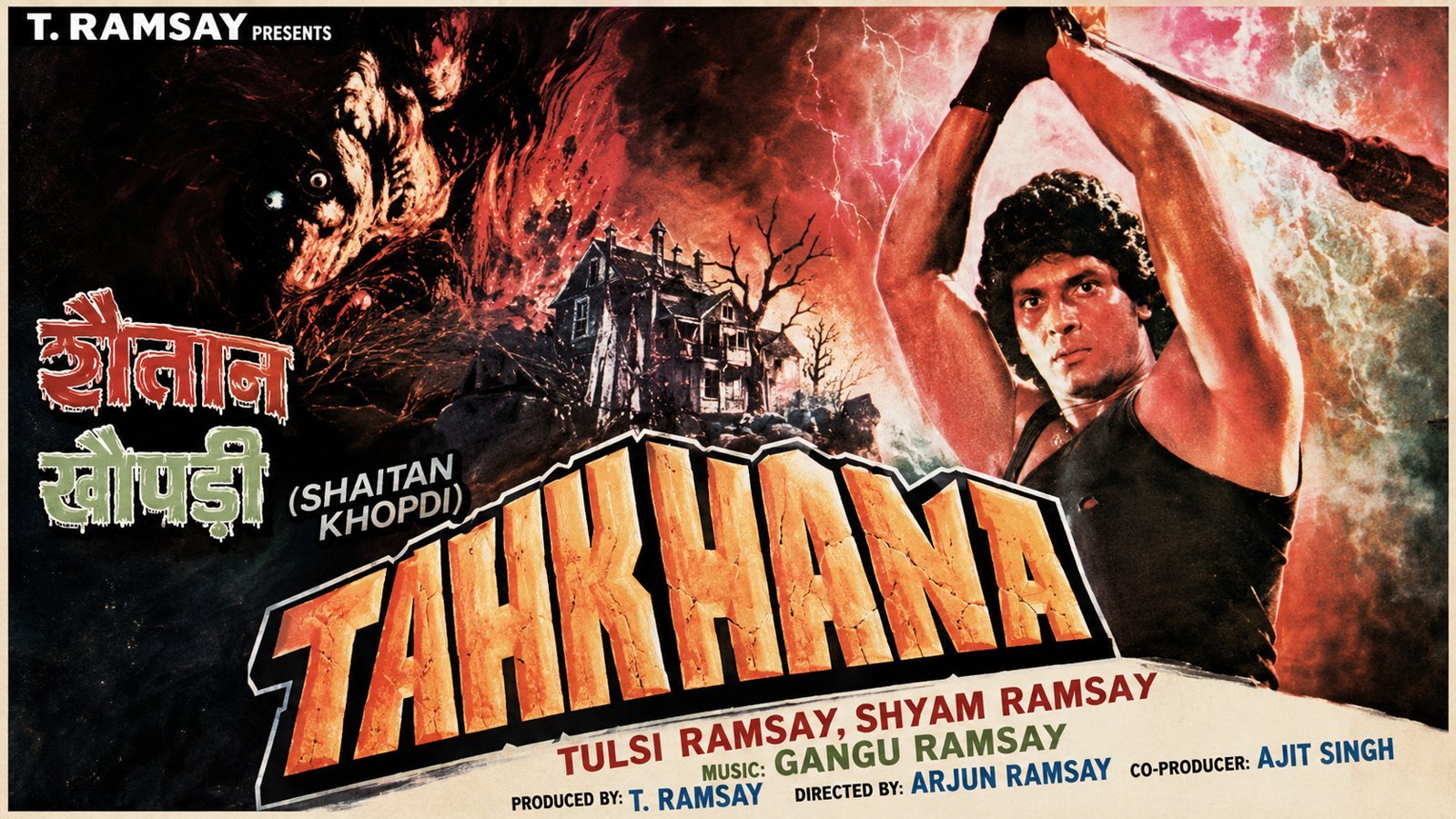
Tahkhana (1986)
Starring: Hemant Birje, Aarti Gupta, Kamran Rizvi, Imtiaz Khan, Puneet Issar
Director: Shyam Ramsay & Tulsi Ramsay
Synopsis: typical Ramsay effort with a hairy monster running amok in the Tahkahana
Produced during the height of the mid-1980s horror boom, Tahkhana was the Ramsays’ attempt to bottle lightning for a second time by recreating the formula that had proved so spectacularly successful in Purana Mandir. The cast is populated almost entirely by familiar Ramsay faces including Hemant Birje, Aarti Gupta, Puneet Issar and company, but the film’s most memorable appearance comes courtesy of one of Indian cinema’s great unsung treasures: the stunning Sheetal, a performer whose contribution to world culture has never been fully appreciated.
The story opens in the obligatory ancestral haveli where an ageing Thakur lies on his deathbed attempting to make his final wishes known. With what little strength remains, he informs his family that none of his fortune is ever to pass into the hands of his younger son Durjan, a thoroughly unpleasant fellow with a worrying interest in satanic rituals and an unfortunate habit of sacrificing children to dark powers.
Durjan responds to his father’s dying words with characteristic sensitivity by mocking him mercilessly until the old man finally expires.
Having secured the old man’s departure from the mortal world, Durjan turns his attention to resurrecting an ancient monster buried beneath the family estate. To achieve this he requires the blood sacrifice of his brother’s two young daughters. The girls manage to escape but become separated during the chaos. One grows up to become the lovely Aarti Gupta while the other eventually emerges as the equally lovely—and considerably more memorable—Sheetal.
Durjan, meanwhile, offers his own body as a vessel for the monster’s spirit in one of the film’s better sequences. Veins bulge, skin twitches and assorted blobs pulse alarmingly as the possession takes hold.
Elsewhere, Durjan’s more respectable brother suffers a convenient heart attack and summons his assembled nephews and nieces to reveal the family secret. Hidden somewhere beneath the dreaded Tahkhana lies the ancestral treasure, accessible only through a map divided into two halves. One half belongs to Aarti, while the other remains with her long-lost sister. The youngsters are made to swear a solemn oath to reunite the family and recover the fortune.
Unfortunately, among the chosen adventurers is the slimy Shahkal, played by Imtiaz Khan, a man whose hobbies appear to include treachery, greed and opportunistic sexual assault.
The missing sister, Sapna (Sheetal), arrives in town searching for employment and quickly falls prey to Shahkal’s schemes. Promised honest work, she instead finds herself working as a nightclub dancer. Shahkal soon decides that her beauty, intelligence and possession of the missing locket make her entirely too tempting to leave alone. Events end badly, and after a struggle Sapna dies, leaving Shahkal in possession of the genuine locket while everyone else receives a worthless fake.
As the heroes begin excavating random sections of the old haveli using inaccurate clues, they inadvertently awaken the monstrous force lurking beneath the estate. The creature, powered by Durjan’s vengeful spirit, is not pleased by the disturbance.
Fortunately the good guys acquire assistance in the form of local strongman Hemant Birje, who arrives armed with bulging biceps, limited dialogue and the unwavering confidence that only a Ramsay hero can possess.
What follows is a familiar mixture of monster attacks, secret passages, hidden treasure, dubious comedy courtesy of Rajendranath and a handful of songs inserted purely because this was still Bollywood and such things were apparently mandatory. Eventually matters culminate in the traditional showdown between good and evil, resulting in the monster being dispatched back to whatever subterranean realm it crawled out of.
Despite the obvious attempt to recreate the Purana Mandir formula, Tahkhana never quite captures the same magic. The haveli is suitably gloomy and filled with the trademark Ramsay fog machines, but lacks the atmosphere of their finest productions such as Veerana, Bandh Darwaza or Purana Mandir itself. The monster is serviceable but entirely generic—a standard issue Ramsay hairy beast with little personality of its own.
The performances are exactly what one expects from a Ramsay production: enthusiastic rather than polished. The background score is similarly familiar, sounding suspiciously like music recycled from half a dozen other Ramsay films.
Tahkhana is by no means a bad film. It moves along briskly enough, contains a few enjoyable moments and never becomes actively painful. Its main problem is that it feels assembled from ingredients that the Ramsays had already used more effectively elsewhere. The emphasis falls heavily upon Hemant Birje’s physique while the monster itself receives comparatively little attention, resulting in a film that entertains without ever becoming memorable.
Not a vintage Ramsay effort, but a reasonably enjoyable one nonetheless—and certainly worth watching for Sheetal alone.