
The Hot Spot Rating
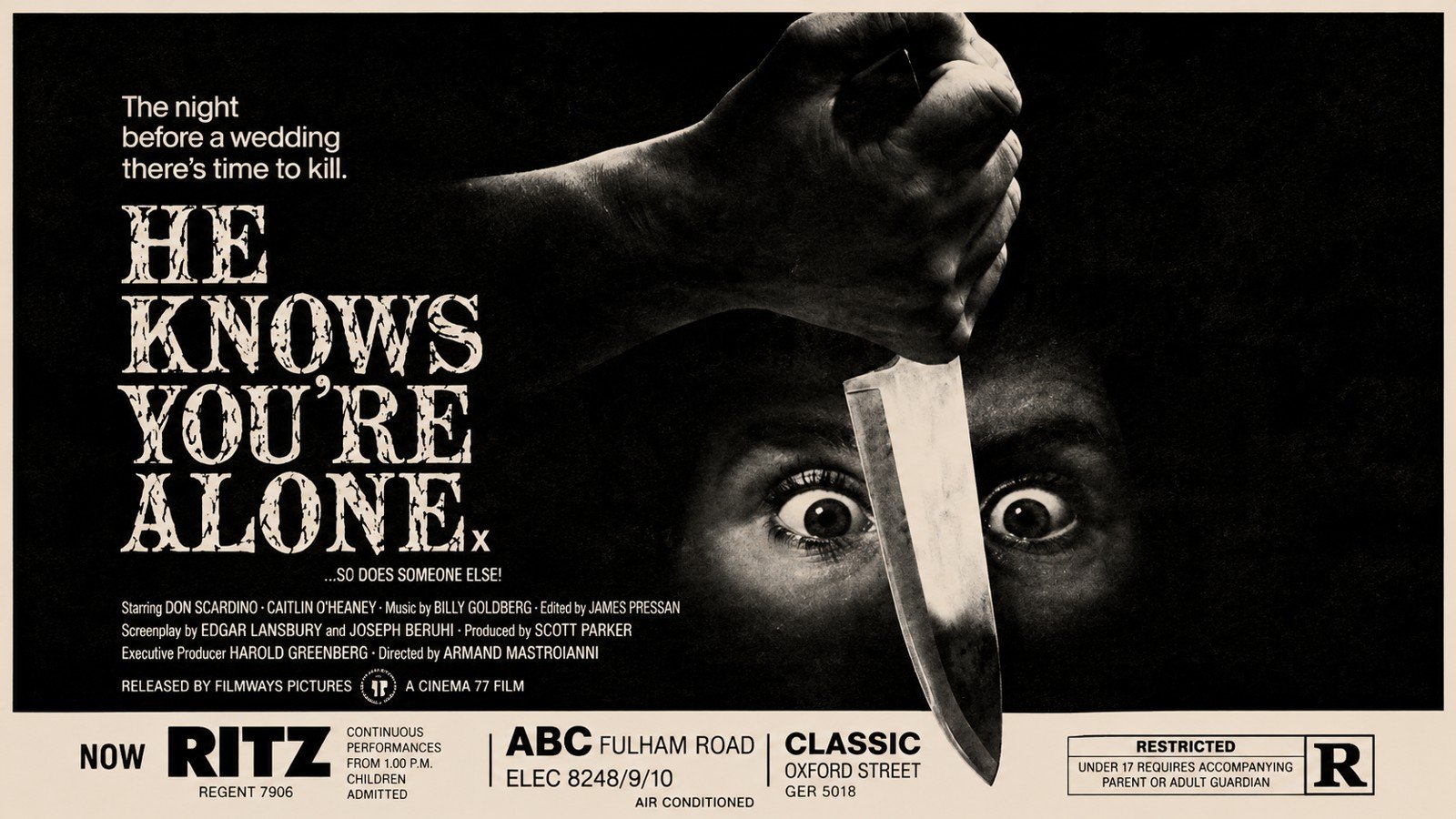
He Knows You’re Alone (1980)
Starring: Don Scardino, Caitlin O’Heaney, Elizabeth Kemp, Tom Hanks
Director: Armand Mastroianni
Synopsis: Effective and typical early 80’s slasher
“dumb and obvious” Time Out
“terrifying in an excruciating way” Creature Features
“better than many of the early 80’s splatter movies” Splatter Movies
“pedestrian chiller” Blockbuster Video
“slice and dice… business as usual” Maltin’s
“Standard grisly rampaging-killer fare… no more than just another by-the-numbers piece of sickening trash.”— Kevin Thomas, Los Angeles Times.
“Slow and strictly second rate… the production values are only slightly better than those in my uncle’s home movies.”— Michael Blowen, The Boston Globe.
“Uncertain pacing, halting performances and innumerable technical flaws.”— Tom Buckley, The New York Times.
“Rarely has a horror movie worked so hard for so little.”— Jack Mathews, Detroit Free Press.
“There are so many cinematic shock tactics employed… that you’re numb by the sixth killing.”— Jack Mathews, Detroit Free Press.
“Another one of those low-budget thrillers that should carry… ‘Based on characters and ideas developed by John Carpenter.'”— Jimmy Summers, Boxoffice magazine.
“Bloody, boring walk down the aisle.”— John Dodd, Edmonton Journal.
“Despite the incompetent script and some irregular pacing, He Knows You’re Alone does deliver a few surprises and some suspense.”— John Herzfeld, The Courier-Journal.
“Gruesome and despicable.”— Gene Siskel & Roger Ebert, Sneak Previews (1980), discussing the film alongside the wave of contemporary slasher movies.
altin’s
If ever there was a more shameless rip-off of Halloween, I’d certainly like to hear about it, because He Knows You’re Alone borrows from John Carpenter’s classic with astonishing audacity. It doesn’t merely imitate the look and feel of Halloween—it virtually steals Carpenter’s famous minimalist piano theme note for note.
The premise is simple enough. A deranged young man, driven over the edge after being abandoned at the altar, vents his bitterness by systematically murdering brides-to-be. Needless to say, rejection clearly didn’t agree with him.
The film constantly strives to recreate the style and atmosphere of Carpenter’s masterpiece but does so with all the subtlety of a sledgehammer. Where Halloween relied on elegant camerawork, patient suspense and an almost hypnotic sense of dread, this offers only mechanical imitation. Every scene feels familiar, every scare telegraphed well in advance, and every character seems to have wandered in from the Slasher Movie Stereotype Handbook.
The performances do little to help matters. The dialogue is flat, the acting uneven and the supposedly startling shocks are undermined by their complete predictability. Worse still, the incessantly derivative score announces every attempted scare long before it arrives, robbing the film of whatever tension it might otherwise have generated.
Yet, despite all its shortcomings—and despite being almost completely devoid of originality—the film somehow manages to remain reasonably watchable. It never quite descends into outright tedium, largely because it moves at a brisk enough pace and keeps the body count ticking over with reasonable efficiency. One almost has to admire the sheer nerve of the filmmakers, who seemingly challenged audiences to spot exactly how many elements they had borrowed from Carpenter’s playbook. Had lawyers rather than critics been the target audience, there might well have been trouble.
Today the film is remembered less for its pedestrian slasher mechanics than for marking the feature-film debut of Tom Hanks, who appears briefly before embarking on one of Hollywood’s most remarkable careers. His presence alone gives the film an added curiosity value.
As a horror film, He Knows You’re Alone contributes very little that hadn’t already been done far better elsewhere. As a historical footnote, however—and as a textbook example of the flood of Halloween-inspired slashers that emerged in the early 1980s—it remains essential viewing for students of the genre.
“