The Hot Spot Rating
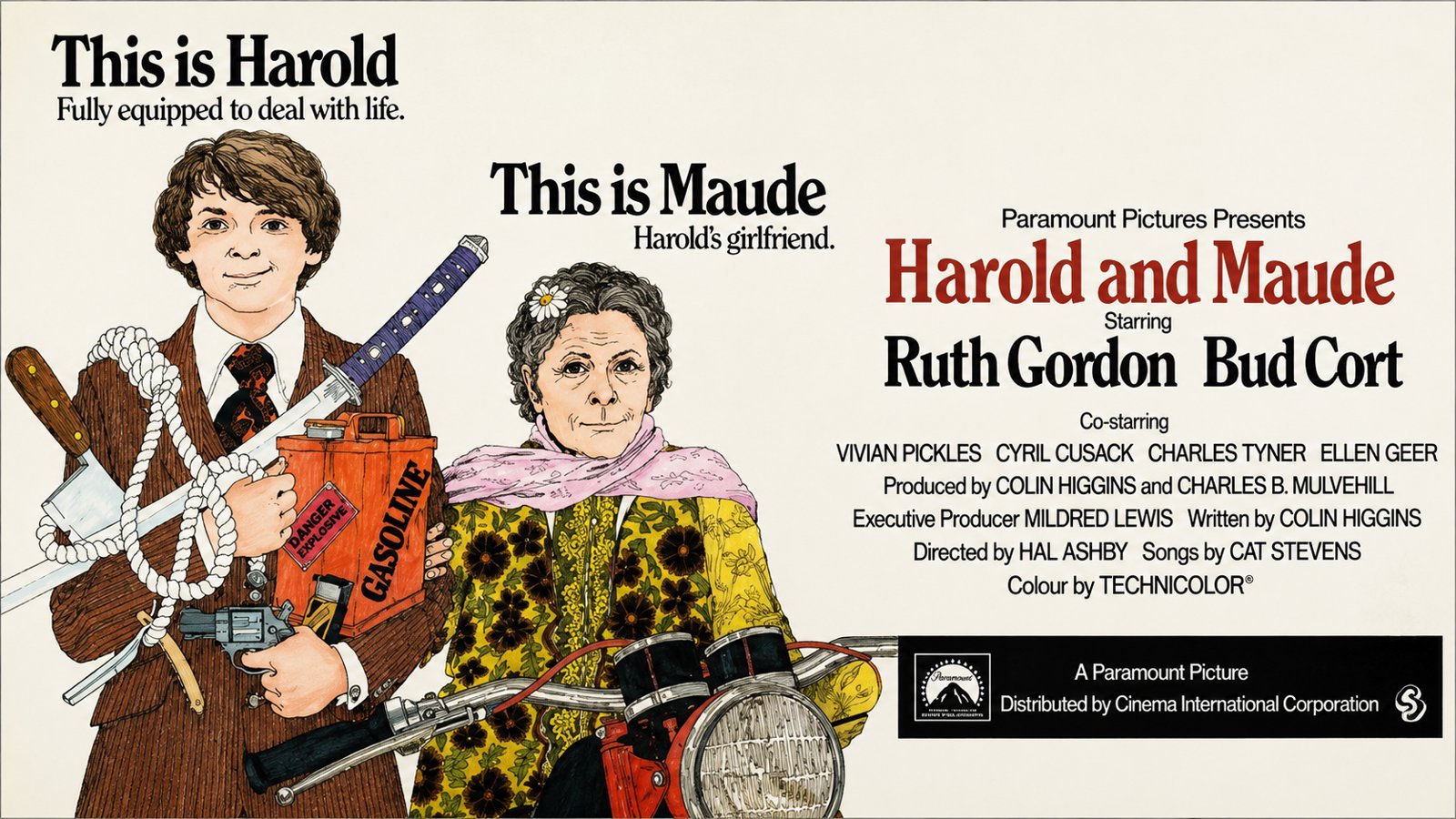
Harold and Maude (1971)
Starring: Ruth Gordon, Bud Cort, Vivian Pickles, Cyril Cusack
Director: Hal Ashby
Synopsis: Flower Power hangover for the 70’s has become an enduring cult classic
“treads the thin line between whimsy and absurdity” Time Out
“Huge Cult Favourite…Ruth Gordon is a sheer delight” Blockbuster Video
“has become a cult favourite…Corts phoney suicides are hilarious” Maltin
“Harold and Maude has all the fun and gaiety of a burning orphanage.”
— John Simon, New York magazine
“Harold is death, Maude life, and they manage to make the two seem so similar that life’s hardly worth the extra bother.”— Roger Ebert, Chicago Sun-Times
“The actors are so aggressive, so creepy and off-putting, that Harold and Maude are obviously made for each other.”— Vincent Canby, The New York Times
“Marred by a greater preponderance of sophomoric, overdone, and mocking humor.”— Variety
“A romance, a tragedy, a satire, a paean to eccentricity, a philosophical statement, and a ‘trip’ film.”— Matt Zoller Seitz, The Criterion Collection
“Hal Ashby’s comedy is too dark and twisted for some… but there’s no denying the film’s warm humor and big heart.”— Rotten Tomatoes Critics Consensus
“An encouragement to think beyond the obvious!”— Cyrus Frisch, Sight & Sound Greatest Films poll
“I’m sorry, Harold and Maude, for denying you for so long. You’re my favorite movie once again.”— Mark Caro, Chicago Tribune
When it was first released back in 1971, Harold and Maude was greeted with a distinctly lukewarm reception, dismissed by many critics as overly sentimental and little more than a lingering hippie hangover from the now fading 60’s. Yet, over time, it has steadily gathered a fiercely devoted following and deservedly emerged as one of American cinema’s great cult classics.
The film centres upon one of cinema’s oddest romantic pairings, which perhaps goes some way towards explaining why it proved so unpalatable to unsuspecting audiences upon its original release. Bud Cort stars as Harold, a young man obsessed with escaping a regimented world whose values he neither understands nor wishes to share. His chief pastime is devising increasingly elaborate methods of staging his own death, each more outrageous than the last. The person who eventually draws him away from his morbid fascination with death and back towards life is an elderly, eccentric woman who is herself knocking gently upon heaven’s door. Yet despite her advancing years, Maude possesses an irrepressible zest for life, boundless curiosity and a sheer joie de vivre that proves utterly infectious.
Ruth Gordon is simply magnificent as Maude, a whirlwind of optimism, mischief and free spirit. Through her wonderfully idiosyncratic, delightfully loopy outlook on life, Harold slowly begins to appreciate that there is another way to live. At last he discovers a purpose, a centre, a direction to what had previously been a soulless, money-filled existence.
The film is admittedly just a touch sentimental and undeniably bears the fingerprints of late-60’s idealism, yet its warmth, vitality and infectious charm more than compensate. It ambles along with an effortless quirkiness, buoyed by a wonderfully offbeat sense of humour. Moments of genuine pathos sit comfortably alongside some of the darkest and funniest comedy imaginable.
Harold’s numerous staged suicides remain consistently hilarious, particularly those involving his permanently bewildered mother, beautifully played by Vivian Pickles, whose increasingly resigned reactions become running jokes in themselves.
Director Hal Ashby would later cement his reputation with another marvellous social satire, Being There, confirming himself as one of American cinema’s true masters of gently subversive humour. Sorry to resort to such a dreadful cliché, but Harold and Maude really is one of those rare films capable of making you laugh one minute and quietly move you the next. Cat Stevens’ beautiful songs weave effortlessly through the picture, gently encouraging both Harold and the audience to embrace life with renewed enthusiasm.
It may be slightly mushy, perhaps a little wishy-washy in places, and very much a product of its era, but it possesses a warmth, humanity and unbridled joy that remain utterly irresistible. More than fifty years later, Harold and Maude still feels like cinematic tonic whenever life becomes just a little too grey.