
The Hot Spot Rating
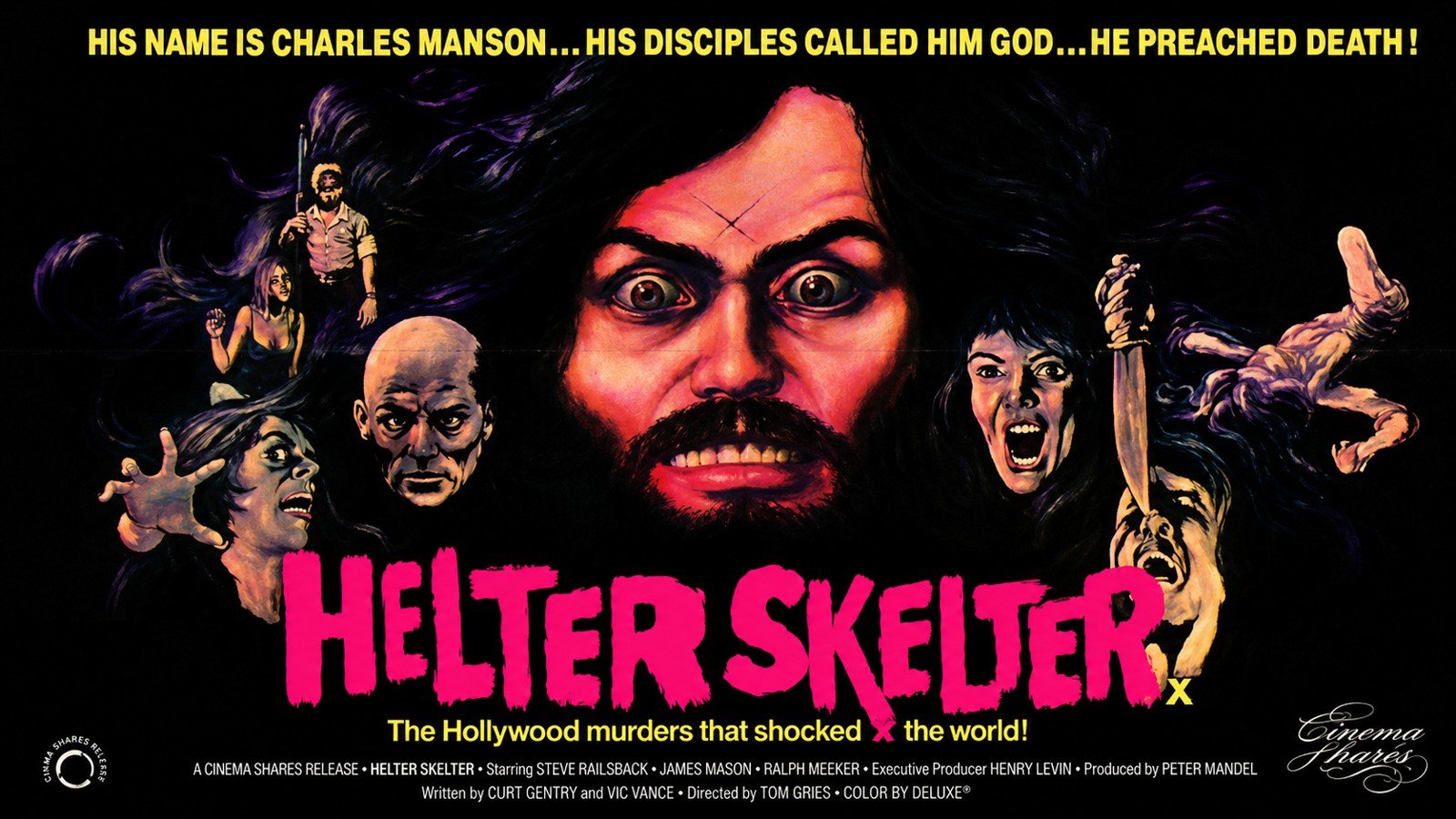
Helter Skelter (1976)
Cast: Steve Railsback, George DiCenzo, Marilyn Burns, Nancy Wolfe, Christina Hart
Director: Tom Gries
Synopsis: Solid docu style dramatization of the infamous Manson Murder trial
“A remarkably effective dramatization of one of the most notorious criminal cases in American history.” — Leonard Maltin, Leonard Maltin’s Movie Guide
“Steve Railsback’s performance as Charles Manson is frighteningly persuasive.”— TV Guide
“One of the best true-crime dramatizations ever produced for television.” VideoHound’s Golden Movie Retriever
“An engrossing, intelligent account of the Manson murders and the subsequent trial.”— Halliwell’s Film Guide
“Railsback dominates the film with an uncanny portrayal of Manson’s manic charisma.”— Radio Times
“The strength of the production lies in its painstaking reconstruction of the investigation and courtroom proceedings.”— AllMovie
“The telefilm remains one of the most compelling adaptations of a true-crime bestseller.” The Encyclopedia of Television Movies
“Unlike many true-crime films, it resists sensationalism and instead concentrates on the painstaking legal process.”— AllMovie
It had to happen sooner or later—a made-for-television dramatization of the ghastly crimes committed by the Manson Family. Yet while the majority of filmed “true crime” stories have tended to be sensationalist and opportunistic, this three-hour (two-part) production proves to be one of the glaring exceptions.
The 1976 television film is based upon Helter Skelter, the bestselling book by prosecuting attorney and true crime author Vincent Bugliosi, a work that brought a new level of credibility to the genre and richly deserved its enormous success. Rather than attempting to recreate every aspect of the Tate-LaBianca murders, the filmmakers wisely present the story as a courtroom-based docu-drama, concentrating primarily upon the investigation and the extraordinary trial that eventually placed Charles Manson and members of his “Family” behind bars.
Though the film inevitably bears the rather flat visual style associated with many television productions of the era, it has an enormous amount going for it. The screenplay remains meticulously faithful to Bugliosi’s exhaustive account and, to its credit, never sensationalises the events. Violence is kept largely off-screen, yet the film still manages to evoke genuine revulsion through the chillingly matter-of-fact recollections of those responsible for the murders.
The performances are uniformly excellent. Steve Railsback is outstanding as Charles Manson, capturing both the magnetic charisma and the simmering madness that enabled him to dominate his followers so completely. Marilyn Burns, still fresh from surviving The Texas Chain Saw Massacre, gives another impressive performance as Linda Kasabian, while Nancy Wolfe is exceptional as Susan Atkins, perfectly conveying the terrifying combination of fanaticism, emotional emptiness and blind devotion that made her so frightening.
Another of the film’s great strengths lies in the way it condenses an enormously long and complicated trial without sacrificing the legal complexities involved. The audience gains a genuine appreciation of the obstacles Bugliosi faced in securing convictions against people who, in many cases, had not physically committed the murders themselves.
If the film has one significant weakness, it is that it never quite captures the social climate that gave rise to Charles Manson and his followers. They did not emerge in a vacuum. Manson and the Family were, in many ways, a grotesque distortion of the counter-cultural upheavals of the late 1960’s, and a stronger sense of that turbulent backdrop would have added another important dimension. That is not to excuse their appalling crimes in any way, merely to understand more fully the world that produced them.
Railsback, who would later portray Ed Gein with similar conviction, is almost uncannily convincing as Manson. The understated direction serves the documentary style well, resisting the temptation to exploit the lurid aspects of the story. The occasional domestic interludes between Bugliosi and his wife are perhaps the weakest moments, though they provide a welcome respite from what might otherwise have become an unrelenting succession of courtroom scenes.
Being a born cynic, one cannot help wondering whether Mr Bugliosi ever realised that this extraordinary trial might also become the foundation for a highly successful book and television adaptation. Whatever the case, he proved himself not only a formidable prosecutor but also an astute author whose account remains the definitive work on the case.
Helter Skelter remains one of the finest true crime dramatizations ever produced. Had it devoted a little more time to the social and political climate that shaped the Manson phenomenon, it might well have been definitive. As it stands, it is an intelligent, restrained and thoroughly commendable piece of filmmaking—one of the very best films ever made about a real criminal case.
“An eerie neglected classic” Time Out
“deservedly developed a cult reputation” Maltin’s
“not for the squeamish” Video Movies Guide
“Made with care, authenticity and attention to detail.”— Variety (1969, pre-release review)
“Kastle’s film succeeds as a kind of chamber drama of desperate attraction and violent death.”— Roger Greenspun, The New York Times
“The photography has a harsh documentary or underground film quality that lends an air of authenticity.”— Stephen Allen, Courier-Post
“Excellent” performances, particularly those of Shirley Stoler and Tony Lo Bianco. Harvey Taylor, Detroit Free Press
“There’s a tawdry truth to the bizarre story of an unreal, grotesque love affair.”— Dayton Daily News
“Writer-director Kastle… is in perfect control of his material.”— Kenneth Turan, Los Angeles Times (1992 revival)
“Its nauseous mixture of laughs and shocks… makes The Honeymoon Killers such an enduring one-off.”— Keith Phipps, The A.V. Club
“A weirdly timeless love story with a body count.”— Gary Giddins, quoted in The A.V. Club review (Criterion DVD liner notes)