
The Hot Spot Rating
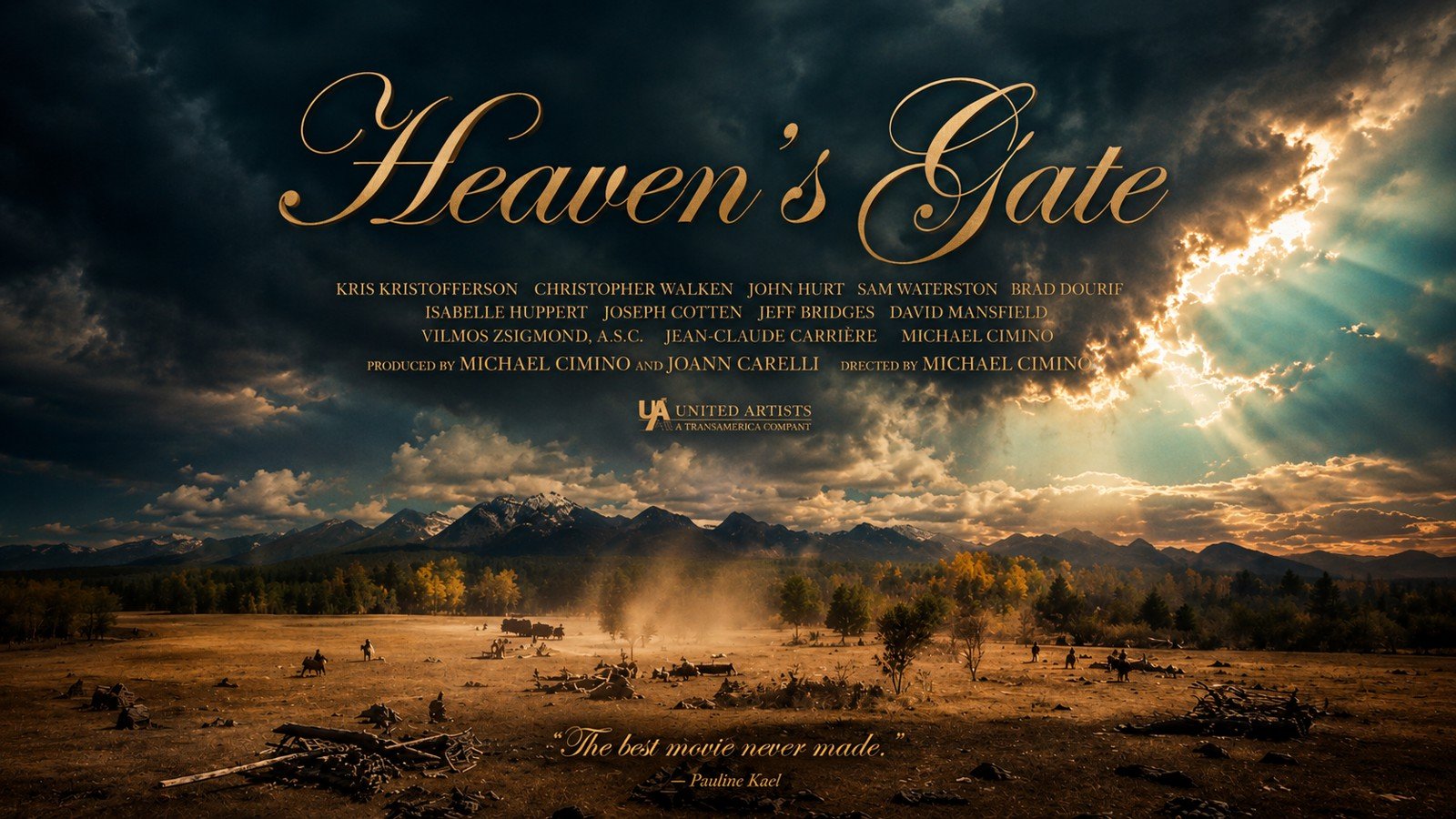
Heaven’s Gate (1981)
Starring: Kris Kristofferson, Christopher Walken, Isabelle Huppert, Brad Dourif, John Hurt
Director: Michael Cimino
Synopsis: Lavish recounting of the Harlan County Wars is one of historys biggest flops
“Michael Cimino’s Heaven’s Gate is one of the most beautiful films ever made.”— Robin Wood, Hollywood from Vietnam to Reagan
“A film of extraordinary ambition and haunting visual beauty.”— BBC Films
“A magnificent failure.”— David Thomson, The New Biographical Dictionary of Film
“The photography by Vilmos Zsigmond is breathtaking.”— Variety
“A work of overwhelming visual splendour.”— Empire
“One of the most misunderstood films of its era.”— Time Out Film Guide
“Perhaps the most unfairly maligned American epic of the 1980s.”— The Guardian
“An astonishing visual achievement.”— Chicago Reader
“One of the greatest westerns ever made.”— Danny Peary, Guide for the Film Fanatic
“One of the cinema’s most spectacular failures—and one of its most fascinating films.”— Leonard Maltin
“A forced, pretentious, overlong movie.” — Vincent Canby, The New York Times (1980)
“A disaster.”— Newsweek
“hopelessly muddled” Maltin
“unduly long, stunning to look at” Blockbuster Video
“awkward and overlong” Video Movie Guide
“majestic and stunningly detailed” Time Out
Heaven’s Gate will forever be remembered within the film industry, though sadly for almost all the wrong reasons. The project gathered momentum after director Michael Cimino suddenly became Hollywood’s hottest property following the enormous critical success of The Deer Hunter. Almost overnight, a director who had been “Michael who?” was transformed into the man with the Midas touch, seemingly incapable of putting a foot wrong. United Artists promptly handed him the green light, together with virtually unlimited creative freedom, to make whatever masterpiece he desired—and so he did.
Unfortunately, Cimino’s ego appeared to swell in proportion to his newfound status, as did his determination to create the definitive American epic. The already substantial budget spiralled ever upwards as the director’s demands became increasingly extravagant. Reports circulated that scenes were being filmed and re-filmed dozens of times before Cimino was remotely satisfied. One oft-quoted story suggested that some shots required as many as forty takes.
More than 150 carpenters were employed to construct the sprawling frontier sets. Actors endured intensive horse-riding lessons, dance rehearsals and bull-whip training. Isabelle Huppert was even reportedly encouraged to spend time living in a brothel to better understand her character. Thousands of extras, period costumes, elaborate make-up, immense outdoor locations and vast numbers of horses all contributed to production costs escalating beyond anyone’s expectations. Slowly but surely, United Artists began to realise that the future of the entire studio rested upon the success of a single film.
As stories of Cimino’s excesses leaked into the press, critics sharpened their knives. The same journalists who had showered The Deer Hunter with praise now seemed positively eager to witness the director’s downfall. Nothing delights the press quite so much as building somebody into a genius before gleefully dismantling them, and Cimino had become the perfect target.
When Heaven’s Gate finally premiered, many within the industry were holding their breath. Running an intimidating three hours and thirty-nine minutes, it was never going to be an easy commercial proposition. Cimino pointed to the success of The Deer Hunter as proof that audiences would willingly sit through lengthy epics, convinced that he could hold their attention for however long he chose. United Artists, however, had reached breaking point. If this film failed, so would they.
Fail it did. Critics descended upon it mercilessly, praising little beyond Vilmos Zsigmond‘s magnificent cinematography and the extraordinary production design. Cimino himself was subjected to a critical mauling rarely witnessed before or since. The film collapsed at the box office within days and soon acquired the humiliating reputation of being “the biggest flop of all time.” Others have undoubtedly surpassed it financially in the decades since, but once a film acquires such an infamous label, audiences tend to stay away in droves.
The consequences were immense. United Artists effectively ceased to exist as an independent major studio. Cimino was abruptly demoted from Hollywood’s directorial elite and never again enjoyed the creative freedom he once commanded. Kris Kristofferson‘s career scarcely benefited, while Isabelle Huppert’s hoped-for American breakthrough never materialised. Yet the greatest casualty of all was Cimino himself, whose extraordinary ambition—and extraordinary excesses—ultimately overwhelmed the project.
Set during the closing years of the nineteenth century, the film follows Kristofferson’s Harvard-educated marshal as he arrives in Wyoming to confront mounting tensions between wealthy cattle barons and newly arrived European immigrants. The opening hour unfolds almost languidly, beginning with Harvard’s lavish graduation celebrations before shifting to the stark, windswept landscapes of Wyoming, where impoverished immigrants—many of them Eastern European Jews fleeing persecution—discover that the promised American dream is rapidly becoming a nightmare. The powerful cattlemen, led by Sam Waterston, compile a list of more than one hundred supposed “anarchists and thieves” marked for extermination.
Against this backdrop enters Isabelle Huppert as the madam of the local brothel, herself caught in the sights of the cattlemen. She loves Kristofferson’s principled marshal, and Cimino slowly develops an understated love triangle before steering the story towards its inevitable bloody confrontation.
The film is clearly a labour of obsessive love, but that obsession is also its greatest weakness. Cimino simply cannot bring himself to cut away from scenes that exist largely to admire their own beauty. The Harvard graduation sequence is visually breathtaking, with couples gliding endlessly around the dance floor while the camera pirouettes among them. It is dazzling to behold—but it goes on forever. Time and again Cimino mistakes duration for profundity, allowing scenes to linger well beyond the point where they have served their dramatic purpose.
Vilmos Zsigmond’s photography is, as expected, magnificent, although it never quite achieves the poetic transcendence of Days of Heaven. Likewise, the climactic battle is undeniably spectacular but eventually becomes exhausting through sheer length. Yet despite these considerable flaws, the film scarcely deserved the ridicule heaped upon it in 1980. Strip away some of the self-indulgence and there may well be a flawed masterpiece lurking beneath the excess. European critics certainly proved far more receptive, with several boldly proclaiming it a misunderstood classic.
Ironically, the film’s greatest legacy lies not on the screen but behind it. Heaven’s Gate fundamentally altered the relationship between filmmakers and the studios. Its catastrophic failure effectively ended the era of the all-powerful auteur entrusted with unlimited creative freedom. Studio executives tightened their grip, test screenings became increasingly influential, and risk-taking gradually gave way to the perceived safety of sequels, remakes and established franchises. Ever since Heaven’s Gate, Hollywood has become markedly more reluctant to gamble on ambitious, unconventional visions. The lesson the studios believed they had learned was brutally simple: never again would they entrust the fate of an entire company to one brilliant, uncompromising young director convinced he was God’s gift to cinema.
“