
The Hot Spot Rating
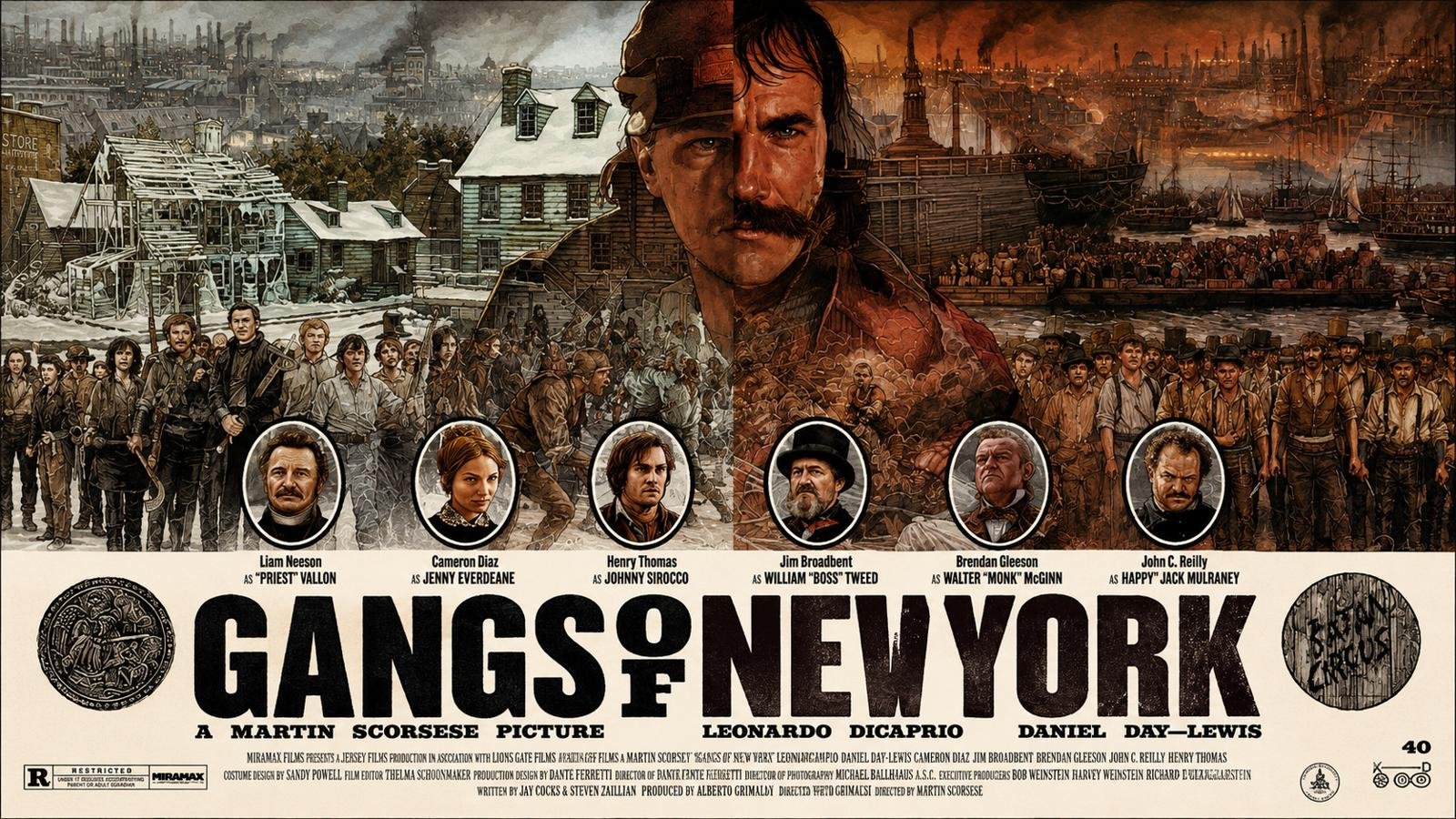
Gangs of New York (2002)
Cast: Daniel Day-Lewis, Leonardo Di Caprio, Cameron Diaz
Director: Martin Scorsese
Synopsis: New York’s meanest streets yet. Scorcese’s epic is good but not great.
Reviewed by: Ali Khan
“An astounding achievement.” — Roger Ebert, Chicago Sun-Times
“A sprawling, spectacular epic.” — Peter Travers, Rolling Stone
“Martin Scorsese’s most ambitious film.” — Variety
“An extraordinary achievement in production design and historical atmosphere.” — Kenneth Turan, Los Angeles Times
“Daniel Day-Lewis gives one of the great performances in modern movies.” — Roger Ebert, Chicago Sun-Times
“Day-Lewis dominates the film with a magnificently ferocious performance.” — Empire
“A violent, visually dazzling historical pageant.” — The New York Times
“Scorsese creates a vivid, almost operatic vision of old New York.” — The Guardian
“The performances, particularly Daniel Day-Lewis’s, are electrifying.” — BBC
“Daniel Day-Lewis’s Bill the Butcher is one of the year’s towering screen performances.” — Time
“A richly textured historical epic that occasionally loses itself in its own ambitions.” — Sight & Sound
“Scorsese’s vision is magnificent, even when the narrative threatens to overwhelm itself.” — The Daily Telegraph
Nineteenth-century New York is raw, primordial and brutally violent. Rival gangs of so-called “natives” battle newly arrived immigrants for supremacy in the lawless streets of the Five Points. During one such bloody confrontation, Irish gang leader “Priest” Vallon (Liam Neeson) is slain by his formidable rival, the nativist leader William “Bill the Butcher” Cutting (Daniel Day-Lewis). Vallon’s young son, Amsterdam (Leonardo DiCaprio), witnesses his father’s murder before narrowly escaping.
Sixteen years later, Amsterdam returns to Five Points bent on revenge. Concealing his true identity, he infiltrates Bill’s inner circle, only to discover that the man who killed his father has become far more than a gang leader. Bill now rules the neighbourhood as its undisputed strongman, thriving through graft, extortion, intimidation and political corruption. Against the backdrop of machine politics, racial tension, unchecked criminality and the looming Civil War, Amsterdam patiently waits for his opportunity to strike.
Gangs of New York opens magnificently. The opening battle, staged to Peter Gabriel’s haunting Signal to Noise, is one of Martin Scorsese’s finest set pieces, ending in Priest Vallon’s death and Bill’s bloody ascension. The film rarely looks less than spectacular thereafter. Dante Ferretti’s extraordinary production design, Sandy Powell’s magnificent costumes and Michael Ballhaus’s sumptuous cinematography combine to recreate nineteenth-century New York with astonishing richness and texture.
It is therefore all the more surprising that, for all its painstaking visual authenticity, the film proves considerably less convincing as history. Scorsese compresses, rearranges and occasionally ignores major historical realities, most notably the enormous influence of New York’s Italian immigrants and the city’s Black community. While dramatic licence is inevitable, the historical simplifications sometimes sit uneasily beside the otherwise obsessive attention to period detail. Scorsese might arguably have produced an even stronger film had he concentrated more narrowly on the extraordinary psychological relationship between Bill and Amsterdam rather than attempting to encompass such a vast sweep of New York’s turbulent history. By the final act the narrative becomes increasingly cluttered and the conclusion, despite its visual grandeur, never quite delivers the emotional impact it promises.
Even so, Gangs of New York remains a powerful and immensely watchable drama. At almost two hours and forty-five minutes it occasionally threatens to overstay its welcome, yet Scorsese’s command of large-scale spectacle and intimate character drama ensures that the film rarely loses momentum. Few directors possess his gift for recreating the chaotic energy of the streets, and he captures the violence, lawlessness and social upheaval of early New York with enormous conviction. The brutality is frequent and often savage, although much of it is suggested rather than graphically depicted. Scorsese makes it abundantly clear that the city was forged not through romantic idealism but through bloodshed, corruption and conflict.
The film is elevated still further by its two principal performances. Leonardo DiCaprio continues the remarkable maturation that had already seen him emerge from teenage heart-throb to genuinely accomplished actor. He gives a strong, committed performance as Amsterdam Vallon, but ultimately finds himself overshadowed by Daniel Day-Lewis in one of the finest performances of his career. Bill the Butcher is terrifying, charismatic, strangely honourable and endlessly fascinating. Day-Lewis invests him with such ferocious intensity that every scene crackles with menace, yet beneath the brutality lies a curious sense of dignity and an unwavering personal code. It is an extraordinary performance and one entirely deserving of its legendary reputation. Those familiar with his restrained work in Scorsese’s The Age of Innocence will marvel once again at the astonishing range of the actor. Cameron Diaz, meanwhile, is agreeable enough but never entirely convincing and remains the weakest element of the principal cast.
Scorsese spent almost a decade bringing Gangs of New York to the screen, enduring delays, escalating budgets and repeated postponements before finally unveiling his long-cherished project. The finished film falls short of masterpiece status and is not quite worthy of its director’s very greatest work. Yet expectations for Martin Scorsese have always been impossibly high. Directed by almost anyone else, Gangs of New York would have been hailed as an unquestioned triumph. By Scorsese’s own extraordinary standards, it remains simply very good rather than truly great—and that is praise enough.