
The Hot Spot Rating
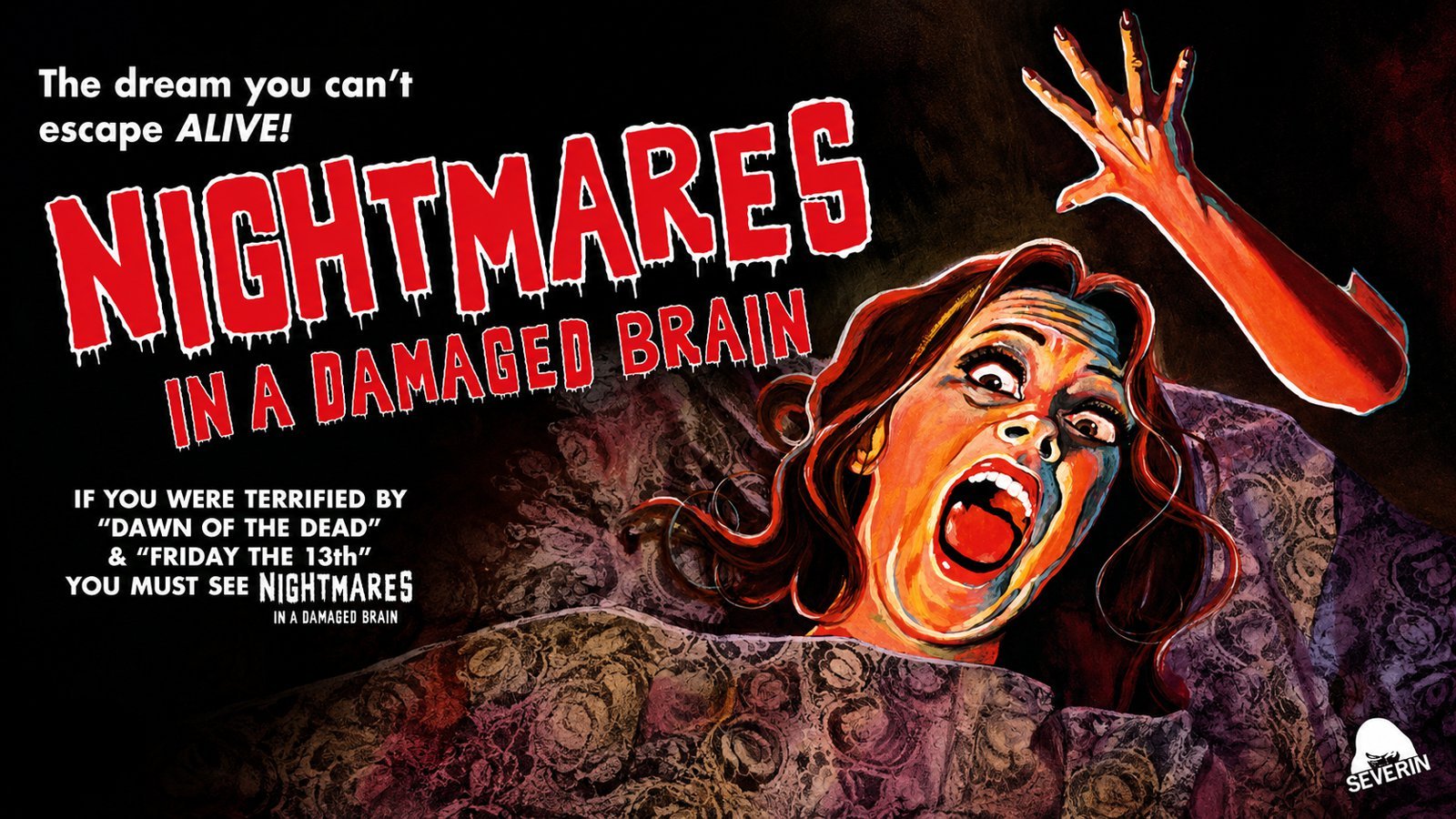
Nightmares in a Damaged Brain (1981)
Cast: Sharon Smith, Baird Stafford, C.J. Cooke, Mik Cribben
Director: Romano Scavolini
Synopsis: infamous, grim and gory shocker was prosecuted as “obscene” in the UK
Reviewed by: Omar Khan
“One of the most notorious of the ‘video nasties’.” — Time Out Film Guide
“A sleazy but undeniably effective shocker.” — AllMovie (Fred Beldin)
“The gore effects are astonishingly graphic for their time.” — The Encyclopedia of Horror Movies (Tom Milne)
“A grim, nasty little slasher with an unpleasant intensity.” — Alan Jones, Radio Times
“Its reputation rests almost entirely on its extreme violence.” — The Slasher Movie Book – J.A. Kerswell
“An exceptionally brutal entry in the early-1980s slasher cycle.” — John Kenneth Muir, Horror Films of the 1980s
“The film’s violence remains genuinely shocking.” — DVD Talk
“A relentless exercise in sadism that became infamous during the Video Nasties panic.” — The Spinning Image
“The controversy surrounding the film often overshadows its actual merits.” — The Digital Fix
“Remembered less as a great horror film than as one of the defining titles of the Video Nasties era.” — The Bloody Pit of Horror
“sleaze and scuzz….has a fascination that holds and repels you” Creature Features
“Humourless and dreadfully generic” Cult Flicks & Trash Pics
“Lurid and gross” Splatter Movies Guide
“gory, derivative and thoroughly dreary” Slasher Movies (Pocket Essentials)
“Lurid, extremely violent exploitation movie” Video Nasties
“Misogynist crap” Psychos! Sickos! Sequels!
This early-’80s psycho-slasher ranks alongside I Spit on Your Grave and The Last House on the Left as one of the most notorious and reviled titles of the infamous “Video Nasties” era—a reputation it has earned, though perhaps not for entirely the right reasons.
The film opens with a striking nightmare sequence. A man awakens to discover a pool of blood beside him and a severed head lying on the bed. Moments later the head opens its eyes. Just then our unfortunate dreamer, Tatum, jolts awake in the psychiatric hospital where he has been confined ever since a traumatic childhood incident. Through an unpleasant flashback we witness the event that scarred him for life: as a child he spies on a couple engaged in particularly sordid sexual activity, an experience that leaves deep psychological wounds. His doctors, however, believe he has recovered sufficiently to be granted parole.
Naturally, they couldn’t be more wrong.
The moment an opportunity presents itself, Tatum disappears, leaving his psychiatrists frantically telephoning the authorities as they realise they have unleashed a homicidal maniac upon the unsuspecting population. Tatum heads back to Florida, where his former wife and children now live, leaving a steadily mounting trail of mutilated corpses in his wake. The inevitable question becomes not why he kills, but who, if anyone, will be able to stop him.
The film itself is a fairly dreary affair, remembered today less for its cinematic qualities than for the extraordinary controversies that surrounded it.
The first erupted in America, where the distributors attempted to market the picture on the reputation of special-effects wizard Tom Savini, then riding high after Friday the 13th and The Prowler. Savini publicly denied having worked on the film, demanded that his name be removed from all promotional material and vigorously distanced himself from the production. Although photographs later surfaced showing him visiting the set, he maintained that he had made no meaningful contribution and wanted absolutely no association with the finished film.
Britain produced an even greater storm. The distributors embarked upon a series of publicity stunts so tasteless that police became involved. One promotion invited members of the public to guess the weight of a brain floating in a jar, the closest estimate winning a cash prize. More significantly, the film became the first successful prosecution under Britain’s Obscene Publications Act, with its distributor actually serving a prison sentence for releasing a version that ignored the censor’s demanded cuts. Overnight, the film achieved a notoriety vastly disproportionate to its actual merits.
Ironically, the notoriety is largely what has kept the film alive. In truth it is a sluggish, amateurishly acted and indifferently directed slasher that survives almost entirely on the strength—or perhaps weakness—of its gore.
There are certainly moments that linger in the memory. A throat-slashing sequence is filmed with almost pornographic fascination as the camera lovingly observes blood pouring from the wound. Elsewhere, a woman is repeatedly hacked with a pickaxe while the audience is treated to lingering close-ups of every impact. The violence is deliberately prolonged and uncomfortably voyeuristic, more interested in lingering over mutilation than generating suspense.
Everything surrounding these isolated gore scenes, however, is depressingly routine. Characterisation is virtually non-existent, the performances range from merely weak to painfully amateurish, and the child actor at the centre of proceedings is less sympathetic than deeply irritating. The shabby production values and generally sleazy atmosphere have often prompted rumours that the director had previously worked in pornography—whether true or not, the film certainly possesses the same cheap, grubby aesthetic.
The closest comparison is probably Uli Lommel’s The Boogey Man, another late-’70s slasher that somehow acquired an enthusiastic cult following despite its obvious shortcomings. Both films share a similarly threadbare narrative, psychological pretensions and generally tacky execution. Yet Nightmares in a Damaged Brain lacks even Lommel’s occasional flashes of style or atmosphere.
Ultimately, this is a film whose reputation rests almost entirely upon controversy rather than quality. It was designed to shock, and in its more graphic moments it undoubtedly succeeds. As cinema, however, it remains a tedious, badly acted, clumsily directed slice of exploitation whose gallons of blood are nowhere near enough to compensate for its glaring deficiencies. A thoroughly unpleasant experience—and one that will probably continue to occupy a small but permanent footnote in horror history, thanks more to courtroom battles than cinematic achievement.
“