

The Hot Spot Rating
Title: The Beast Within
Cast: Ronny Cox, Bibi Besch, Paul Clemens, Don Gordon, R.G. Armstrong
Director: Philippe Mora
Nutshell: A twisted metaphor on the nightmare of rape? Maybe not, but a fun twist on the usual werewolf routine with a showstopping transformation scene. Whacky and uneven but compelling.
Reviewed by: Omar Khan
“Silly shocker” – Blockbuster Video
“Dark, Moody atmosphere” – Creature Featurs
“One of the more bizarre horror films of the early 1980s.”— retrospective cult-horror assessment
“A deeply unpleasant but undeniably memorable monster movie.”— horror review commentary
“The film’s final transformation sequence is astonishingly grotesque.”— Fangoria-era retrospective
“A southern-fried nightmare drenched in sweat, religion and mutation.”— cult cinema review
“Equal parts body horror, rural gothic and fever dream.”— modern reassessment
“The Beast Within succeeds through sheer atmosphere and weirdness.”— horror retrospective commentary
“The cicada-inspired monster effects are both ridiculous and disturbing.”— creature-feature review
“An outrageously strange blend of puberty horror and backwoods grotesquerie.”— exploitation-film appraisal
“A horror movie so preposterous that it occasionally becomes entertaining.” – Vincent Canby, New York Times
“Sickening.” – Leonard Maltin
On a dark, stormy Mississippi night in 1964, a pair of newlyweds are struggling to reach their honeymoon destination but making very little progress. Their battered old car has clearly seen better days and is now barely coping with the relentless rain and violent winds. Before long, disaster strikes when the vehicle veers off the road and sinks deep into thick, sticky mud in the middle of nowhere.
Meanwhile, the audience is introduced to a shackled, hairy beast that suddenly breaks free from its restraints and lumbers ominously into the surrounding forest.
Ronny Cox, playing husband Eli McCreary, trudges off into the storm to seek help, leaving his wife — played by Bibi Besch — alone in the stranded car. Their dog suddenly bolts from the vehicle, and when she follows after it, she is horrified to witness the animal mangled and tossed aside like rubbish before her eyes.
The Beast is about to descend upon her, but she manages to flee briefly before colliding with a branch and losing consciousness. What follows is an extremely unpleasant assault sequence in which the creature rapes her while she lies helpless. Eli returns moments too late, finding his wife barely alive, though still with enough presence of mind to get her urgent medical attention in time to save her.
Seventeen years later, the same couple are still together and once again find themselves at a hospital — this time because their son Michael’s health has deteriorated so severely that he is barely being kept alive through artificial intervention.
Michael drifts in and out of consciousness, repeatedly dreaming of the same decaying house with its mysterious basement, as though some dark force is summoning him back there.
The parents return to Mississippi hoping to discover what is afflicting their son, fully aware that he was conceived during the horrifying attack seventeen years earlier. They suspect some inherited illness or congenital disorder linked to Michael’s unknown biological father.
However, their arrival is met with hostility. The sheriff and various members of the local community are clearly uncomfortable with the McCrearys asking questions and reopening old wounds. The townsfolk are harbouring dark secrets surrounding the rape, the aftermath, and exactly what became of the creature responsible. The whole affair is steeped in murky, sordid business that resurfaces with the family’s return to the otherwise sleepy town of Noia, Mississippi.
As events unfold, Michael grows increasingly sick while his dreams become ever more vivid and disturbing. At the same time, he develops an uncontrollable bloodlust that must somehow be satisfied.
One by one, various members of the thoroughly unpleasant local community begin turning up at the morgue in increasingly gruesome condition — disembowelled, mutilated, and with their throats savagely torn open. After each killing, Michael temporarily regains strength and appears healthier, until the murderous urge returns once again.
Eventually comes the moment of truth, when Michael desperately tries to resist his urge to kill his girlfriend. The instinct, however, proves overwhelming.
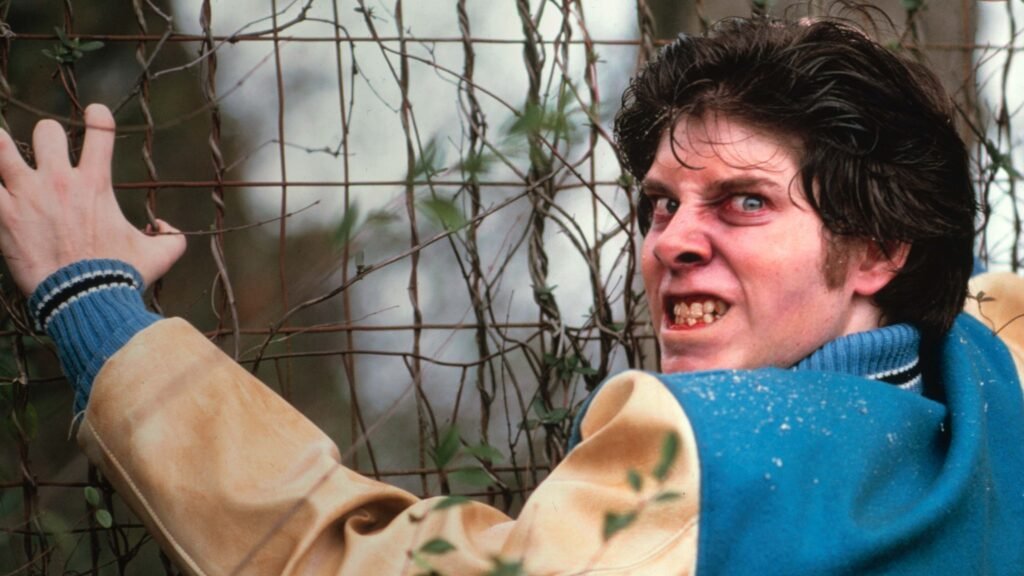
Finally, strapped to a hospital bed like Regan in The Exorcist, Michael undergoes the film’s infamous transformation sequence as his face grotesquely balloons and mutates into something resembling a bizarre cross between Donald Trump, Kim Jong Il, and a severe case of the mumps.
It is the film’s grand showstopper climax and, for its time, represented one of the earlier attempts at depicting physical transformation through prosthetics and make-up effects rather than traditional stop-motion animation.
The Beast Within arrived during a period when horror make-up effects had suddenly become the genre’s great obsession, particularly elaborate “transformation” scenes achieved through prosthetics and practical effects. The Howling had stunned audiences with its groundbreaking werewolf transformation and raised the bar enormously. An American Werewolf in London followed shortly afterwards and, with its far larger budget and the genius of Rick Baker, pushed things even further.
In both films, the transformation scenes were the main attraction — the trump card audiences were waiting for.
The Beast Within, therefore, had serious competition to contend with. While its effects are admittedly rough-and-ready compared with those classics, they are so gloriously over-the-top that they still manage to hold their own through sheer outrageousness. If that were not enough, the film also throws in a spectacular decapitation sequence for good measure.
By 1982, horror cinema was deep into its boom period. The genre, fuelled largely by the success of Halloween and Friday the 13th, was becoming increasingly oversaturated and desperately short of fresh ideas. As Hollywood struggled to invent new plots, the special-effects teams increasingly became the true stars of the show, often providing the only memorable aspects of otherwise formulaic productions.
It really was not until A Nightmare on Elm Street arrived that horror audiences finally had something genuinely fresh and exciting to rally around again.
The Beast Within was initially marketed almost as a werewolf film, heavily emphasising the full moon and man-to-monster transformation angle. In reality, however, it is not a werewolf movie at all. Written by Tom Holland — who certainly possesses strong horror credentials — the film ultimately emerges as a fairly satisfying and gruesome horror romp, though one hampered by a meandering middle section that frequently drifts into tedious territory.
Still, the outrageous climax almost redeems everything through sheer lunatic excess alone.
The film may not rank among the true classics of its era, but it deserves credit for at least attempting something different from the endless conveyor belt of slasher movies dominating cinemas in 1982. Replacing the werewolf with a monstrous cicada-inspired creature was certainly an unusual choice.
The first thirty minutes are atmospheric, well-constructed, and genuinely intriguing. The middle section, however, alternates between strong moments and stretches of rather dreary padding before the film finally redeems itself with its wildly insane climax.
Not a great film, perhaps, nor an especially frightening one, but certainly an interesting early entry in the “transformation horror” cycle — and at the very least a welcome change from the increasingly stale slasher formula that was exhausting itself by the early 1980s.