
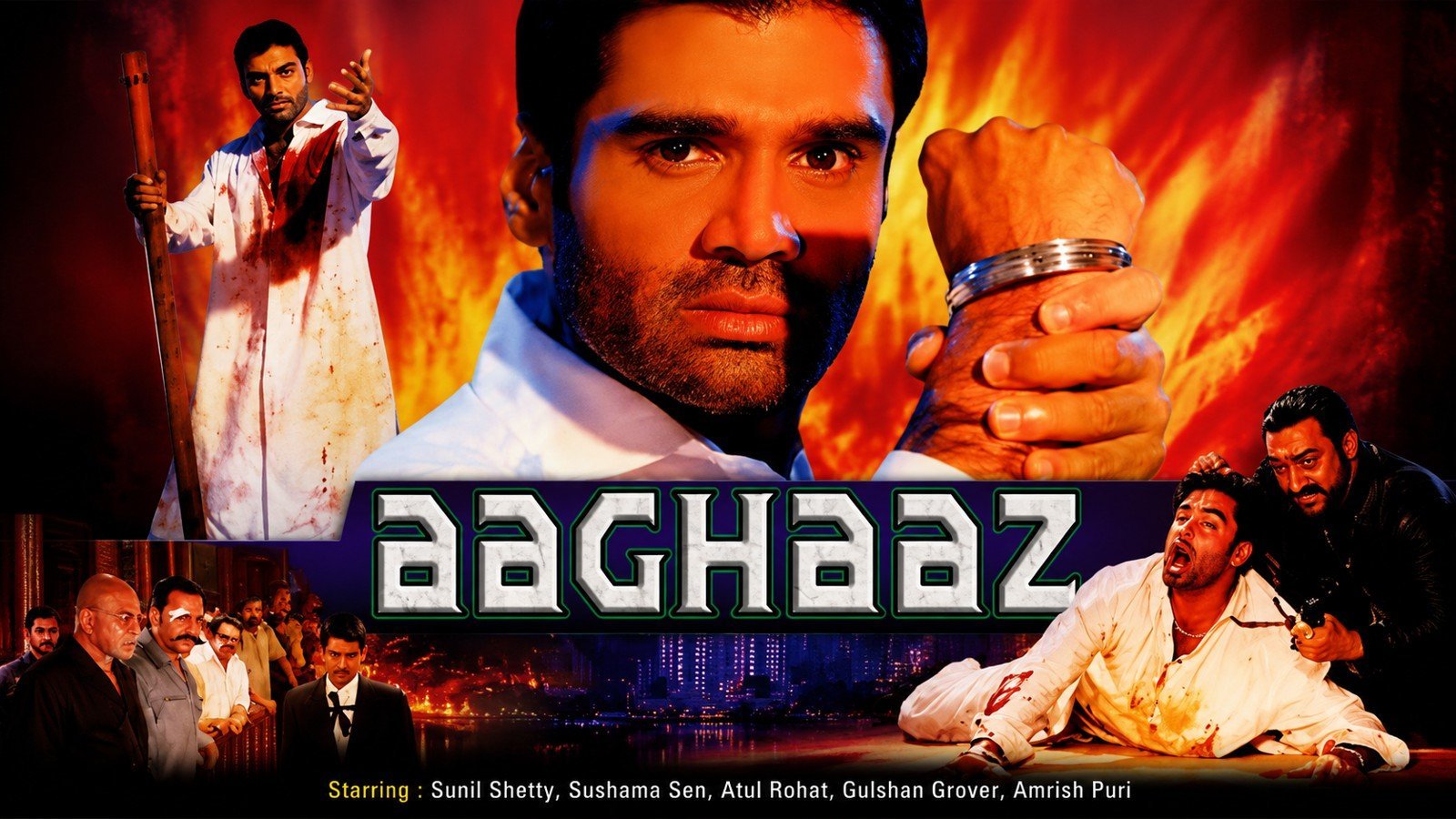
Aaghaaz (2000)
Cast: Sunil Shetty, Sushmita Sen, Namrata Shirodkar
Director: Yogesh Ishwar
Music Director: Anu Malik
Synopsis: Dreadful, supposedly hard-hitting social commentary.....depressingly awful
Reviewed by: Faiz Khan
Aaghaaz marked the directorial debut of Yogesh Ishwar. Judging by the results, one could be forgiven for assuming it might also have been intended as his farewell.
This is an overlong, painfully predictable and relentlessly tedious piece of commercial cinema that offers remarkably little reward for the considerable amount of time it demands from its audience.
The storyline is depressingly familiar. My immediate point of comparison was Ghulam, another film built around a young man confronting local gangsters. Comparing the two, however, is rather like comparing Hemlata with Lata Mangeshkar.
The film opens with Govind (Sunil Shetty) and his sister arriving in Mumbai to begin a new life. It isn't long before Govind finds himself standing up to the neighbourhood goonda, who is attempting to molest a young woman. Publicly humiliated, the thug and his equally unpleasant elder brother swear revenge. Their chosen method is to kidnap Govind's sister, luring him into a confrontation that inevitably ends with both villains receiving the sort of spectacular thrashing that only Hindi cinema can provide.
Naturally, they vow vengeance.
Meanwhile, one heroine (Namrata Shirodkar) spends much of her screen time dancing through exotic foreign locations while nursing an unrequited affection for Govind. Unfortunately, our hero's heart belongs elsewhere. A conveniently placed song sequence reveals that he is still hopelessly devoted to Sudha (Sushmita Sen), suggesting that perhaps the screenplay still has one or two surprises in store.
Sadly, it doesn't.
Instead, we are treated to an extended flashback explaining Govind's tragic romantic history. Sudha leaves to become a police officer while Govind, through a series of melodramatic misunderstandings, finds himself married to Suman Ranganathan—a woman whose unforgivable crime is that she became pregnant before marriage.
Her brother (Sharad Kapoor), convinced that Govind is responsible for bringing disgrace upon the family, subjects him to constant hostility. When he eventually discovers that another man fathered the unborn child, his response is not directed towards the guilty party but towards his own sister. Believing she has brought unbearable dishonour upon the family, he poisons her during Karwa Chauth, deciding that neither she nor her unborn child deserves to live.
It is an extraordinarily unpleasant sequence.
More disturbing still is the film's apparent willingness to present this warped moral universe without ever seriously questioning it. Honour-based violence remains a tragic reality across parts of the subcontinent, but portraying such attitudes without meaningful criticism leaves an extremely sour taste. The victim becomes the object of shame, while the culture that enables such brutality is barely challenged.
The film then lurches back to the present, where matters descend into outright absurdity. Govind is stabbed, slashed, shot and generally subjected to enough physical punishment to dispatch several ordinary human beings, yet somehow continues fighting with admirable determination. He is eventually dragged back to his neighbourhood, where he is forced to witness the assault upon his sister while the surrounding community stands by in silent acceptance.
By this stage, the film has abandoned credibility altogether.
The climactic confrontation, which the filmmakers presumably imagined would be a powerful and emotionally devastating finale, instead collapses beneath the sheer weight of its own melodramatic excess. So much happens, and so little of it carries any emotional impact.
Sunil Shetty delivers exactly the sort of performance we have seen from him countless times before. He is perfectly competent, but the role offers him nothing remotely fresh or challenging.
Sushmita Sen, despite receiving prominent billing, scarcely appears until after the interval, apart from a fleeting appearance in an earlier song. Her role is frustratingly underwritten, yet even within these limitations, she displays a natural screen presence suggesting that stronger material could make far better use of her considerable talent.
Namrata Shirodkar, meanwhile, proves more irritating than engaging.
The music rarely rises above the ordinary, the direction lacks confidence, and the pacing is disastrously slack. At well over two and a half hours, the film feels considerably longer.
Aaghaaz ultimately exemplifies everything that was becoming increasingly tiresome about mainstream Hindi cinema at the turn of the century: recycled storylines, paper-thin characters, endless melodrama and the mistaken belief that simply piling tragedy upon tragedy somehow creates powerful drama.
It doesn't.
Give this one a miss.

0 Comments
Leave a Comment