
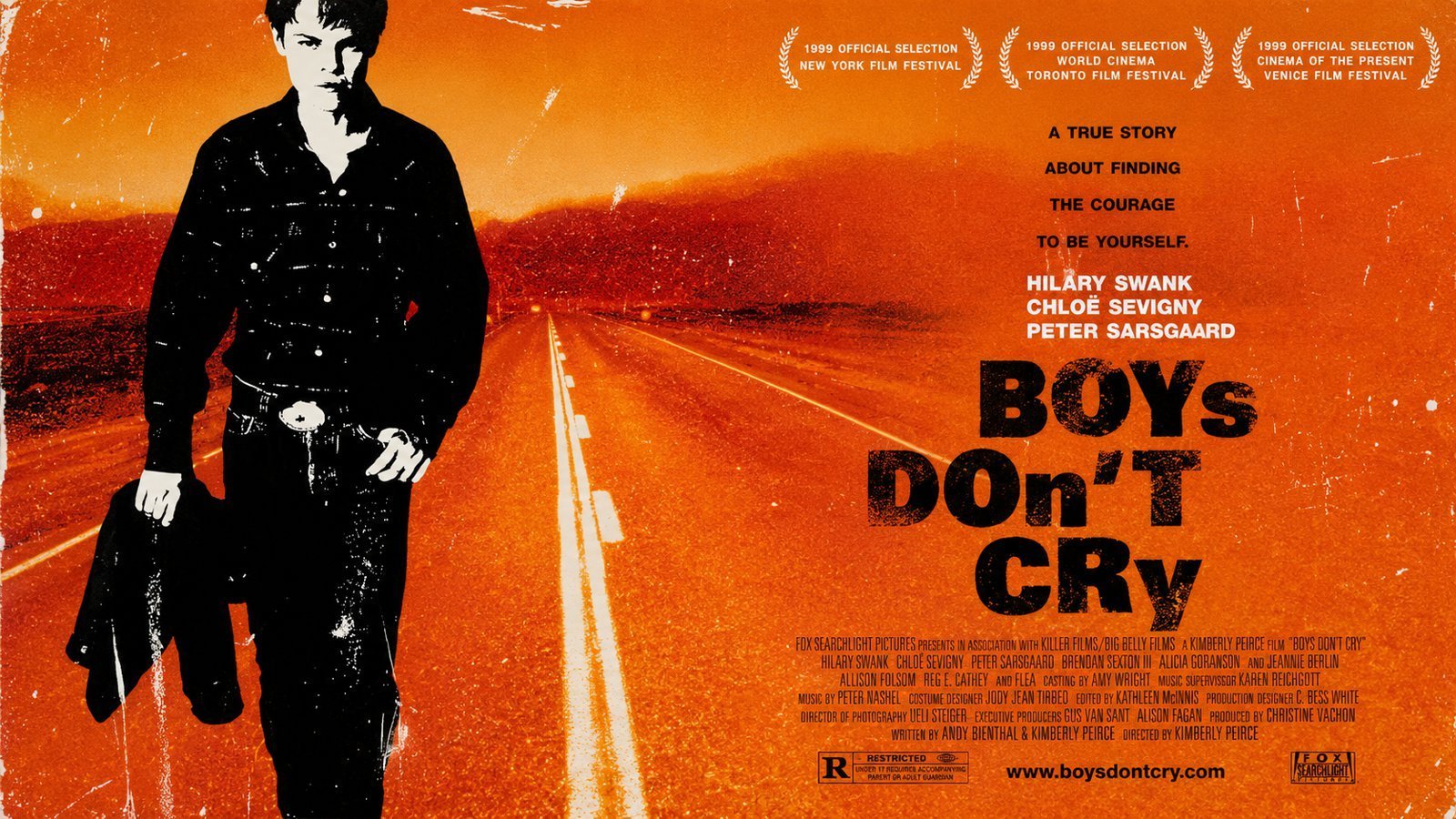
Boys Don't Cry (1999)
Starring: Hilary Swank, Chloe Sevigny, Peter Saarsgaard
Director: Kimberly Peirce
Synopsis: An exceptionally powerful, beautifully acted film containing a stunning reminder of how hellish life can be in an intolerant society
Reviewed by: Omar Khan
"The movie is a fine, terrifying, tragic poem that is also, at times, subversively funny", New Yorker
brave, devastating" Time Out
strikingly shot and tautly structured", Total Film
"as fascinating as it is darkly disturbing" Empire
An exceptionally powerful, beautifully acted and deeply moving film that stands as a searing reminder of just how hellish life can become in an intolerant society where people find it all too easy to sit in judgment of those who are different. Its impact is made all the more devastating by the knowledge that these events are rooted in fact. Brandon Teena was a real person whose fragile life was brutally extinguished, not in some distant medieval society or present-day dictatorship, but in small-town America in the mid-1990s.
Brandon Teena is a young woman who longs to live life as a man. In the opening scenes, we watch as she transforms herself into Brandon—cropping her hair, binding her body and completing the illusion with a rolled-up sock stuffed into her jeans. It is a simple but extraordinarily effective sequence, immediately drawing us into Brandon's desperate search for identity and acceptance.
Her first attempt at passing as male ends in humiliation when the deception is uncovered, forcing Brandon to flee. She is running not only from a growing criminal record built on petty offences, but from a suffocating atmosphere of prejudice and intolerance that refuses to allow her to live life on her own terms. More than anything, she is running from an identity that the outside world insists on imposing upon her.
Arriving in another forgotten corner of Nebraska, Brandon falls in with a group of hard-drinking, hard-living local youths who accept "him" without question. For the first time, life begins to offer some genuine hope, particularly when Brandon falls in love with Lana, a young woman trapped in the same dead-end existence as everyone around her. Through Brandon's warmth, sensitivity and quiet optimism, Lana begins to glimpse the possibility of a better life beyond the confines of Falls City. She senses that something about Brandon is unusual, but she loves the person rather than the label.
From this point onwards, the film builds almost unbearable suspense. We know the truth cannot remain hidden forever, and we dread the inevitable moment when Brandon's secret will be discovered. When it finally arrives, it does so in one of the most harrowing and emotionally devastating sequences of modern American cinema, as the two men Brandon had trusted decide to establish the truth by the most brutal and degrading means imaginable.
Boys Don't Cry is not an easy film to watch, nor should it be. It presents a vision of America at its most neglected—a landscape of economic decline, broken dreams, crime, frustration and simmering violence. Yet the greatest ugliness is not the poverty but the intolerance that poisons the community from within. Brandon emerges as a vibrant, hopeful and compassionate soul trying simply to live honestly, only to be crushed beneath the weight of hatred and ignorance.
Like Romeo and Juliet before them, Brandon and Lana find themselves trapped in a world where love is considered less important than prejudice, conformity and blind intolerance. Their tragedy feels both timeless and horrifyingly contemporary.
Hilary Swank delivers a phenomenal performance as Brandon Teena. It is one of those rare portrayals in which the actor disappears completely into the character. Her work throughout the film is remarkable, but particularly during and after the horrific assault, where every expression conveys unimaginable trauma without descending into melodrama. She deserved every accolade she received, including the Academy Award, ahead even of the outstanding Annette Bening in American Beauty.
This is a profoundly important film—not simply because of its superb performances or sensitive direction, but because it reminds us of one of the fundamental qualities upon which any civilised society depends: tolerance. Wherever prejudice, dogma and hatred are allowed to flourish, humanity itself becomes the victim.
Boys Don't Cry is not merely excellent cinema.
It is essential viewing.

0 Comments
Leave a Comment