
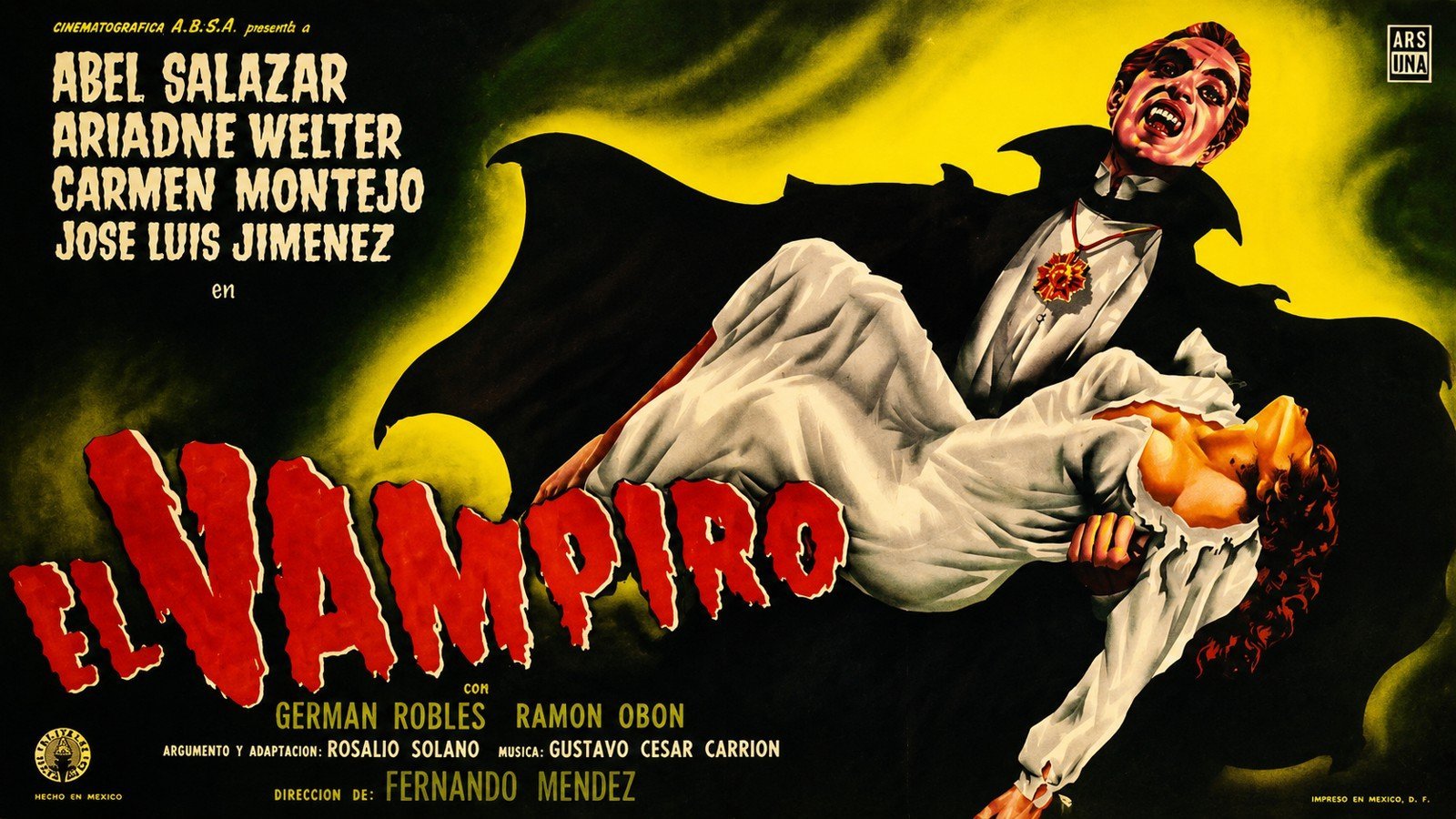
Vampire, El (1957)
Cast: Abel Salazar, German Robles, Ariadna Welter, Carmen Montego
Director: Fernando Mendez
Synopsis: An evil count arrives in Mexico in order to ressurrect his deadly vampire sibling
Reviewed by: Omar Khan
The opening scenes immediately establish the wonderfully Gothic tone. Outside a lavish hacienda, the sinister Count Lavud mesmerises yet another beautiful victim before transforming into a hideous leathery bat and silently flapping towards her bedroom window. As the terrified beauty recoils in horror, the Count closes in, his gleaming fangs illuminated by the pale moonlight.
It is a splendid beginning to one of Mexico's finest vampire films.
The story then shifts to a train leisurely arriving in the sleepy town of Santa Negra, a curious place where the deeply superstitious locals refuse to venture outdoors after dark. Among the passengers is the beautiful Marta, who has travelled to visit her elderly aunts at the family hacienda, one of whom is gravely ill.
Unfortunately, transport to the estate proves impossible to find.
Fortunately, the charming Abel Salazar is stranded for exactly the same reason.
Before long, a horse-drawn cart arrives to collect a rather unusual consignment that has travelled all the way from a remote Hungarian village. The mysterious shipment consists of a coffin filled with native earth, addressed to one Count Lavud—a recent arrival whose business interests appear to be considerably more sinister than he initially admits.
Count Lavud is, in reality, the notorious vampire Count Duval, who has journeyed to Mexico with a singular purpose: to resurrect his equally bloodthirsty brother, whose remains lie entombed beneath Marta's ancestral hacienda.
Having already enslaved one of Marta's unfortunate aunts through his hypnotic powers, the Count now requires complete control of the estate in order to complete the gruesome ritual that will restore his brother to the family business of drinking human blood.
Unfortunately for him, Marta proves every bit as stubborn as her uncle.
With persuasion proving unsuccessful, the Count and his loyal accomplice begin plotting the young woman's downfall, clearing the way for the resurrection of their undead relative and the continuation of the family's rather unhealthy traditions.
This classic slice of Mexican Gothic horror arrives courtesy of the delightfully eccentric people at Mondo Macabro, whose DVD label continues to rescue fascinating, obscure and often neglected gems from around the world.
Presented in a style strongly reminiscent of Universal's classic horror cycle of the 1930s and 1940s, the film possesses an elegance and atmosphere that immediately distinguish it from many of its contemporaries.
The beautifully designed sets, expressive lighting and carefully composed cinematography combine to create an almost dreamlike Gothic atmosphere, while the dramatic musical score provides exactly the right level of creeping menace throughout.
Despite its reputation as a vampire film, there is remarkably little graphic violence on display. This makes the British Board of Film Classification's decision to award the film an 18 certificate rather puzzling. Presumably the rating stems largely from one particularly savage attack on a young boy by the blood-crazed Count Lavud, as there is little else that would trouble modern audiences.
German Robles delivers an effortlessly charismatic performance as the aristocratic vampire, projecting exactly the right balance of sophistication, menace and quiet authority. Opposite him, Abel Salazar makes for an immensely likeable hero, bringing warmth, charm and understated humour to the role. It is little surprise that Salazar became such an important figure in Mexican horror cinema, not only starring in numerous productions but producing many of them as well.
This is a classy, stylish vampire film steeped in old-world Gothic charm, handsomely photographed and consistently well acted. It may lack the bloodshed expected by modern horror audiences, but it more than compensates through atmosphere, craftsmanship and sheer cinematic elegance.
For lovers of classic horror cinema, this deserves to be considered essential viewing.
Thanks to Mondo Macabro's superb DVD release, another forgotten gem has been rescued from obscurity and made available for a new generation of discerning horror fans.

0 Comments
Leave a Comment