
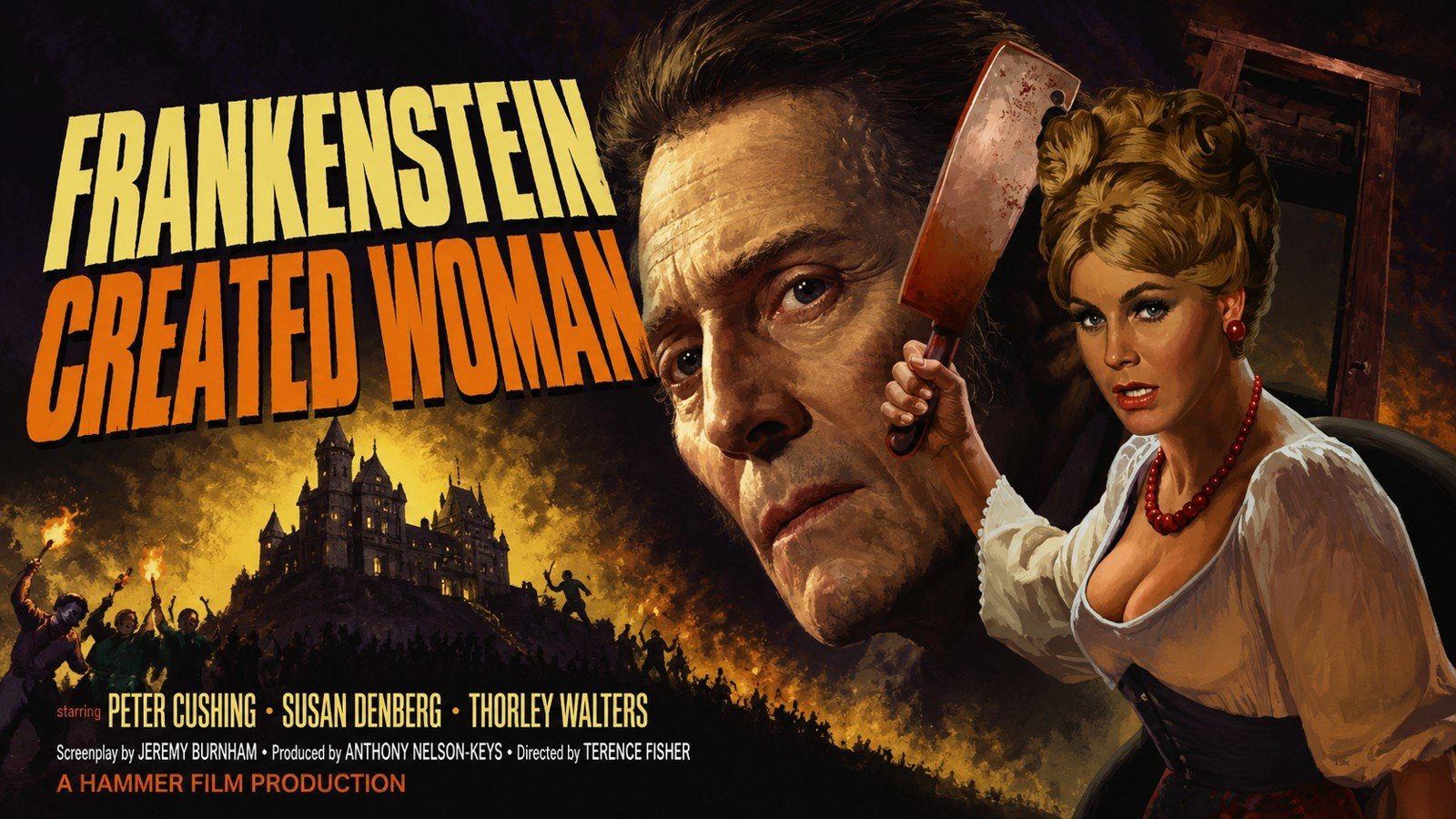
Frankenstein Created Woman (1967)
Starring: Peter Cushing, Susan Denberg, Thorley Walters
Director: Terrence Fisher
Synopsis: Fourth in Hammer's Frankenstein series is an interesting but misguided effort.
Reviewed by: Ali Khan
By the time Hammer Films reached the fourth entry in its Frankenstein series, it had become abundantly clear that simply providing Baron Frankenstein with ever larger or more grotesque monsters was a formula destined to run out of steam.
Frankenstein Created Woman represents Hammer's bold attempt to solve that problem.
Remarkably, it does so by changing not merely the appearance of the "monster" but the very nature of Frankenstein's experiments.
Gone are the familiar tales of stitched-together corpses animated by transplanted brains. Baron Frankenstein (Peter Cushing) has advanced considerably beyond such comparatively primitive procedures. His latest obsession lies not with flesh, but with the human soul itself.
His revolutionary theory is that the soul can survive physical death.
Capture it...
preserve it...
and transplant it into another body.
If successful, death itself may finally be conquered.
It is certainly one of the more imaginative departures the series had attempted.
The story centres upon Hans, an innocent young man unjustly executed for a murder he did not commit. His devastated sweetheart Christina (Susan Denberg), unable to endure the loss, throws herself to her death shortly afterwards.
Frankenstein seizes the opportunity.
The Baron's latest experiment transfers Hans' living soul into Christina's lifeless body, creating a new being driven by memories, love and an overwhelming desire for revenge against those responsible for the tragedy.
The result is perhaps the most unusual "monster" ever to emerge from Hammer's Frankenstein laboratory.
Indeed, there is scarcely a monster at all in the traditional sense.
Instead, Terrence Fisher cleverly transforms the familiar Frankenstein narrative into something approaching a Gothic revenge tragedy. The resurrected Christina becomes both victim and executioner, pursuing those whose cruelty destroyed two innocent lives.
It is an inspired variation upon the established formula.
One of the film's greatest strengths is that Baron Frankenstein himself gradually retreats from centre stage. Whereas earlier films revolved almost entirely around his obsessive experiments and their disastrous consequences, here he functions more as the catalyst that sets the tragedy in motion. Once his scientific achievement has been accomplished, the story increasingly belongs to Christina and Hans.
That shift in emphasis allows Fisher to explore themes seldom associated with Frankenstein adaptations.
Class.
Power.
Cruelty.
The true villains are not supernatural creations but privileged young aristocrats who casually abuse those beneath them, secure in the knowledge that wealth and social standing place them beyond ordinary justice. Their casual sadism towards Hans and Christina provides the emotional foundation upon which the entire story rests.
The film also examines prejudice with surprising sensitivity.
Christina's physical deformity makes her an object of ridicule and pity, while Hans suffers under the shadow cast by his father's criminal past. Both characters exist on the margins of society, judged not by their own actions but by circumstances entirely beyond their control.
In many respects, Frankenstein Created Woman becomes the revenge of the powerless against those who have always exercised power without consequence.
For a Hammer horror film of the 1960s, these are unexpectedly thoughtful concerns.
Terrence Fisher handles them with his customary elegance. His direction is never showy, yet he creates an atmosphere of quiet melancholy that distinguishes the film from many of its predecessors. The early sequences, in particular, possess an almost fairy-tale quality before gradually descending into tragedy.
Visually, the production remains unmistakably Hammer.
Beautifully composed Gothic interiors.
Rich colours.
Fog-shrouded streets.
Laboratories glowing with strange scientific apparatus.
The familiar ingredients are all present, but they are employed in the service of a more reflective story than audiences had perhaps come to expect.
The film's greatest weakness lies in its central scientific premise.
Previous entries stretched credibility by transplanting brains and reconstructing bodies, but Fisher always grounded these ideas—however improbably—in a recognisable form of experimental science.
Capturing and transplanting the human soul, however, pushes the series firmly into metaphysical territory. At that point, Frankenstein begins to resemble a mystic almost as much as a scientist.
For some viewers, that leap may prove one step too far.
Yet even this questionable premise produces one of the series' most fascinating concepts.
The soul of one lover...
imprisoned forever within the body of another.
It is simultaneously romantic, tragic and profoundly unsettling.
More than any previous Hammer Frankenstein, this instalment is driven by sadness rather than horror. The emphasis shifts away from shocks and monstrous creations towards doomed love, injustice and the devastating consequences of human cruelty.
As a result, the film contains fewer moments of outright terror than its predecessors, but considerably more emotional weight.
Peter Cushing once again delivers a wonderfully controlled performance as Baron Frankenstein. Even when relegated to the edges of the narrative, he dominates every scene in which he appears. His Baron remains courteous, intelligent and utterly amoral—a man whose relentless pursuit of knowledge has long since eclipsed ordinary human compassion.
Whenever Cushing disappears from the screen, one becomes acutely aware of his absence.
Susan Denberg, meanwhile, makes an unexpectedly affecting heroine. Arguably the most striking and certainly the most alluring of all Hammer's Frankenstein creations, she brings genuine pathos to Christina's transformation, ensuring that the audience views her not as a monster but as a tragic victim seeking justice.
Ultimately, Frankenstein Created Woman stands as one of Hammer's most courageous sequels.
It refuses simply to recycle familiar ideas and instead attempts to broaden both the mythology of Frankenstein and the emotional range of the series. Not every experiment succeeds, and the supernatural direction occasionally sits uneasily beside the Baron's traditionally scientific pursuits.
Nevertheless, it remains an intelligent, atmospheric and unusually poignant entry in Hammer's finest series.
Perhaps not quite the masterpiece it aspires to be...
but certainly one of the studio's most interesting and ambitious Frankenstein films.

0 Comments
Leave a Comment