
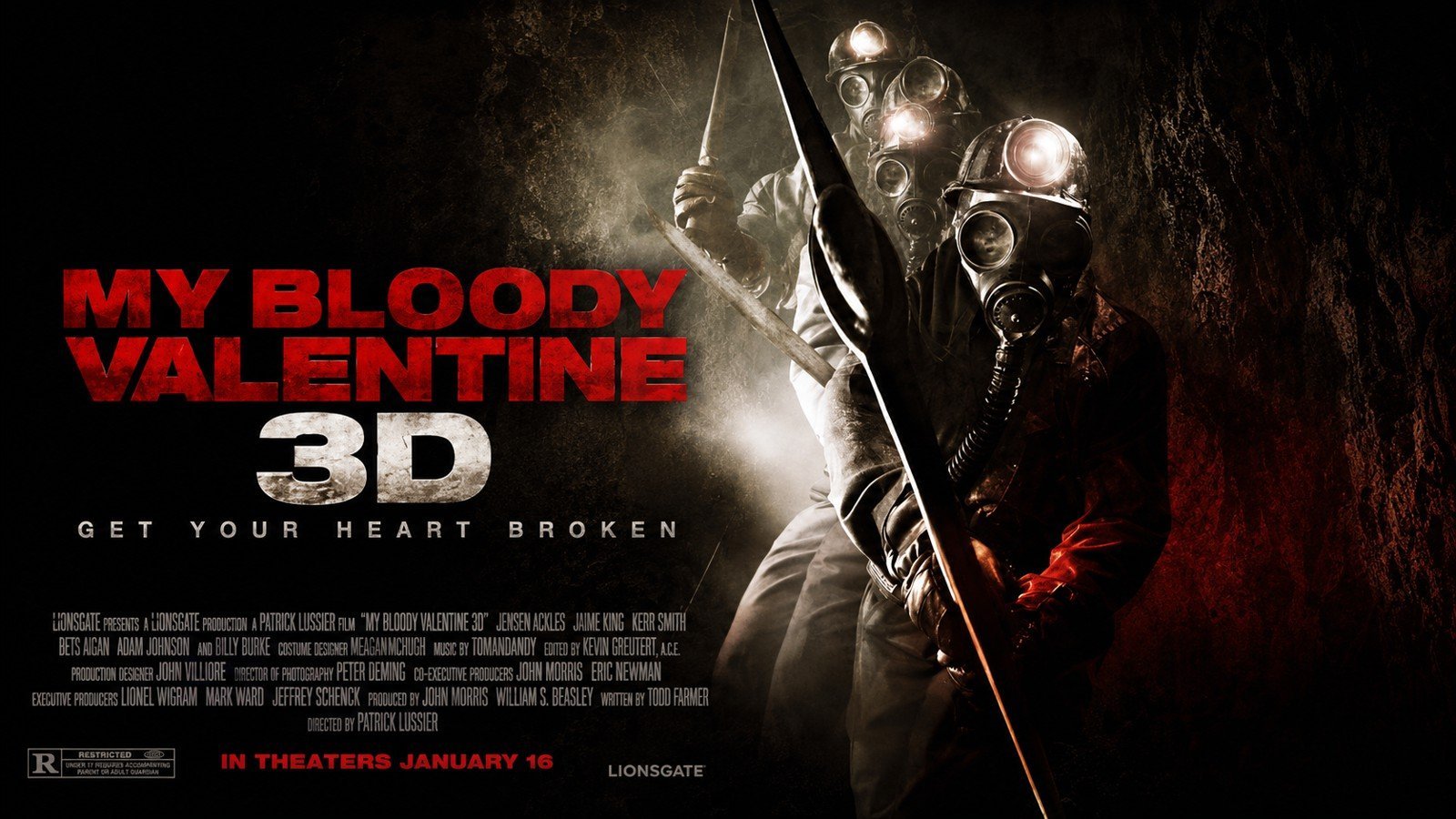
My Bloody Valentine (2009)
Cast: Jason Ackles, Jamie King, Todd Farmer, Kerr Smith
Director: Patrick Lussier
Nutshell: Classic slasher film given the 3D makeover treatment, but the results are resoundingly flat.
My Bloody Valentine (1981 & 2009): Atmosphere Lost in Three Dimensions
Time has been extraordinarily kind to the original My Bloody Valentine.
Dismissed by some critics upon its release in 1981 as merely another entry in the seemingly endless procession of post-Halloween slashers, the film has quietly earned a far greater reputation over the decades. Today, it comfortably occupies a place among the better examples of the genre, thanks largely to qualities that have nothing whatsoever to do with body counts or buckets of fake blood.
Its greatest strength is atmosphere.
Director George Mihalka drenches the film in an almost oppressive sense of foreboding. The isolated mining town feels genuinely claustrophobic, while the gloomy mine shafts themselves become an intimidating labyrinth from which there appears to be no escape. Excellent cinematography and imaginative lighting transform what could easily have become routine locations into places of genuine menace. Every shadow seems capable of concealing death.
The killer himself is among the most striking to emerge from the slasher boom of the early 1980s. Clad in a miner's uniform, complete with a gas mask, helmet and wielding an intimidating pickaxe, he possesses an instantly recognisable silhouette that remains every bit as memorable today as the hockey mask of Jason Voorhees or Michael Myers' blank white face.
The screenplay itself never ventures far beyond familiar slasher territory. A dark local legend, attractive young victims, and a mysterious killer stalking them one by one hardly constituted revolutionary storytelling, even in 1981. Yet the assured direction consistently elevates the material above its rather conventional foundations. Strong production values, excellent pacing and several genuinely memorable murder sequences combine to create a film that has matured remarkably well with age.
Commercially, My Bloody Valentine performed respectably without ever becoming the sensation Paramount Pictures had hoped for. Having acquired the relatively inexpensive Canadian production, the studio understandably dreamed of another Halloween or Friday the 13th—the kind of low-budget horror phenomenon capable of generating enormous profits and spawning an endless succession of sequels.
That never happened.
The film comfortably recouped its costs and returned a respectable profit, but nothing approaching the spectacular financial windfall Paramount had anticipated. Consequently, unlike many of its contemporaries, My Bloody Valentine quietly disappeared instead of becoming an annual franchise.
Ironically, that may have worked in its favour.
Without an endless parade of diminishing sequels diluting its reputation, the original has remained remarkably fresh.
My own first encounter with the film came during its original American release in February 1981.
At the time, I had somehow managed to become the film critic for my college newspaper, an appointment that conveniently provided the perfect excuse to make regular pilgrimages from the sleepy town of Bradford into nearby Boston to catch the latest cinema releases. Horror films naturally headed my list of priorities.
Bradford itself possessed no cinema, but fortunately, I had discovered the ideal accomplice.
My long-suffering friend Hajime Ogata.
More often than not, Hajime would patiently drive me into Boston, enduring what must have seemed an endless procession of maniacs, masked killers and assorted cinematic psychopaths without ever once complaining. Looking back, I suspect he displayed considerably more patience than I deserved.
On this particular occasion, however, I was flying solo.
The only option was to catch the bus into Boston, watch the film and make certain I returned before the college curfew.
Like most horror fans at the time, my expectations were impossibly high.
John Carpenter's Halloween had completely redefined the modern horror film only a couple of years earlier. It possessed such elegance, suspense and sheer cinematic confidence that almost every slasher released afterwards inevitably suffered by comparison. It took me several years to accept that nothing was ever likely to equal Carpenter's masterpiece.
Unfortunately, My Bloody Valentine became one of those films measured against an impossible standard.
I enjoyed it, but left the cinema feeling slightly underwhelmed.
Only later did I discover that the version I had seen had already been savaged by the censors.
The Motion Picture Association had demanded extensive reductions to the film's violence before granting it an R rating. Approximately nine minutes of graphic footage reportedly disappeared, much of it involving the elaborate murder sequences that had originally distinguished the production from its competitors.
The resulting theatrical version felt oddly restrained for a film whose reputation had promised considerably more.
It would be many years before horror fans finally had the opportunity to experience something approaching the director's original intentions. When the long-awaited Blu-ray restoration reinstated much of the previously missing material, it became possible to appreciate the film in a very different light.
Like many viewers revisiting it after decades, I found myself enjoying My Bloody Valentine far more than I had on that chilly February evening back in 1981.
Time had revealed strengths I had overlooked the first time around.
The atmosphere.
The creeping sense of dread.
The confident direction.
The beautifully controlled lighting.
These were qualities that had little to do with graphic violence and everything to do with skilled filmmaking.
Far from fading with age, My Bloody Valentine had quietly grown into one of the most accomplished and enduring entries in slasher cinema.
My Bloody Valentine (1981 & 2009): Atmosphere Lost in Three Dimensions – Part Two
Horror cinema never stands still.
By the time My Bloody Valentine returned to the screen almost three decades later, the landscape had changed beyond recognition. The straightforward slasher formula that had dominated the early 1980s had risen, flourished and, by the end of that decade, largely exhausted itself. Audiences had grown accustomed to masked killers dispatching groups of attractive young people in increasingly inventive ways, and what had once felt fresh had become predictable.
The genre desperately needed reinvention.
It arrived in 1996.
Wes Craven's Scream breathed fresh life into the slasher film by doing something remarkably simple—it acknowledged that its audience already understood the rules. Kevin Williamson's witty screenplay allowed the characters themselves to discuss horror clichés even as they became trapped within them. The result was intelligent, self-aware entertainment that restored commercial credibility to a genre many critics had already written off.
Success inevitably bred imitation.
Films such as I Know What You Did Last Summer, Urban Legend and a host of similarly polished productions followed in its wake, replacing grimy menace with glossy young casts and fashionable soundtracks. Slashers were fashionable once again, but they had become rather different beasts. Irony increasingly replaced genuine suspense.
At the same time, another influence was quietly making itself felt.
Japanese horror.
Films such as Ringu and Ju-on demonstrated that atmosphere could still be every bit as frightening as explicit violence. Their American remakes proved enormously successful, introducing Western audiences to a slower, more unsettling style of horror built around psychological unease rather than relentless carnage.
Then came another dramatic shift.
Torture porn.
Whether one appreciates the label or not, there is little doubt that films such as Saw and Hostel profoundly altered audience expectations during the first decade of the new millennium. Graphic violence became the principal attraction rather than merely one ingredient among many. Elaborate death sequences evolved into the cinematic equivalent of special-effects set pieces, with audiences eagerly anticipating not who would die but precisely how.
The pendulum had swung decisively away from suggestion.
At almost exactly the same moment, Hollywood rediscovered another old gimmick.
Three-dimensional cinema.
James Cameron's Avatar demonstrated that modern digital 3D could become a major commercial attraction, and suddenly studios everywhere were scrambling to convert existing projects or develop new productions capable of exploiting the technology. Unlike the headache-inducing red-and-blue spectacles of earlier decades, digital 3D was cleaner, brighter and technically far more sophisticated.
It also became a marketing dream.
The promise of images bursting from the screen proved almost irresistible to distributors searching for ways to lure audiences away from increasingly sophisticated home entertainment systems.
I have to confess that I have never shared the enthusiasm.
Perhaps I am simply old-fashioned.
For me, three-dimensional cinema has always represented little more than an occasionally amusing distraction. Certainly, modern technology eliminated many of the frustrations associated with earlier generations of 3D, where double vision and splitting headaches often became more memorable than the films themselves. Objects now flew convincingly towards the audience, bullets appeared to leave the screen and blood sprayed enthusiastically into the auditorium.
It could be entertaining.
For about five minutes.
Beyond that, I found myself increasingly aware of the technology rather than the story.
Whenever given the choice, I would invariably seek out the traditional two-dimensional screening. My reasoning was very simple.
If a film is genuinely compelling, it should not require objects hurtling towards my face to hold my attention.
Strong writing.
Atmosphere.
Character.
Suspense.
These are the qualities that endure long after technological fashions have passed into history.
If 3D genuinely enhances those qualities, then it has served a worthwhile purpose.
Too often, however, it merely draws attention to itself.
By the late 2000s, the horror genre appeared perfectly suited to the format. Knives, axes, chains, bullets and generous quantities of blood could all be projected enthusiastically into the auditorium, transforming murder into something approaching an amusement-park attraction.
It was perhaps inevitable that somebody would eventually revive My Bloody Valentine.
After all, what better excuse could there be for repeatedly thrusting a pickaxe directly towards the audience?
Lionsgate clearly recognised the commercial potential. Having acquired the rights to the property, the studio commissioned a lavish remake designed from the outset to exploit digital 3D technology. It represented the first major horror film conceived specifically for the format since Friday the 13th Part III had briefly flirted with three dimensions over a quarter of a century earlier.
The marketing campaign promised exactly what audiences expected.
More blood.
More elaborate kills.
More spectacle.
And, above all...
everything in glorious 3D.
Audiences responded enthusiastically.
The film earned back its production budget almost immediately and ultimately generated many times its cost worldwide, proving that the commercial gamble had paid off handsomely.
Financially, there could be little argument.
Artistically...
That would prove to be a very different matter indeed.
My Bloody Valentine (1981 & 2009): Atmosphere Lost in Three Dimensions – Part Three
I deliberately chose to watch the remake in its conventional two-dimensional presentation.
Perhaps that sounds rather perverse given that the film had been conceived almost entirely as a 3D experience, but I have always believed that if a film genuinely works as cinema, it should continue to work perfectly well without technological embellishment.
A great story does not depend upon gimmickry.
Within seconds of the opening sequence, however, it became abundantly clear that My Bloody Valentine (2009) had been designed with entirely different priorities.
Almost every set piece appears constructed around the next opportunity to thrust something towards the audience.
Blood splatters directly into the camera.
Pickaxes lunge repeatedly through the screen.
Bullets, body parts, flying debris and assorted sharp implements are hurled enthusiastically in the viewer's direction with relentless regularity.
One cannot really criticise the filmmakers for this.
After all, audiences had paid a premium to experience a three-dimensional spectacle, and the production delivers precisely what its advertising promised. Considerable ingenuity has gone into staging these moments, and viewed purely as demonstrations of digital 3D technology, many of them undoubtedly succeeded.
The problem lies elsewhere.
Technology can certainly enhance cinema.
It cannot replace craftsmanship.
That, unfortunately, is precisely where the remake comes undone.
What made the 1981 film memorable was never its body count.
It was the atmosphere.
George Mihalka understood that horror grows out of anticipation rather than impact. The darkness of the mine shafts, the oppressive silence, the eerie lighting and the constant sense of unseen danger created an environment in which the audience's imagination became an active participant. The violence punctuated the suspense rather than replacing it.
The remake reverses that equation.
Here, spectacle becomes the main event.
Every elaborate death scene appears designed to provoke cheers, gasps or nervous laughter rather than genuine fear. Instead of building unbearable tension before unleashing violence, the film races impatiently from one effects sequence to the next, mistaking momentum for suspense.
As a result, very little of it lingers in the memory.
Curiously, despite a considerably larger budget and every technological advantage available, the remake often looks strangely artificial. The harsh digital photography gives many scenes the appearance of a television production rather than a feature film, while the performances rarely rise above routine. Attractive actors dutifully deliver functional dialogue before waiting their turn to become the next victim.
One never truly believes in the town.
Or its people.
Or the danger surrounding them.
Consequently, one never really cares.
There is remarkably little sense of dread.
Almost no sustained suspense.
And scarcely a single sequence that generates the kind of mounting anxiety so effortlessly achieved by the original.
The irony is that the filmmakers faithfully reproduce many of the superficial elements that made My Bloody Valentine distinctive.
The mining setting returns.
Harry Warden's iconic miner's outfit and gas mask remain wonderfully intimidating.
The pickaxe is once again put to enthusiastic use.
Yet these are merely ingredients.
Possessing the recipe is not the same as understanding why it works.
The soul of the original has quietly slipped away.
Watching the remake, I was frequently reminded of a beautifully wrapped present that contains very little inside. It is polished, technically accomplished and eager to impress, but somehow emotionally hollow. Everything has been amplified except the one ingredient horror cinema requires above all others.
Fear.
The greatest irony of all is that the original My Bloody Valentine, even in its heavily censored form, remains the more effective horror film. It asks comparatively little of its audience beyond patience and imagination, yet rewards both with an atmosphere that continues to unsettle decades later.
The remake asks considerably more.
Bigger effects.
More graphic violence.
More elaborate technology.
And despite all of that...
it delivers considerably less.
In the end, watching the 2009 My Bloody Valentine is rather like eating a can of Pringles.
For a few fleeting moments the experience is undeniably enjoyable. One reaches instinctively for another, and then another, before eventually realising that the satisfaction has been entirely superficial. What lingers afterwards is not fulfilment but an unpleasant aftertaste—a sense of having consumed something highly processed, artificially manufactured and strangely empty.
Real food leaves a lasting impression.
So does real cinema.
The original My Bloody Valentine has quietly endured because it understood a simple truth that many modern horror films seem to have forgotten.
Atmosphere lasts.
Technology dates.
This remake is ultimately little more than cinematic junk food—flashy, disposable and designed for immediate consumption rather than lasting appreciation.
The original, by contrast, continues to reward every return visit.
That, more than forty years later, is the difference between a slasher that has become a minor classic and one that has already begun to gather dust.

0 Comments
Leave a Comment