
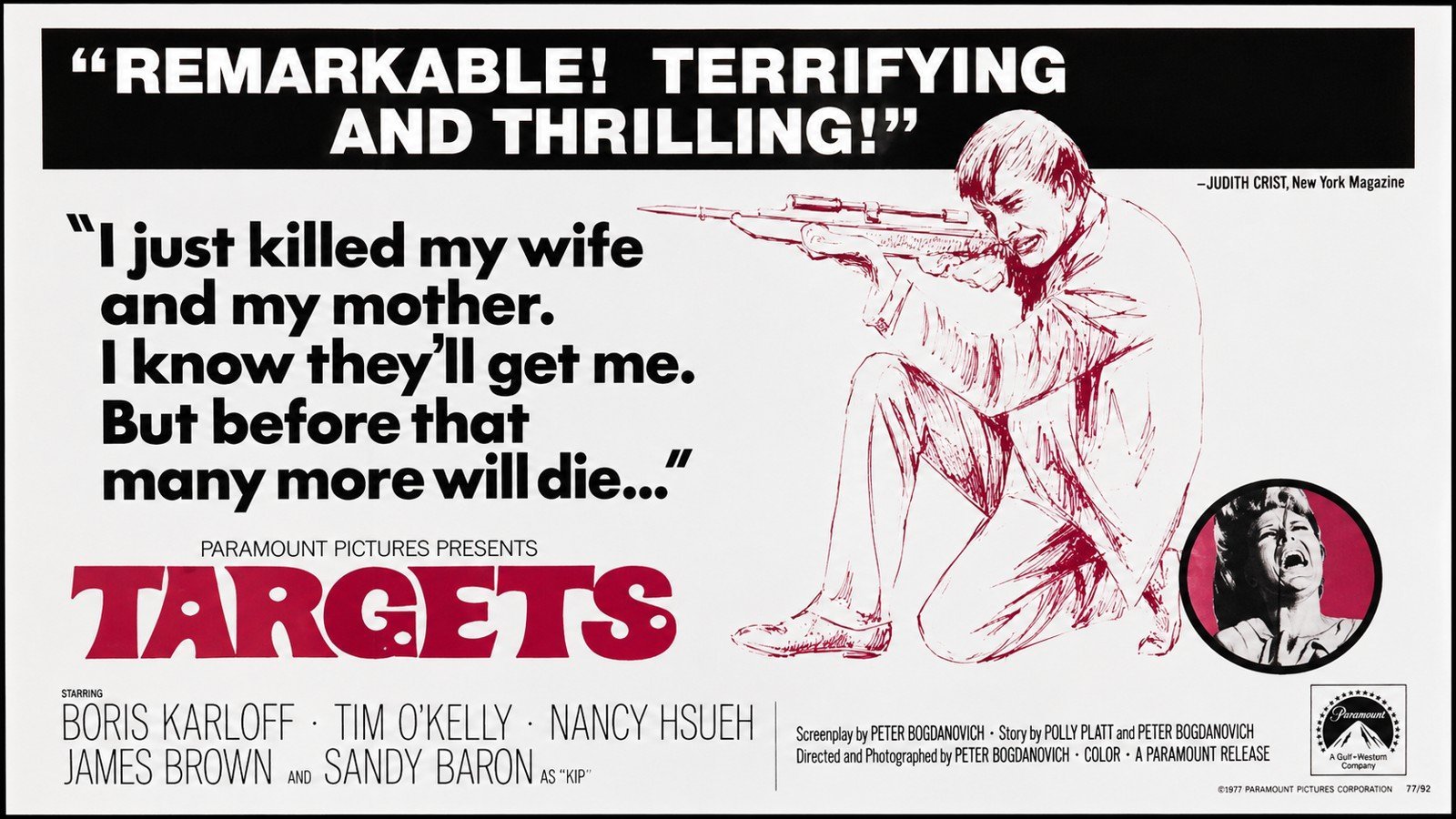
Targets (1968)
Starring: Boris Karloff, Tim O'Kelly, Peter Bogdanovich
Director: Peter Bogdanovich
Synopsis: Superb thriller - All-American blue-eyed boy "snaps" with murderous results
Reviewed by: Omar Khan
This remarkable film announced Peter Bogdanovich as a director of extraordinary talent back in 1968, at a time when contemporaries such as Francis Ford Coppola and Martin Scorsese were only just beginning to establish themselves.
The origins of Targets are almost as fascinating as the finished film itself.
Roger Corman, never one to waste a penny, reportedly handed Bogdanovich unused footage from his own horror film, The Terror and challenged the young director to construct an entirely new film around it.
Bogdanovich disappeared and returned with one of the great unsung American films of the 1960s.
Targets works brilliantly on several different levels.
It serves as a moving tribute to horror legend Boris Karloff, who effectively plays a fictionalised version of himself: an ageing horror icon approaching the end of a distinguished career, increasingly weary of both his screen persona and the ugliness of the modern world surrounding him.
At the same time, it is a chilling examination of violence in contemporary America, touching upon gun culture, suburban complacency and the frighteningly thin line separating everyday normality from unimaginable horror.
The film unfolds through two parallel storylines that gradually converge in a superbly sustained climax.
Karloff plays Byron Orlok, an ageing horror star who has grown tired of making frightening movies and wishes to retire quietly. Persuaded by his loyal secretary and an enthusiastic young director—played by Bogdanovich himself—he reluctantly agrees to make one final promotional appearance at a local drive-in cinema.
Elsewhere, in an apparently perfect suburban neighbourhood, lives an equally perfect American family. Beneath the surface, however, their polite, clean-cut young son (Tim O'Kelly) harbours an increasingly disturbing obsession with firearms.
Eventually, something inside him snaps.
What follows remains one of the most unsettling portrayals of random violence ever committed to film.
Bogdanovich directs the material with astonishing confidence for a first-time filmmaker. His greatest achievement lies in his refusal to sensationalise the horror. There are no manipulative musical cues, no flashy camera tricks and no attempts to glamourise the violence.
The murders unfold with an almost documentary-like detachment.
That restraint makes them all the more horrifying.
Looking back today, it is remarkable just how assured Bogdanovich already was. Within only a few years, he would direct masterpieces such as The Last Picture Show and the delightful Paper Moon, establishing himself as one of the brightest talents of the New Hollywood generation. Although his later directing career never consistently scaled those same extraordinary heights, these early films alone secured his place amongst the most gifted American filmmakers of his era.
Boris Karloff, meanwhile, gives one of the finest performances of his distinguished career. There is genuine poignancy in his portrayal of an ageing horror star confronting a world whose real-life violence has become infinitely more frightening than anything he ever portrayed on screen.
More than half a century later, Targets remains every bit as intelligent, disturbing and relevant as it was upon its original release.
It deserves to be recognised not merely as Peter Bogdanovich's remarkable debut, but as one of the finest American thrillers of the 1960s.

0 Comments
Leave a Comment