
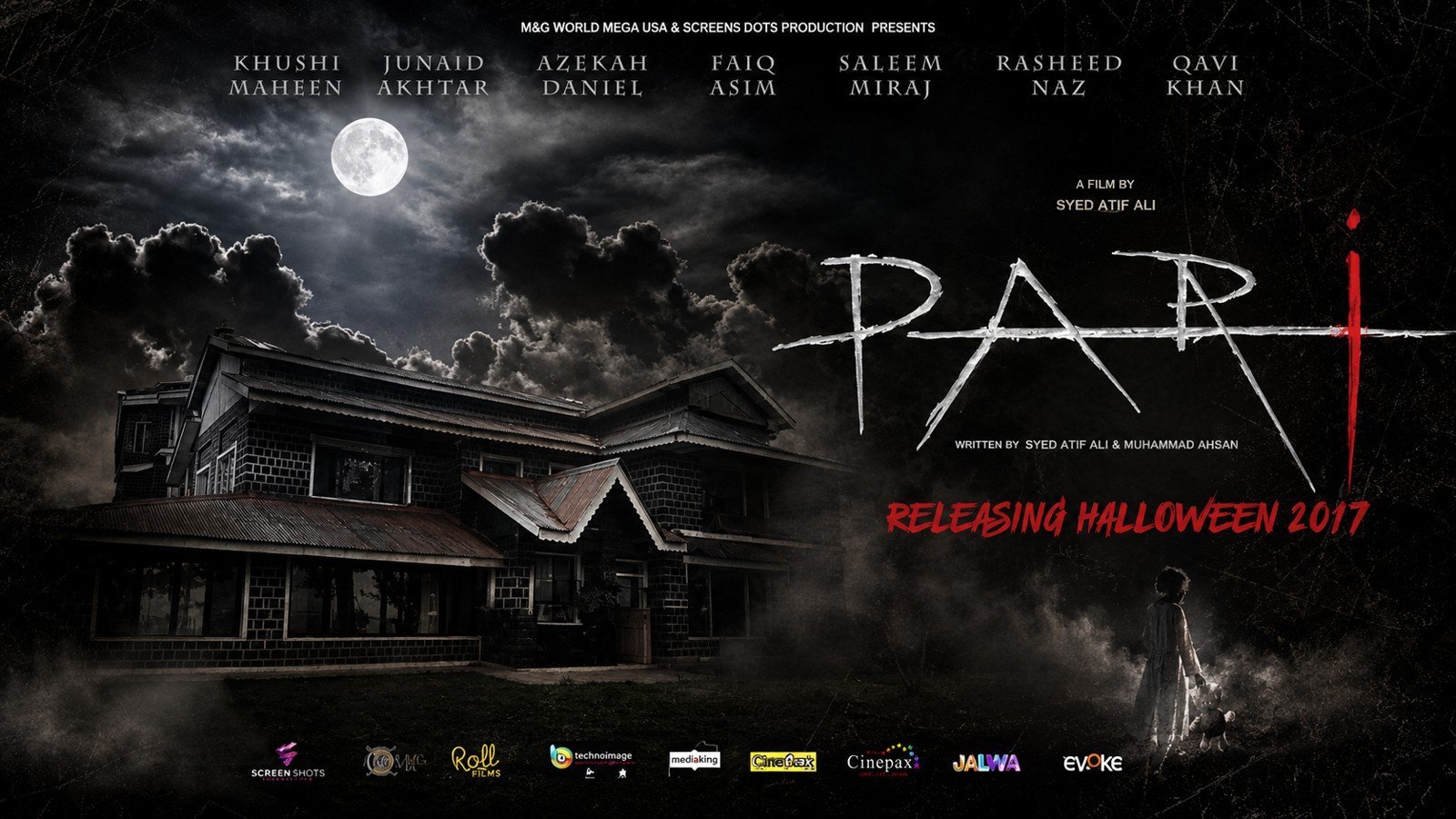
Title: Pari (2018)
Cast: Junaid Akhtar, Azekah Daniel, Khushi Maheen, Salim Mairaj, Rasheed Naz, Qavi
Director: Syed Atif Ali
Nutshell: The only terrifying thing about this farce is its 150-minute length!
Reviewed by: Omar Khan
Once again, amidst the seemingly endless procession of "Punjabi in Karachi"-style feel-good comedies complete with obligatory Dalda-advert song sequences bursting with colour, it comes as a pleasant surprise to see a horror film creep into local cinemas. There has always been a healthy appetite for horror across the subcontinent, and a handful of brave souls duly turned up for the "first day, first show" screening of the latest Pakistani fright-fest after an absence of at least a couple of years.
Pari arrived with very little publicity or fanfare, and the trailer released on YouTube hardly set pulses racing. Nevertheless, around forty people packed into the tiny cinema hoping for a few enjoyable thrills and chills. The bar for Pakistani horror had recently been set fairly low, with Maya, Siyah and Hotal doing little either to terrify audiences or excite the box office.
The cast is largely made up of unfamiliar faces, although veteran actor Qavi appears alongside Rasheed Naz, a familiar face since Khuda Kay Liye. Salim Mairaj, who previously dabbled in horror with Zibahkhana, returns as a mysterious wandering minstrel whose significance gradually emerges during the climactic stages of this two-and-a-half-hour marathon.
Explaining the plot is almost a pointless exercise because Pari is little more than a patchwork quilt stitched together from the most popular horror films of the previous decade. Take generous portions of Insidious, Ring, Mama, Bhoot, The Conjuring, Paranormal Activity, The Guardian, throw in a splash of The Amityville Horror, season liberally with pseudo-philosophical waffle about spirituality and belief versus scepticism, stir thoroughly—and there you have it.
Unfortunately, it simply doesn't work.
The acting is woeful throughout, with Azekah Daniel delivering what can only be described as a remarkably convincing zombie performance. The only problem is that she isn't actually appearing in a zombie film.
The ghostly child, seemingly borrowed directly from Insidious and The Grudge, sports huge black circles around his eyes in an apparent attempt to appear menacing. Instead, he resembles a somewhat unfortunate panda.
Pari herself discovers the joys of borrowing her mother's makeup before befriending an evil crow straight out of Bhoot, which promptly introduces her to a sinister satanic tree demanding regular blood sacrifices. Ever eager to please, the child duly obliges, first smearing crow's blood across her own face just in case the audience has somehow failed to realise she has embraced the forces of darkness.
The sound design deserves a special mention—although not for the right reasons. Endless waves of ominous low-frequency rumbling repeatedly attempt to batter the audience into believing that what they are watching is genuinely frightening. Sadly, it merely serves as a constant reminder that what is unfolding on screen is very, very bad. The only genuinely terrifying aspect of Pari is its punishing running time.
To be fair, the film works considerably better as an unintended comedy. Those audience members who hadn't already drifted off to sleep found plenty of opportunities to laugh, often at moments that were clearly never intended to be amusing.
The dialogue is painfully awkward throughout, although the inspired use of the word "cheesipan" certainly raised a smile.
Salim Mairaj remains a capable actor when given worthwhile material, but this is hardly one of his finer performances, although he is rewarded with a surprisingly tuneful song to mime along to. I noticed one or two audience members discreetly attempting to Shazam it, while another confidently informed his companion that it was Ibrar Ul Haq singing. The songs themselves feel completely out of place and merely slow the already glacial pace still further, although the second number is probably one of the few genuinely enjoyable aspects of the entire production.
The horror sequences fare little better. None of the supposed shock scenes generate even the slightest jolt, while the supernatural moments frequently provoke outright laughter.
One particularly memorable sequence finds Mehwish (Azekah Daniel) supposedly asleep while the soundtrack's booming bass insists something terrifying is about to happen. Instead, she slowly raises one leg, rather like a dog preparing to relieve itself. Moments later, the other leg follows, then one arm, then the other. By now the audience is giggling helplessly in embarrassed unison—a rare moment of communal catharsis.
Later, a rocking chair begins moving by itself in a transparent nod to The Changeling, while the ghostly panda child demonstrates supernatural powers by sucking up Pari's glass of milk before wiping the milk from his lips in an unmistakable homage to Damien.
The film's undisputed highlight is veteran actor Qavi.
As children we delighted in his wonderfully theatrical performances in classics such as Aina, forever remembering his immortal drunken declaration:
"Bah... such a gramoruss flat. Sweet smuggled visssky. Biyoootiful phurneechurr. God nay tumhe boooooooht accha taste gifff kiya hai."
Here, Qavi either delivers the hammiest performance of his entire career or embarks upon a remarkable self-parody. His doddering old uncle, terrorised by the evil child, quakes, quivers and splutters with such glorious enthusiasm that he steals every scene in which he appears. There can surely be no other explanation.
Eventually the story meanders towards its conclusion, although by this stage the audience has long since ceased caring, having been thoroughly pulverised by boredom and the director's inability to tell a coherent story. A handful of bargain-basement CGI effects and several late plot twists arrive far too late to rescue proceedings.
For a film this artistically lifeless, poorly acted and haphazardly written, a two-and-a-half-hour running time borders on the sadistic. Who, in this day and age, makes a horror film of such epic length unless it is an inspired masterpiece rather than a cut-and-paste compilation of recent genre successes?
Apart from one pleasant song—which arguably shouldn't even have been included—there is precious little here to recommend. What lingers in the memory are the dreadful acting, the clumsy screenplay, the interminable running time, Qavi's extraordinary performance and an absolutely woeful sound mix.
It is perhaps time Pakistani filmmakers realised that owning a drone and a Steadicam does not automatically result in quality cinema. A coherent screenplay, convincing performances and a modest degree of originality also help.
It was, however, a thoughtful gesture to dedicate the film to Khwaja Sarfaraz, director of Zinda Laash.
A pity that Pari bears so little resemblance to Sarfaraz's elegant Dracula classic from 1967.
0 Comments
Leave a Comment