
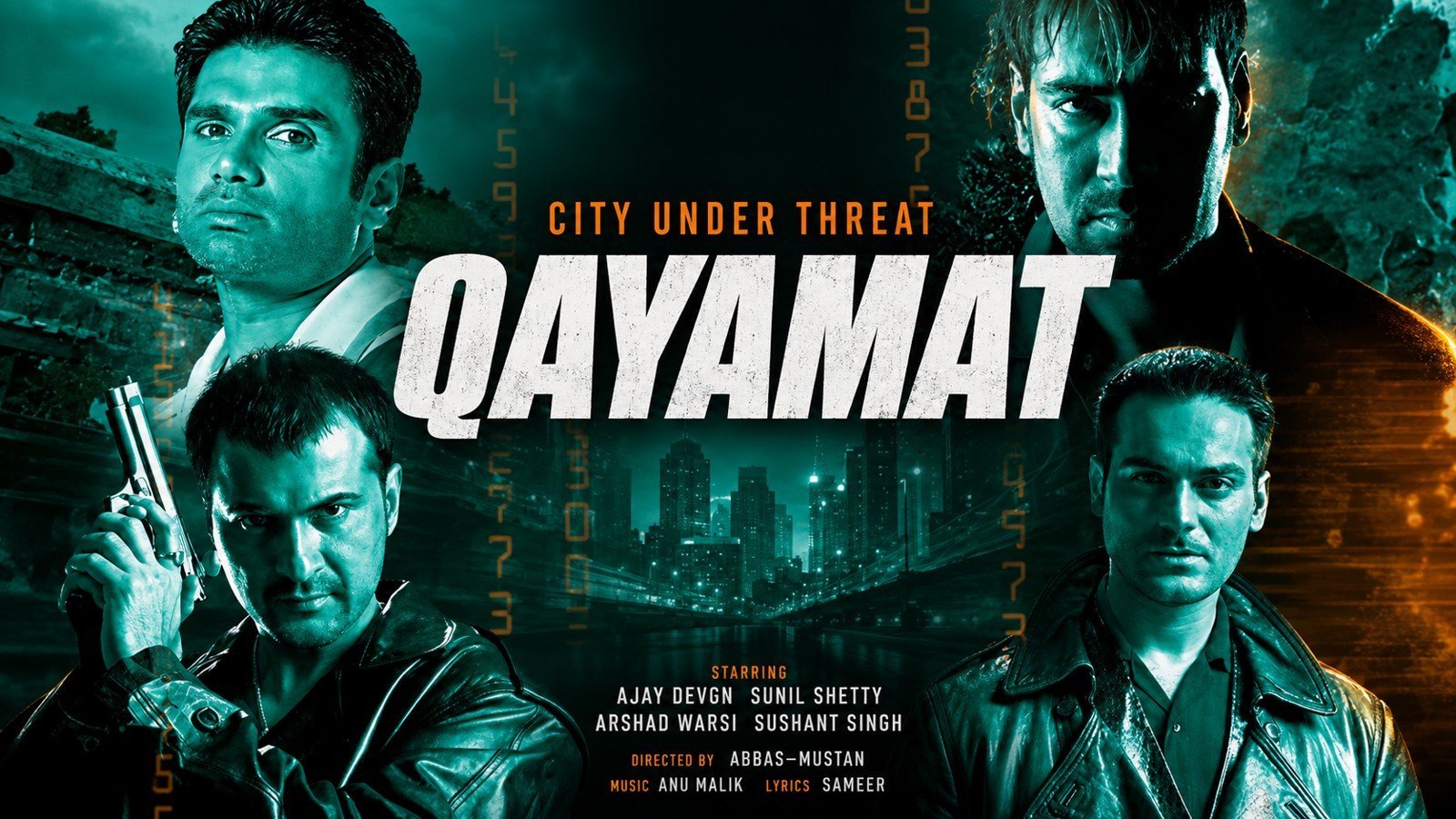
Qayamat (2003)
Cast: Ajay Devgun, Suniel Shetty, Sanjay Kapoor, Arbaaz Khan, Neha Dhupia,
Director: Harry Baweja
Music Directors: Nadeem Shravan
Synopsis: Bollywood does the Bruckheimer thing - loud, mindless, orgy of violence
Reviewed by: Faiz Khan
The sepia-tinted opening credits of Qayamat attempt to convince us that something dark and profound is about to unfold. Slow-motion drops of water fall artistically, mysterious prisoners are inexplicably gunned down and director Harry Baweja does everything possible to create an atmosphere of impending doom.
The sequence is undeniably stylish.
It also has remarkably little to do with the rest of the film.
That, in many ways, sums up Qayamat perfectly.
It is a film far more interested in style than substance, borrowing liberally from Hollywood action cinema—particularly Michael Bay and Jerry Bruckheimer's The Rock—while replacing suspense with relentless noise, frenetic editing and enough explosions to satisfy even the most undemanding action fan.
The story wastes little time.
We are introduced to Akram Sheikh (Suniel Shetty), the obligatory upright Muslim police officer, who is hot on the trail of a terrorist cell. Bursting dramatically into their hideout moments too late, he surveys the evidence with Sherlock Holmes-like precision. There are three terrorists, he deduces. One of them must be a woman because...
there are lipstick marks.
A map of Mumbai bearing the letter "L" immediately convinces him that catastrophe is imminent.
One cannot accuse the screenplay of subtlety.
Our villains are soon revealed to be brothers Abbas and Ali Rehmani (Sanjay Kapoor and Arbaaz Khan), accompanied by the seductive but thoroughly evil Laila (Ishaa Koppikar). The trio resemble comic-book villains who have wandered in from a bargain-basement Batman sequel, chewing scenery with such enthusiasm that one almost expects the word "BANG!" to appear across the screen in giant comic-book lettering.
Meanwhile, scientist Rahul (Ashish Chowdhry) has developed an antidote to a deadly virus. Unfortunately, his embittered colleague Gopal (Chunky Pandey) steals the virus and promptly joins forces with the terrorists.
One rather suspects that laboratory security could have been tighter.
The gang proceeds to seize approximately two hundred hostages during a visit to the old Elphinstone Jail, an obvious stand-in for Alcatraz, before threatening to unleash the virus unless their demands are met. Their requests are straightforward enough—vast sums of money and safe passage out of India, with more than a few unsubtle hints that Pakistan is the intended destination. References to "General Sahib" and repeated reminders about the enemies of India leave precious little to the imagination.
The government's response is hardly inspiring.
Faced with the prospect of mass murder, the Chief Minister's thunderous declaration of...
"How dare you!"
...is unlikely to strike fear into even the least committed terrorist.
The question, of course, is how anyone intends to enter the heavily fortified prison.
Fortunately, Akram Sheikh knows exactly the man for the job.
Rachit (Ajay Devgn).
The only problem is that he happens to be serving time in prison himself.
Cue the obligatory flashback.
Once upon a time, Rachit worked alongside the villainous brothers. Then he committed the unforgivable crime of falling in love with Sapna (Neha Dhupia) and deciding that perhaps a life of organised crime was not an ideal long-term career choice. His former partners respond by attempting to murder his girlfriend, leaving Rachit convinced she has died. Revenge follows, another body falls and our hero duly finds himself back behind bars.
Now emotionally shattered and barely communicating, Rachit spends much of the early film wandering about like a sleepwalker who has accidentally wandered into an action movie.
Naturally, he is the only man capable of saving Mumbai.
The elite commandos accompanying him are dispatched with alarming efficiency, leaving Rachit and the rather bewildered scientist Rahul to confront the terrorists almost single-handedly.
Then comes one of the film's more unintentionally amusing developments.
Sapna, who turns out not to be dead after all, suddenly reappears and encourages Rachit over a loudspeaker to return to her.
Apparently inspired by the sheer power of romance, he instantly rediscovers his fighting spirit, acquires almost supernatural abilities and develops an uncanny talent for producing throwing knives exactly when the screenplay requires them.
Logic quietly packs its bags and leaves.
Will Rachit save Mumbai?
Will he reunite with Sapna?
Will the terrorists succeed in carrying out their spectacularly overcomplicated plan?
And will anyone involved ever stop shouting?
If these burning questions continue to trouble you, then by all means watch the remainder of Qayamat.
To Harry Baweja's credit, he never pretends he is making sophisticated cinema.
His objective is straightforward.
Deliver a loud, energetic action film aimed squarely at the front-bench audience.
In that respect, he largely succeeds.
The pace rarely slackens, there are enough explosions to satisfy the most enthusiastic action fan and the production keeps moving briskly enough to prevent boredom from setting in completely.
Well...
almost.
I must confess that somewhere during the extended excursions through the murky corridors of Elphinstone Jail, I briefly fell asleep.
That probably tells its own story.
Despite the relentless action, everything unfolds with such mechanical predictability that genuine suspense never materialises. One set piece simply follows another until the inevitable conclusion arrives exactly as expected.
Ajay Devgn performs his duties professionally, bringing his customary intensity to a role that asks little more of him than looking brooding and dispatching villains with increasing efficiency.
Suniel Shetty is surprisingly restrained in what amounts to an extended guest appearance.
The villains, however, rapidly become exhausting. Arbaaz Khan and particularly Sanjay Kapoor mistake constant shouting and exaggerated facial expressions for menace. Kapoor, in particular, seems determined to outdo every comic-book villain ever committed to film.
Neha Dhupia is given remarkably little to do beyond looking attractive, and no number of glamorous slow-motion shots emerging from the sea is likely to disguise the thinness of her role.
As for Ishaa Koppikar, her cartoonish performance resembles a curious cross between Jack Nicholson's Joker and one of Bindu's old vamp roles, though unfortunately without possessing the charisma of either.
The soundtrack fares little better.
Although one or two songs enjoyed some popularity, they bring the narrative to a grinding halt, and by the time the closing credits rolled I struggled to remember a single memorable tune.
Ultimately, Qayamat delivers exactly what it promises.
It is loud.
It is noisy.
It is spectacularly implausible.
It borrows shamelessly from better films and substitutes explosions for excitement whenever inspiration runs short.
If all you require is two and a half hours of mindless action accompanied by generous helpings of gunfire, explosions and patriotic heroics, you could certainly do worse.
If, however, you're looking for suspense, originality or intelligent filmmaking...
I'd suggest watching The Rock instead.

0 Comments
Leave a Comment