
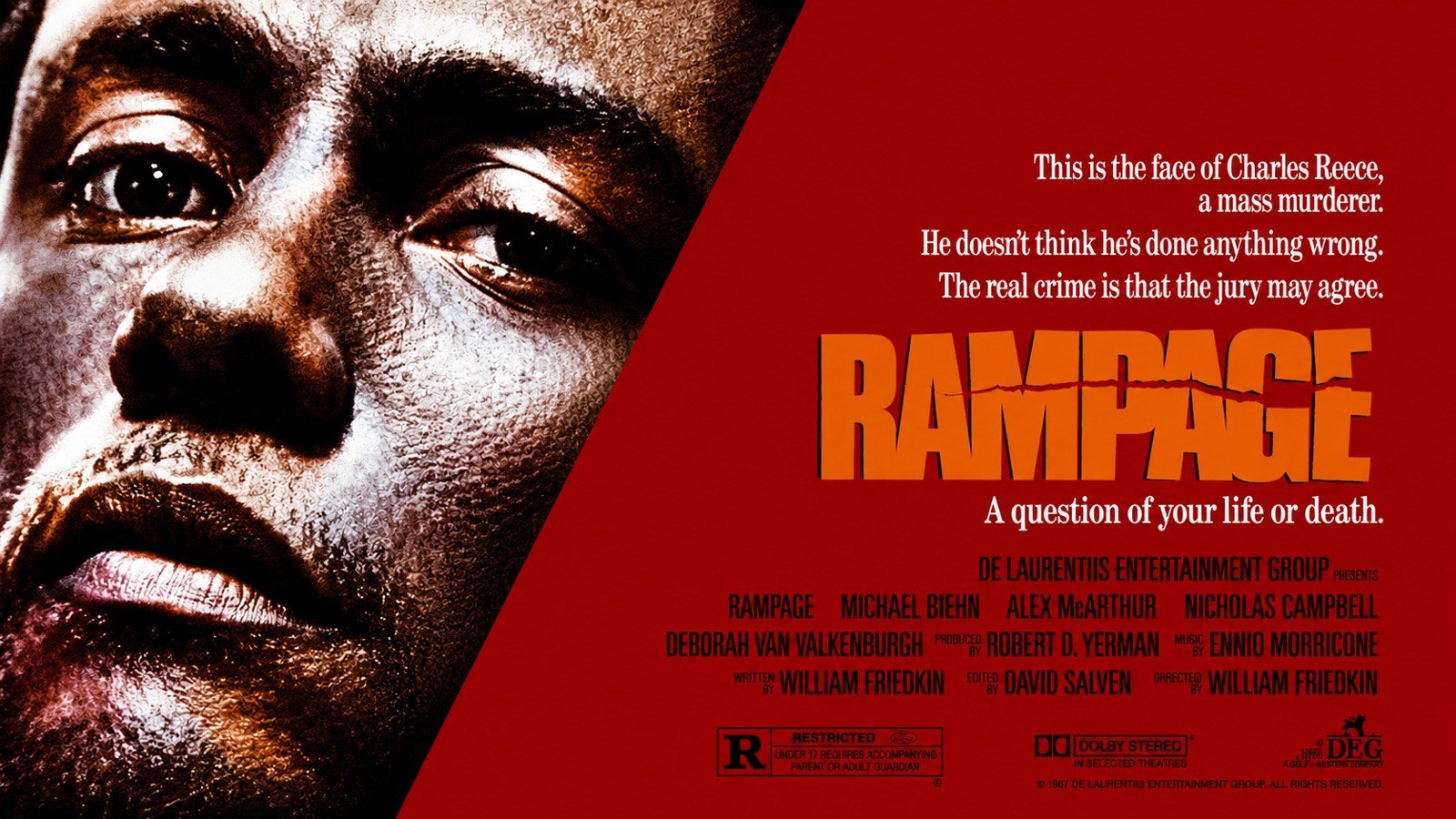
Rampage (1987)
Cast: Michael Biehn, Alex McArthur, Nicholas Campbell
Director: William Friedkin
Synopsis: Based on real-life "Dracula Killer" Richard Chase's grisly murder spree
Reviewed by: Omar Khan
"not for the squeamish" Maltin
"powerful, provocative film making" Time Out
"violent treatment" Blockbuster Guide
"sat on the shelf for five years and probably should have stayed there" Video Movie Guide
"This is not a movie about murder so much as a movie about insanity." — Roger Ebert
"Rampage has a no-frills, realistic look that serves its subject well." — Janet Maslin, The New York Times
"It avoids an exploitative tone." — Janet Maslin, The New York Times
"The movie devolves into hateful propaganda." — Owen Gleiberman, Entertainment Weekly
"Its muddled legal arguments come off as cover for a kind of righteous blood lust." — Entertainment Weekly
Retrospective assessments have generally been kinder:
"Half-serial killer thriller, half-courtroom drama, Rampage is an unnerving study on the nature of evil." — Fangoria
"A dark little thriller." — GamesRadar
A seemingly ordinary young man wanders the quiet suburban streets of Sacramento, accompanied only by the ominous ticking of an unseen time bomb. He enters a gun shop, calmly purchases a revolver and, moments later, embarks upon a spree of random, motiveless slaughter against strangers who simply happen to be in the wrong place at the wrong time.
William Friedkin's Rampage is loosely based upon the horrific crimes of Richard Chase, the notorious "Sacramento Vampire", whose descent into homicidal madness shocked America during the late 1970s. Chase appeared outwardly unremarkable, yet beneath that harmless exterior lurked one of the most dangerously disturbed killers of modern times. The premise alone contains enormous dramatic potential.
Friedkin initially seems intent on exploring precisely that. The opening passages, following the killer as he quietly prepares for his murderous rampage, are tense, unsettling and highly effective. Unfortunately, once the murders have been committed, the film abruptly changes direction.
Rather than continuing as a chilling psychological study of a disintegrating mind, Rampage gradually transforms into an earnest courtroom drama centred largely upon the moral arguments surrounding capital punishment. The result is surprisingly pedestrian. What begins as a potentially fascinating examination of madness soon resembles an extended television police procedural or legal drama.
This is especially frustrating because Richard Chase's story possesses an almost unbearable tension. Here was a walking catastrophe—a human time bomb drifting anonymously through ordinary suburbia, his mind consumed by delusion while his outward appearance remained deceptively normal. The idea is genuinely terrifying, yet Friedkin never fully exploits its psychological possibilities.
The performances are generally competent without being exceptional, although Alex McArthur leaves a strong impression as the Richard Chase-inspired Charles Reece. His vacant stares, detached manner and matter-of-fact recollections hint at the profound mental disintegration lurking beneath the surface, and his performance is easily the film's strongest asset.
Watching Rampage also prompts inevitable comparisons with Friedkin's remarkable earlier career. That the director of The Exorcist should produce something this dramatically ordinary is difficult to comprehend. While The French Connection deservedly remains another major achievement, much of Friedkin's subsequent output has struggled to approach those lofty standards.
Ultimately, Rampage is less a bad film than a deeply disappointing one. A subject possessing immense psychological fascination and genuine horror is gradually smothered beneath an uninspired legal drama that never comes close to fulfilling the promise of its opening act. One cannot help feeling that Richard Chase's tragic and terrifying story deserved a far more compelling film.

0 Comments
Leave a Comment