
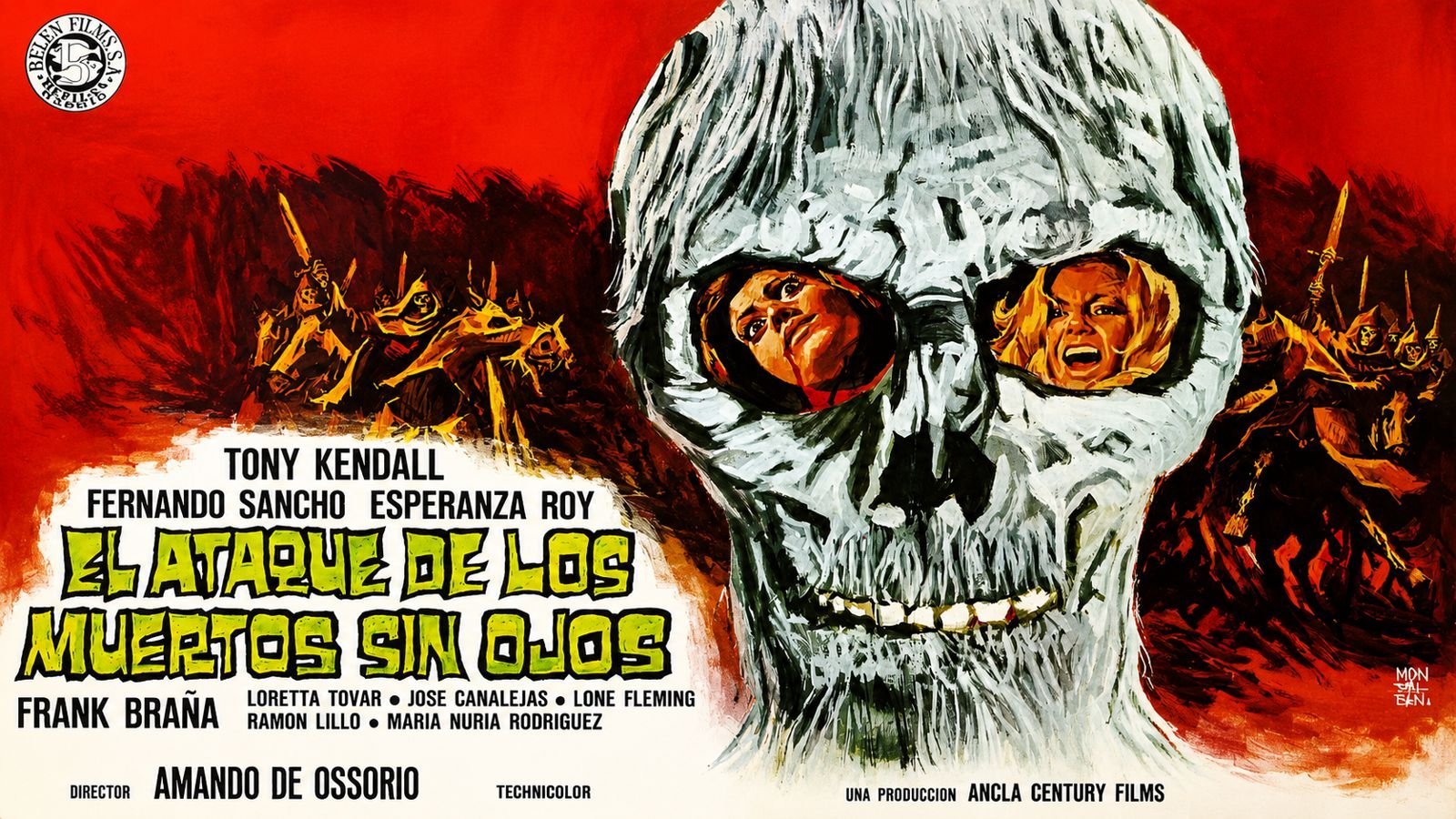
Return of the Evil Dead (AKA Return of the Blind Dead) (1973)
Starring: Tony Kendall, Fernando Sancho, Esther Ray, Frank Blake, Lone Fleming
Director: Amando De Ossorio
Synopsis: murderous Templars wreak vengeance upon a village that opposed them
Reviewed by: Omar Khan
"Less a sequel than a complete re-imagining of the first film." — Paul Corupe, DVD Verdict
"The Knights Templar are in virtually every scene." — Adam Tyner, DVD Talk
"Pretty much everything worthwhile about the original is discarded." — Adam Tyner, DVD Talk
"Though Return lacks the charming simplicity of the first Blind Dead film, it does sustain a gradual building of tension more successfully than Tombs." — Peter Dendle, The Zombie Movie Encyclopedia
"A pessimistic vision in which youth and beauty are always destroyed." — Jamie Russell, Book of the Dead: The Complete History of Zombie Cinema
"Sex becomes nothing more than prelude... that brings us ever closer to the final end." — Jamie Russell
Buoyed by the unexpected worldwide success of his zombie epic Tombs of the Blind Dead, writer-director Amando de Ossorio hurried back into production, hoping to keep both the magic—and his bank balance—very much alive.
This time, proceedings begin with a buxom brunette being abducted by the dreaded Knights Templar, who drag her back to their lair, intending to feast upon her blood. Unknown to the undead marauders, however, an enraged mob has followed them. The townsfolk storm the Templars' stronghold, set the knights ablaze and gouge out their eyes with burning torches before consigning them to oblivion. As they perish, the Templars vow vengeance, reminding their executioners that death is no obstacle to immortality.
Five centuries later, the town of Berzano prepares to celebrate its famous victory over the accursed knights with a lavish festival. Unfortunately for the revellers, the Blind Dead have chosen this very occasion to rise once more from their mouldering graves and settle a score that has remained unpaid for five hundred years.
De Ossorio wastes little time reintroducing his unforgettable creations. The first victim is an oily rogue played by an actor with the curious distinction of being killed by the Blind Dead twice, having already met his end in the original film. Even more pleasing is the return of María Elena Arpón, star of Tombs of the Blind Dead, although sadly, she is playing an entirely different character this time.
No sooner do the festivities begin than the Templars thunder into town on horseback, sealing every escape route before methodically carving their way through the terrified population. This time, they are not merely searching for fresh blood—they intend to wipe the town from existence. A small group of survivors eventually barricades itself inside a church while the undead horsemen slowly close in.
As in the original film, the slow-motion shots of the eyeless Templars advancing relentlessly towards their victims remain wonderfully eerie. Indeed, these sequences continue to define the entire series and are accompanied once again by Antonio García Abril's magnificent, ominous score. Unfortunately, much of the atmosphere dissipates once the film descends into extended battles between villagers and zombies. The supposedly invincible Templars suddenly begin falling like ninepins whenever grenades or sufficient manpower are thrown at them, diminishing much of the supernatural menace that made them so unforgettable in the first place.
The slow-motion attack scenes remain the film's greatest strength. Between them, however, De Ossorio fills the running time with largely uninteresting subplots involving characters in whom the audience has little emotional investment. Unlike Tombs of the Blind Dead, where one genuinely cared about the central characters, here one often finds oneself wishing the Templars would hurry up and dispatch them.
Equally unsuccessful are the repeated attempts at comic relief. The humour sits awkwardly alongside the horror and repeatedly undermines the atmosphere rather than enhancing it. Gore remains relatively restrained, although the occasional hacked-off limb provides welcome compensation.
Perhaps the film's greatest handicap, however, is not one usually associated with criticism—the dreadful English dubbing. While Tombs of the Blind Dead largely escaped this fate, all three sequels suffer badly from intrusive post-synchronisation, and much of their atmosphere evaporates as a result. Watching ancient Spanish knights speak in broad American accents is enough to shatter any illusion the films have painstakingly created. Subtitles would have served these productions immeasurably better.
Return of the Evil Dead certainly has its moments, and whenever the Blind Dead ride through the mist accompanied by Antonio García Abril's haunting score, the series briefly recaptures its former glory. Sadly, those inspired moments are separated by too many pedestrian stretches where the pace slackens alarmingly. A respectable Euro-horror sequel, certainly—but never the riveting classic that Tombs of the Blind Dead proved to be. One had expected rather more.

0 Comments
Leave a Comment