
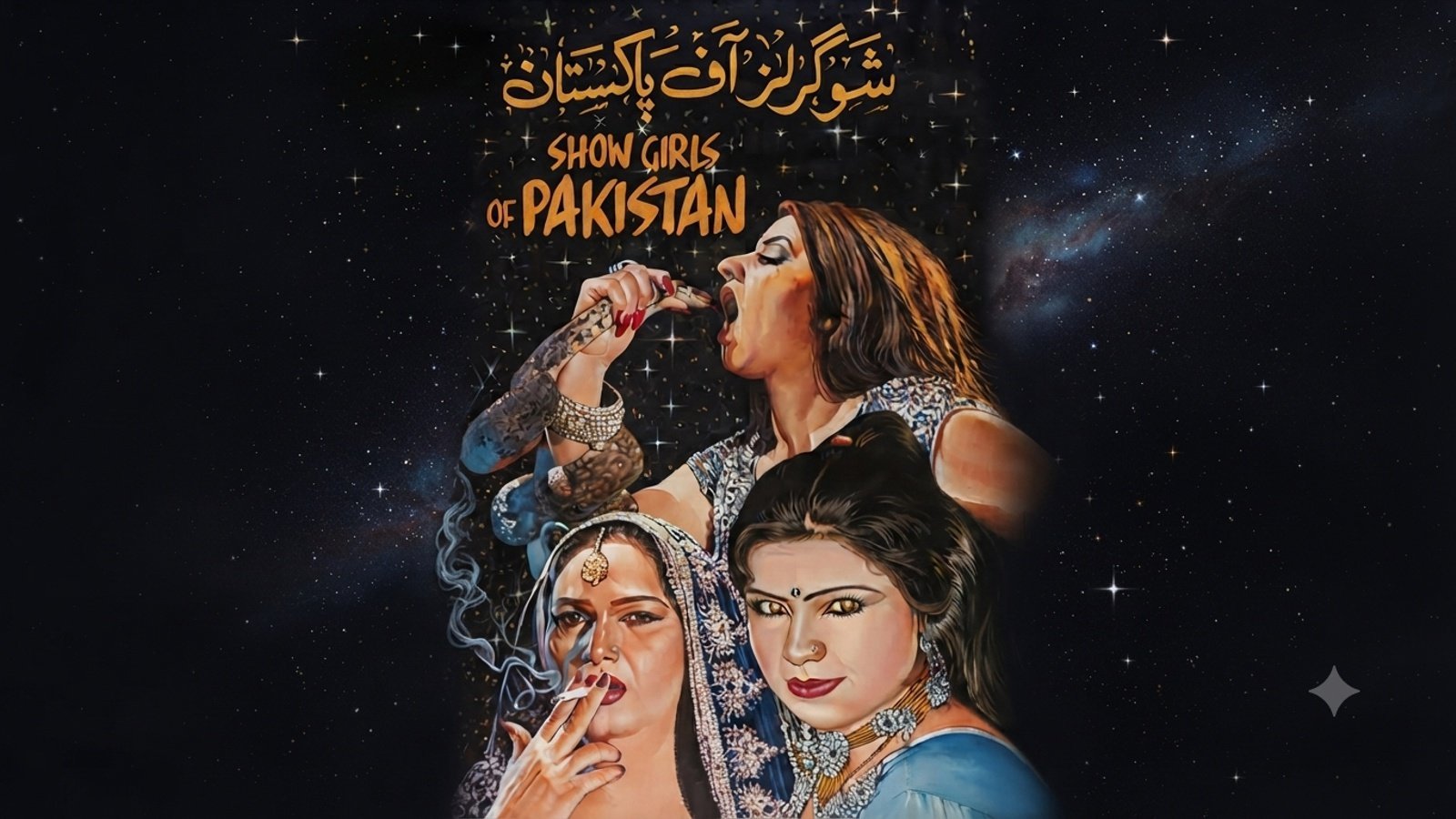
Showgirls Of Pakistan (2020)
Cast: Afreen Khan, Reema Jaan
Director: Saad Khan
Synopsis: An exceptional film that introduces us to the side of Pakistan we prefer to pretend doesn’t exist!
Reviewed by: Omar Khan
Showgirls of Pakistan (2020) is a startling documentary that exposes the vice-like grip of patriarchy on Pakistani society. It heralds the few brave souls spirited enough to swim against a tsunami of hate and intolerance. A labour of love, passion, and devotion, director Saad Khan gives us an honest depiction of a fundamental aspect of life that we prefer to whitewash in Pakistan.
Many of these realities will be too brutally close to a nerve for us ‘civilized Pakistanis’ to digest. It’s easier to pretend away the exploitation of women and a thriving, lucrative sex trade in the country.
Showgirls of Pakistan begins by lulling you into a false sense of security with the late actor Agha Talish’s voice, providing a soothingly familiar verse from the Quran in his inimitable manner. This plays out over an ominous backdrop of a divinely tacky digital night sky filled with twinkling stars – a perfect throwback to the dawn of digital wizardry in Pakistan. It’s a template with a lasting ‘impect’ on Pakistan’s visual culture. Just as you almost expect Space Invaders to explode from the screen, we are whisked away to a set of freshly painted toes, compelling enough on their own and a foot fetishist’s wet dream. We hear the voice of a woman addressing her ‘sweet, sweet fans’ as the camera lingers on lovingly at her glossy toenails, hot pink and immaculately on point. The viewer can tell she has a fair notion of how to cultivate a sizable online following. They love a ditzy airhead; she is canny enough to play along. And then suddenly, Afreen Khan thunders into action onto the stage. She is the ‘supperstar’ of Punjab’s ‘heaving theatre’ scene. The men go wild, roaring their approval and greeting the star with rapturous and unbridled joy. Her presence brings about the WMD (Weapons of Mass Destruction) levels of repressed, pent-up testosterone. It’s midnight, and the show has just begun.
This world of the ‘people’s entertainment’ is far from the polite poetry readings, ghazal renditions, naat recitals, and beautiful calligraphy exhibitions held just down the road for wealthy folks. The songs Afreen and other dancers perform mirror the cheap and sexy pyrotechnics on stage. For these bawdy numbers, there can only be one voice: Naseebo Lal, the sweet, diminutive dame who belts out the most deliciously risqué numbers that get Pakistan’s many custodians of morality all hot, bothered and sweaty under the collar. Lal, one of the greatest singers this nation has ever produced, has been the victim of numerous witch-hunts. She has been previously banned from earning a livelihood and found guilty of spreading ‘obscenity’. She doesn’t write any of her songs and sings the words as written by men, for men, songs describing the flavour of ripe melons bursting with sticky juice or a bunch of juicy berries swaying gently in slow motion. Or plenty of churning thick fresh cream, lassi, and maybe a delicious sugar cane ready to be sucked dry.
For artists like Afreen, the stage is a pipeline to escape the suffocating poverty around them and also a means to provide for their loved ones. Afreen knows her shelf life is limited, and she must cash in while the going is good. Those blessed with marketable looks and skills like her can eventually use their popularity to ask for a better cut of the profits. She knows that. The golden goose can call the shots but only within limits. She best not flap her wings too much or risk getting them hacked off entirely. In a scene where Afreen discusses rates
Showgirls Of Pakistan backstage with her fellow dancers, we see that men control the stage bookings and private party circuits. Naseebo Lal’s and Afreen’s jobs remain safe if they follow the rules. Their opinions or hopes do not exist and are only there to be exploited.
Occasionally, Afreen grows weary from all the hate, violence, and hypocrisy around her. Barriers are constantly placed in her way, but she remains fiercely determined to own and control her destiny. She is a fighter; she is from the people and of the people but not a name familiar to the ‘decent’ Pakistanis who studied at proper schools for gentlemen—the kind who can and would sing along to Adele and Coldplay in the car.
As the film goes on, there is a quiet sense of dread. The kind of dread that treads behind a self-determined woman like Afreen.
For a stage dancer to make the mistake of being self-determined immediately puts her life in danger. The long list of fatalities over the years is a chilling reminder.
The next segment of the film follows another woman swimming against the tide infested with male sharks seeking blood. Uzma Khan’s story is another tale of a woman born into desperate poverty and whose only ticket out of hell was her pleasant looks and appeal to men. She eloped at 13 and, within a few years, was used and thrown out by a husband, who kept the daughter born to them. She has not been allowed to see her flesh and blood. Ever. Just another harsh reality with which Uzma has to learn how to cope. Meanwhile, Imran, her boyfriend and manager, book her for private shows, including trips to Dubai, where she performs at one of many ‘Indian and Pakistani’ bars.
These women spend months in Dubai, imprisoned in a room with impounded passports and are never allowed out of their cells except to perform at night in the dance bars. As one might expect, the boyfriend/manager thing doesn’t pan out well. Eventually, things sour between Uzma and Imran. He receives a call from her neighbour claiming she had another man stay with her overnight, and they break up. Sometime later, Uzma finds a bag of hash planted in her luggage at the airport. She reacts furiously to his two-timing, and he responds with sabotage. All this blows up horribly, with Imran plotting revenge in an appalling style. The conversation between Imran and his hitman with connections to the police is chillingly familiar and a grim reminder of what many working-class women must face.
Ultimately, Uzma ends up playing the game and winning. Images on screen celebrate her unrelenting power with visuals of classic desi rape-revenge dramas, and the kind which usually ends in male genitals being hacked off in the style of I Spit on Your Grave. It’s a game fraught with violence and danger, but this time, for once, the woman stands firm and fights her battle with everything available to her. This is accomplished despite a plot involving the police to brutalize her, the way it is done to most poor women who dare to stand up to a man in a toxic society. Uzma Khan played with fire and survived, but the question poses itself — how long is it before she also joins the long list of women whose lives have been snuffed out by men who couldn’t tolerate their courage to survive and make a living?
The third and final story is about a member of the ‘third gender’ or Khawaja Sira community, which has existed for centuries in this part of the world. Reema Jaan is a stage performer whose best days are behind her. She struggles to make a living as the stage shows dry up, leaving her to hit the streets to find a wedding or a newborn to bless. She does this hoping that some money is eventually thrown in her direction. It’s a huge comedown from the heyday of her headlining theatre shows, when she appeared alongside big movie stars like Madiha Shah. Reema also made a foray into films during the height of her popularity, but time has taken its toll, as well as the dubious politics and control within her community. Reema is told that her very existence is at the behest of a community elder who claims to ‘own the streets’ where she has been trying to earn a buck. Her Guru has now turned against her because they
Showgirls Of Pakistan feel she is not paying a large enough cut of her earnings and, in response, has her banned from working the streets. It’s evident that if Reema is seen operating on the roads marked by the Guru Don, she will be taught a lesson and replaced with more compliant disciples. In a video clip, we are shown the brutal treatment of those who dare not follow the line delineated by the Gurus. Against all the odds, in a hostile and unaccepting environment, Reema carries on, which is in itself a triumph of sorts. Her journey is a bittersweet one. It’s an energysapping struggle, yet her spirit, courage and resilience see her through. She radiates the warmth of a kind, vulnerable, proud, and determined human being. There is a sense of hurt at the cards fate has dealt her, yet she soldiers on, often with a smile and a clear conscience.
But God helps you if you are at the receiving end of one of her tongue lashings as she displays an astounding command over cussing in Punjabi, a language that has made an art out of the outrageously graphic insult.
The merging of material from social media with footage shot through conventional ways lends the film a magnetic insight into the unfiltered world of the characters on screen. There is an almost voyeuristic delight in watching things unfold — eavesdropping on fascinating environments of intrigue, delight, and at times horror.
The true masterstroke of this film was to resist having a voiceover of any sort during the entire movie. This adds considerably to the film’s authenticity and truth. Like the best of any fly-on-the-wall documentary, it allows the viewer to interpret the information through their lens. To absorb the impact of the cold hard evidence and react.
The visuals are memorable – Afreen’s Reptile Act, Reema Jaan smouldering to Madam Noor Jehan in the credit sequence, little observations and gestures that capture the mood, the lingerie in the markets, the seductive live streams, and the painted toes, among other things. Reema Jaan’s early morning torrent of abuse is a hernia- inducing moment of unadulterated joy. The series of drone shots of women swirling away on rooftops, throwing around their hair with abandon, lost and liberated, are perhaps the most ethereal moments. The sights, sounds, and imagery are all framed within a deliberate kitschy template that breathes life, soul, and vigour into the film. The soundtrack is magnificent, and art director Joey Chriqui’s work significantly brings the film its tone and texture. This is the insight and perspective that only someone who is looking in from the outside can get. This is mainly expressed in those Space Invader graphics, Urdu calligraphy, and classic Lollywood sound effects. It’s a telling contribution.
In a world tinged with delusion, some believe that all the ‘vulgarity’ of the mujra world has been imported and imposed upon us by our devotion to Bollywood and Hollywood. We are the so-called innocent victims of a heinous plan to sully our purity. It hardly comes as a surprise that the Pakistani Censor Board endorsed a film in 2006 titled Saturday Nite, in which a mass murderer of stage dancers is ultimately lauded by the police for cleansing society and is set free as a hero. A clip from this film appears in Uzma’s story as a direct reminder of the threat of state-sanctioned moral vigilantism that is at hand.
When every film from Pakistan is slanted to reflect an image that must be endorsed and approved by the powers, here is a film that is brave enough to tell its tale without fear of persecution. No judgmental or patronizing messaging tells you what you are supposed to make of what you see. Often shocking, often brutal, I have yet to experience a more honest depiction of the beautiful yet imperfect piece of land we call home.

0 Comments
Leave a Comment