
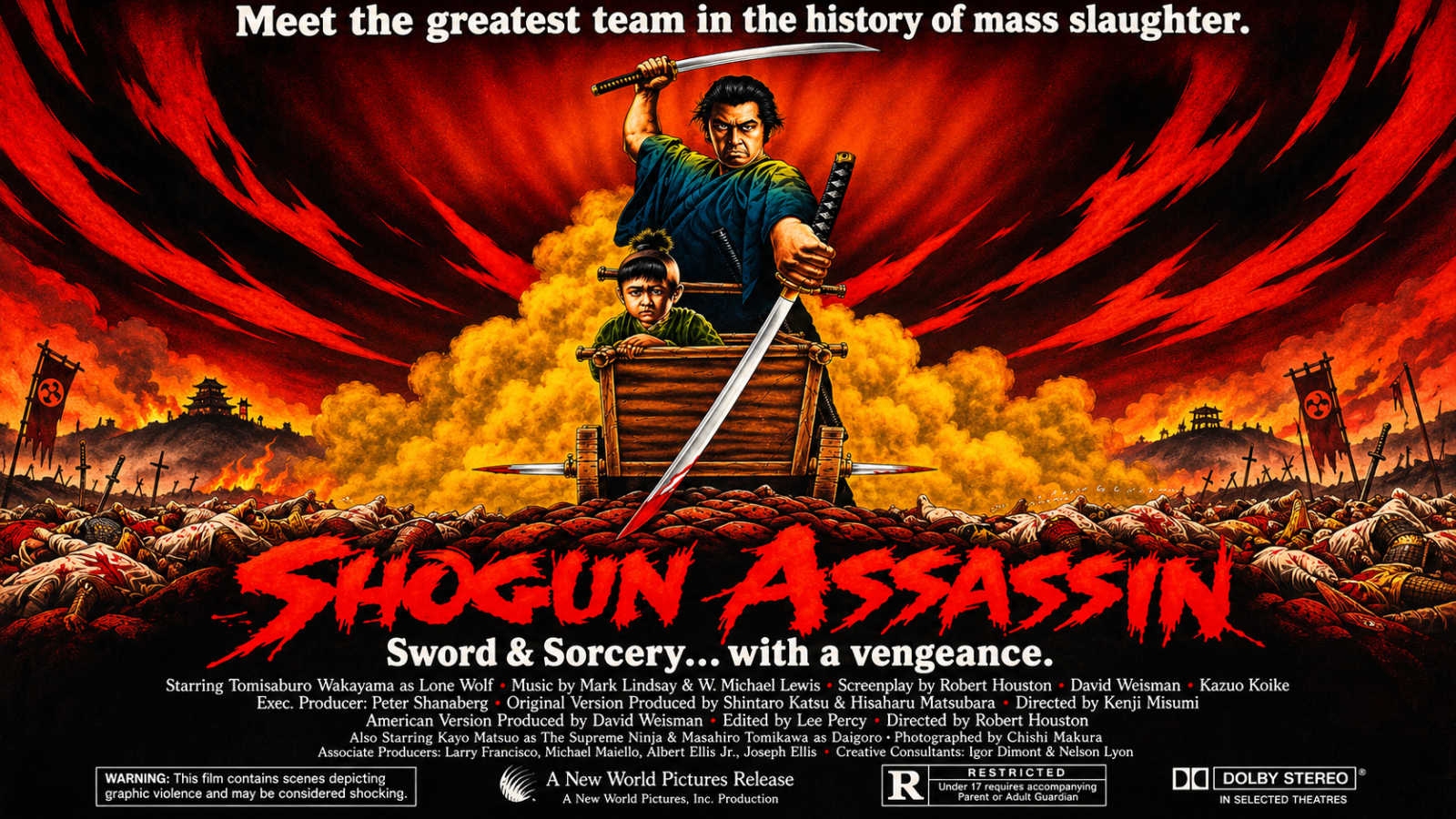
Shogun Assassin (1980)
Cast: Tomisaburō Wakayama, Kayo Matsuo, Minoru Ôki, Shôgen Nitta
Director: Robert Houston and Kenji Misumi
Nutshell: A disgraced samurai and his young son carve a spectacularly bloody path across feudal Japan, pursued relentlessly by the Shogun’s assassins.
Review by Omar Khan
Shogun Assassin became quite the thing in Britain in the wake of the Video Nasties crisis. The film was talked about in the same breath as the “Nasties” and flirted with the notoriety of an outright ban, despite never earning the dubious honour of inclusion on the official list of banned Video Nasties. VIPCO, the company that released the original VHS tape of the film, cleverly used its notoriety to their advantage, plastering the words “BANNED since 1983” across the video cover and ensuring that the film attracted considerable attention. The early 1980s were a time when the official censors were several steps behind the burgeoning video boom, and numerous titles flooded the market without having been officially certified by the Censor Board. These became known as the “pre-cert” titles and were highly sought after at the time, becoming even more desirable in subsequent years. Many controversial films remained banned or unavailable until the James Ferman era at the censor board eventually came to an end and attitudes began to change, with some wonderful films gradually becoming legally available in Britain, including The Exorcist, Straw Dogs and The Texas Chain Saw Massacre. Shogun Assassin made quite a name for itself during the early 80s, with newspaper articles eagerly citing its extraordinary body count and the gallons of blood unleashed during this spectacular slice of mayhem. Yet it was never officially placed on the coveted Video Nasties list, gaining considerable notoriety simply through its association with the whole phenomenon. The film did extremely well on VHS and became a must-see item for those who actively sought out controversial cinema, where the whiff of censorship or prohibition was often enough to guarantee an eager audience.
Shogun Assassin is essentially fashioned from two films: Lone Wolf and Cub: Baby Cart at the River Styx (1972), together with approximately twelve minutes of footage from Lone Wolf and Cub: Sword of Vengeance. The films themselves originated from the hugely popular Japanese Lone Wolf and Cub manga series. The ever-canny Roger Corman recognised the material’s potential, and the film eventually found its way into American hands, where it was drastically reworked for Western audiences. The two original films were cut together, the soundtrack was changed, a new voice-over was added, and the entire thing was dubbed into English. The resulting film was released theatrically in the United States in November 1980 through Roger Corman’s New World Pictures and found a natural home on the grindhouse circuit, where it exceeded expectations and connected immediately with its target audience. Over the years its reputation continued to grow, finding admirers among a later generation of filmmakers, most notably Quentin Tarantino, whose affection for this sort of cinema is writ large across the Kill Bill films, with Shogun Assassin itself famously turning up within Kill Bill: Volume 2.
The film itself is a period piece set in feudal Japan, where the land is ruled by a Shogun who has grown old, sick and increasingly suspicious of everyone around him. He feels his grip on power beginning to slip and responds with brutal repression and killings on a massive scale. Cruelty and violence reign supreme, and there are those who have begun to believe that the Shogun has simply gone mad, consumed by paranoia and evil.
Our hero, the Lone Wolf, is at this time the Shogun’s official executioner and decapitator, but the ruler’s suspicion eventually turns upon even his most loyal servant, and he sends his deadly ninjas to destroy him. The executioner’s wife is murdered, leaving him alone with his infant son, Daigoro, and setting the pair on a path of retribution. They begin a journey fraught with danger as the Shogun’s accomplices unleash their deadly forces upon them in wave after wave, yet the resilient father and his little son repeatedly survive the onslaught. One after another, trained assassins, ninjas and fighting forces are sent to destroy the rebellious Shogun’s executioner, only to be dispatched with his superior swordsmanship and formidable expertise. The film soon becomes a whirlwind of sequences in which Daigoro and his father are attacked from every direction, while the Lone Wolf methodically nullifies every threat that comes their way. There is much hacking of limbs, impaling, decapitation and fountains of blood spraying and spouting in all directions. In the pre-CGI days it is all achieved with such terrific glee and enthusiasm that any lack of realism simply adds to the fun. The body count rises to astronomical levels as wave after wave of attackers are sliced, diced and eliminated until, finally, there is the ultimate showdown with the three deadly brothers known as the Masters of Death.
The film is essentially a succession of stylised fight sequences filled with comic-book blood splatter, with fountains of red spewing liberally in every direction. The gore is deliciously comical and gratuitous, and at a running time of around 85 minutes the film never outstays its welcome or becomes repetitive and dull, despite the plot being built largely around one fight sequence after another. Daigoro’s voice-over works surprisingly well, even though much of the time he is simply stating the obvious. The words are cleverly chosen and suitably childlike, giving the film a strange fairy-tale quality amid all the carnage.
Shogun Assassin is an enormously entertaining romp, helped immeasurably by the manner in which everything is played. There is never any knowing comedy or winking at the audience; the whole thing is performed with complete, straight-faced earnestness. The action sequences are delirious yet expertly staged, and the gore and spectacular arterial jets of blood are simply icing on the cake. It is hardly Kurosawa, nor does it pretend to be, but as a comic-book tale of vengeance and survival it is made with style, verve and tremendous energy. The action comes thick and fast, the pace rarely falters, and there is always another colourful opponent waiting around the corner to be dismembered.
That the film has endured as a cult classic is no surprise. It has no pretensions to greatness and, ultimately, it is not a great film. What it unquestionably is, however, is great fun.

0 Comments
Leave a Comment