
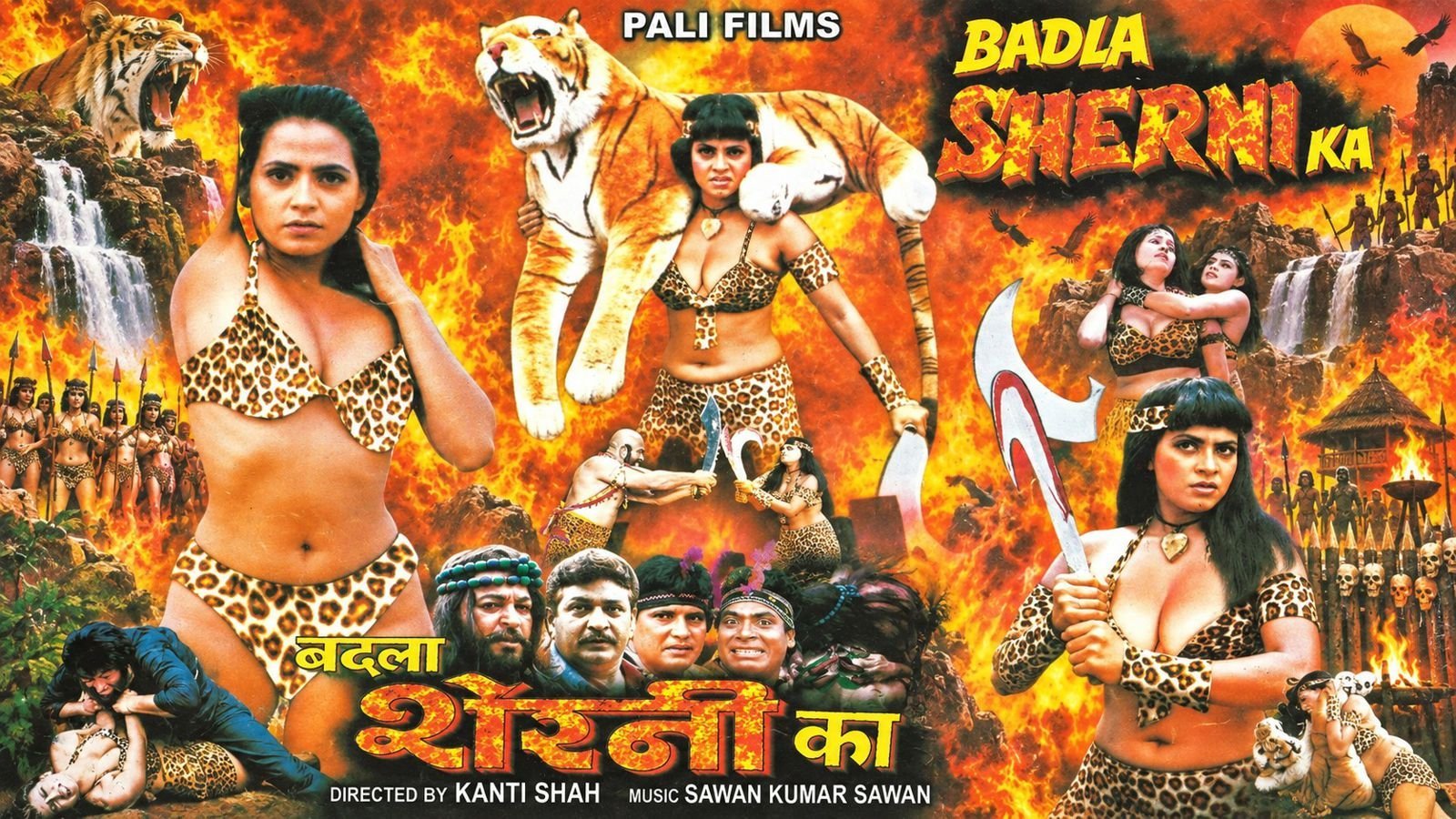
Badla Sherni Ka (2001)
Cast: Sapna, Amit Pachori, Anil Nagrath, Vinod Tripathi, Dimple, Praveen, Gurbachan Singh, Arun Mathur, Seema, Randhir Singh, Shakkal
Director: Kanti Shah
Dialogues by Bashir Babbar
Nutshell: Another delirious mashup of Munnibai, Jungle Ki Nagin and others. Stupendously crude dialogue, fabulous production values, and bombastic acting—exhilarating, heady stuff.
Review by Omar Khan
Viewers of Kanti Shah's epics will be familiar with Badla Sherni Ka within seconds of its opening. It features the same actors, the same locations, the same props and costumes, identical dialogue and, quite often, virtually identical scenarios. It is all essentially a mashup of Kanti Shah’s other epics, with a few minor tweaks here and there. Sometimes the character names are changed, although many remain exactly as they were in previous instalments.
It would not be inaccurate to call these films episodes, because they are essentially the same film shaken up and stirred, with the ingredients, methodology and formula remaining largely unchanged. It seems very much as though Kanti Shah, with visionary foresight, shot a dozen films using the same cast, crew and locations.
In the 1960s, Hammer Films would make back-to-back productions on the same sets and locations—The Reptile and The Plague of the Zombies, for example—which was economical and saved them a great deal of money. Kanti Shah appears to have gone one better, merely switching a few character names and costumes here and there, using one crew to churn out a dozen or so films while apparently paying for the production of only one.
Absolutely inspired.
In this episode of the Kanti Shah opus, we have Sherni (Sapna), Nagin (Sapna) and Diljali pitted against Bangroo, his brother Kangroo, and a gang of poachers who slaughter animals for their skins, led by Dilawer (Anil Nagrath). All the usual side characters are present including Junior Jagdeep and his trusty sidekick.
Bashir Babbar retweaks his masterful dialogue and once again delivers some thunderous lines. Perhaps his finest moment, however, is so crude and sexually charged that it establishes entirely new standards even for a Kanti Shah production.
There is a scene in which two men and a shapely female discuss how they have choosoed one another. The men refer to how she has choosoed them, before she announces that she is perfectly capable of choosoing herself and proceeds to try—unsuccessfully. The dialogue’s relentless emphasis on who is choosoing whom, what exactly is being choosoed, and in what manner, reaches almost operatic levels of vulgarity.
Lines such as “main ne to tumhara sara choos liya,” “main apne aap ko khud choos sakti hoon” and “to phir mera choos lo” are incredulously vulgar and represent another feather in the caps of Bashir Babbar and Kanti Shah. Then there is:
“Ek ladki ne mera sara zehr choos choos ke nikal diya.”
“Jaise tu ne hamara choosa tha, waise hum tumhara choosenge.”
And the magnificent:
“Nahi, nahi, main tumhe choosne nahi doongi, kyun ke mujhe choosna aata hai aur main apna khud choos loongi.”
These and the other choosoing exchanges are among the most watched portions of the film on YouTube. Bashir Babbar plainly understood that his audience would lap up this sort of vulgarity in spades.
For anyone requiring assistance in appreciating the finer literary nuances, the Google translation of the above exchanges makes matters considerably clearer. The men speak about how she has sucked them; she responds by claiming that she is capable of sucking herself—and then attempts to do so, only to fail. The entire conversation revolves around the act of sucking, who is doing it to whom, and with what degree of enthusiasm.
Translated lines include: “I sucked you dry,” “I can suck myself,” “So go ahead and suck me,” “A girl sucked all the poison out of me,” “Just as you sucked us, we will suck you,” and “No, no, I won’t let you suck me, because I know how to suck and I’ll suck myself.”
A dubious achievement, perhaps, but an achievement nevertheless.
The action is relentless and utterly ridiculous, with Nagin aided in her adventures by a stuffed tiger named Bagheera. It is so spectacularly absurd that it becomes joyous—the sheer bare-balls audacity of Kanti Shah operating at his most magnificent.
Meanwhile, tensions begin to flare between Nagin and her erstwhile friend Diljali, who has developed a soft spot for the earnest, hunky cop Shankar (Amit Pachori). Nagin, herself in love with Shankar, decides to teach Diljali a lesson for encroaching on her boyfriend she will never forget.
Cracks begin to appear in their once-solid alliance. Diljali plots Nagin's downfall, but will her nefarious scheme succeed, or will Sherni—or Nagin—find a way out?
The second half of what has already been a hugely entertaining film is therefore set up with mouthwatering potential. The enmities, love triangles, collapsing alliances, and betrayals culminate in a thrilling, sustained climax.
Sapna is as excellent as ever in her double role as Sherni and Nagin, while Diljali makes a formidable friend-turned-foe. The assorted villains are in vigorous form, with Anil Nagrath particularly potent and, of course, Bangroo and Kangroo as dastardly as ever.
The hair-raising finale is suitably rousing, with Nagin and Sherni decimating Bangroo and his cronies. But Shankar is captured, Diljali remains as determined as ever to claim him as her conquest, and the battle is far from over.
Will Sherni and Nagin prevail, or will Bangroo and his newest accomplice, Diljali, finally win the day?
Badla Sherni Ka is high farce of the most delicious kind. Sapna and the supporting cast are all in top form, the fights are brilliantly staged, and Bagheera the stuffed tiger repeatedly threatens to steal everyone’s thunder.
The film is aimed squarely at the lowest reaches of lowbrow cinema, while Bashir Babbar’s dialogue remains quite literally below the belt. It is another forbidden secret recipe regurgitated from the patented Kanti Shah formula, yet somehow it achieves heights of absurdity most mortal filmmakers could only dream of.
Absolutely ludicrous, deranged, manic filmmaking—the kind that makes the world a better place.
0 Comments
Leave a Comment