
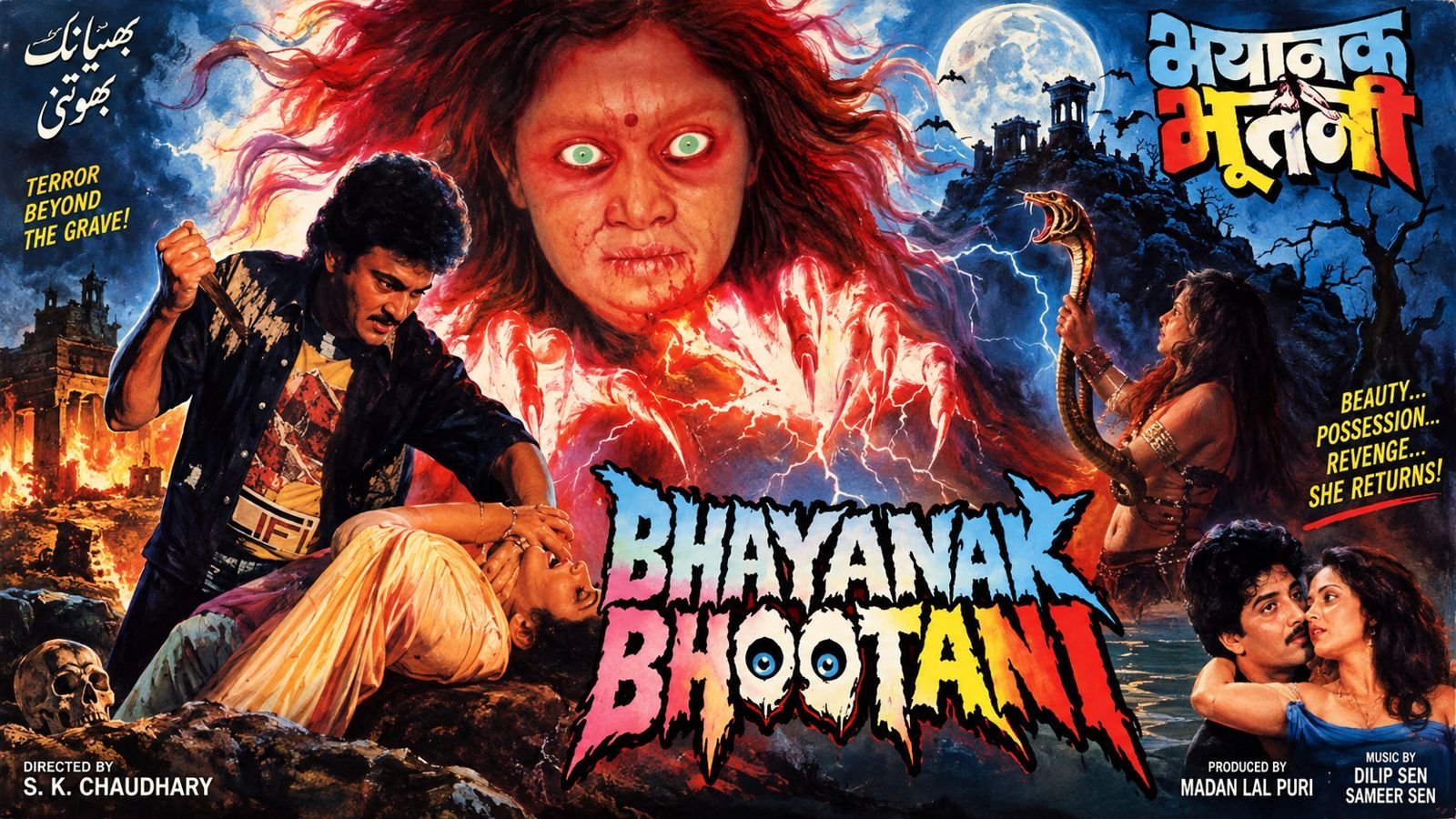
Bhayanak Bhootni (2001)
Cast: Somya, Kanta Rao, Jaya Rakhsha
Director: A.G. Baby
Nutshell: The usual tale of white sari clad vengeful spirits and possession.
Review by Omar Khan
The film begins with a fabulous title sequence reminiscent of Harinam Singh at his finest, so it comes as something of a surprise to discover that it is directed by the renowned and seasoned horror filmmaker Baby. Even more surprising is that Bhayanak, in the title Bhayanak Bhootni, has been misspelt.
The opening scene takes place during a festival at a Hanuman shrine, where three witches dance around a fire to the great amusement of the assembled devotees. Among them is Payal, a beautiful young girl who offers the temple priest a coconut for Hanuman. Unfortunately, the coconut turns out to be rotten inside, prompting the priest to immediately ask the deity’s forgiveness for Payal’s unfortunate offering.
Meanwhile, elsewhere in the locality, a bus arrives from the city and three young men disembark under the watchful eye of a distinctly shifty-looking buzzard.
Ominous signs indeed.
The city lads take rooms at the guest house run by Payal’s mother, Laxmi Devi. When Payal arrives with water, the three are thunderstruck by her beauty and begin staring and drooling over her in a deeply uncomfortable scene, particularly as Payal appears to be barely fifteen while the men are fully grown adults.
The lads soon venture out to explore the surroundings and discover the sprawling Raj Mahal, once owned by a local lord but now abandoned and falling apart. Despite its decrepit condition, the old mansion remains an imposing sight. Two of the men decide to investigate the ruins while the idiot of the trio prefers to remain outside lounging in the sun with a drink.
Descending into the vaults, the pair are soon confronted by what appears to be a plastic skull snapping its jaws menacingly. One of them nearly jumps out of his skin while his more composed companion reassures him.
Moments later, something rather more substantial emerges from the darkness.
An apparition in a white sari appears to float through the ruins while singing a song of bitterness and revenge. Their visit seems to have disturbed a disgruntled spirit, and she is not in a forgiving mood.
The ghost soon makes her way to the room where Payal and Laxmi Devi are asleep. She lies beside Payal and enters the girl’s body.
Payal begins writhing, gnashing her teeth and looking suitably ferocious while an enormous storm erupts outside. Thunder crashes, lightning flashes, the bed shakes in full Exorcist fashion and a witch cackles somewhere in the darkness.
By morning, Payal refuses to wake as usual, while Raja, one of the visiting lads, has disappeared from his bed. He is eventually discovered asleep amongst the rubble near the ruined mansion. Laxmi Devi, meanwhile, becomes increasingly unsettled by her daughter’s strange, detached behaviour.
Later that morning, Jagan, the resident creep amongst the three visitors, makes a move on Payal and is firmly put in his place by Raja. Jagan does not take the humiliation particularly well and threatens him, insisting that sooner or later Payal will belong to him.
Laxmi Devi becomes equally disturbed by the growing closeness between Raja and her daughter. After catching the pair flirting one afternoon, she drags Payal to the Hanuman temple.
The possessed Payal refuses to enter.
At the threshold, the spirit leaves her body and Payal abruptly returns to normal, with no apparent memory of her earlier behaviour. The following day she tells a confused Raja that he should stop getting overly friendly with her.
The Swami advises Laxmi Devi to take her daughter for a medical check-up and also gives Payal a protective amulet to ward off evil. Unfortunately, when she undergoes an MRI scan the amulet is removed and, in a particularly convenient development for the evil spirit, nobody remembers to put it back on afterwards.
Jagan’s mother soon arrives in the village, takes one look at Payal and decides that she would make an ideal bride for her son. Engagement plans begin immediately.
As if one lecherous admirer were not enough, another sleazy associate of Jagan also develops designs on Payal. He takes a room at the guest house and begins spying on her, eventually attempting to seduce her.
The spirit has other ideas.
In a trademark Baby horror sequence, Payal transforms into the vengeful entity and, in a scene that briefly recalls Carrie, the would-be seducer meets a nasty end in the bathroom.
The police begin investigating, with both Laxmi Devi and Payal questioned over the death. Meanwhile, Jagan’s mother takes Payal back to her home, determined to proceed with the proposed marriage.
That does not go terribly well either.
Payal once again transforms into a cackling witch and conjures up a firestorm inside the house. Jagan’s mother desperately attempts to escape but is fatally impaled by a shard of glass, bringing her matrimonial arrangements to a sudden halt.
Jagan, however, is not easily discouraged and continues with his plans to marry Payal.
What he has failed to consider is that his intended bride is possessed by an extremely vindictive spirit with a growing body count.
Events begin building towards the night of Amavas, when the local tantrik, the pujari and the assorted forces of faith prepare themselves for battle against the supernatural. Raja still hopes to marry Payal, but everything now depends upon what happens before the night is over.
Can Payal finally be freed from the spirit’s grip, or will the witch continue her campaign of death and destruction? Will the Buzzard find peace?
The buzzard, which has been keeping a suspicious eye on proceedings since the opening scenes, continues to observe events from above. The cackling ghost is far from finished, and the local holy men soon discover that defeating her will require rather more than the usual collection of chants, amulets and sacred trinkets.
Baby has ultimately made a fairly routine example of Indian low-budget horror, complete with the obligatory white-sari ghost causing havoc from beyond the grave. It is the familiar possession-and-revenge formula and offers very little that has not been seen many times before.
The performances are adequate and the effects are about as good — or as bad — as one expects from this particular corner of the genre. The film is never especially frightening, nor particularly inventive, but neither does it descend into complete incompetence.
During the final stretch, the mystery surrounding the spirit is finally explained: who she was, what happened to her and why she has returned for revenge. The revelations are serviceable rather than surprising and do little to elevate the film above the familiar.
Bhayanak Bhootni is therefore a thoroughly average addition to the genre. It runs a little too long, occasionally drags and never quite works itself into the frenzy one hopes for, but it just about holds together without plunging into full Z-grade rubber-mask territory.
On second thoughts, a few rubber masks might have livened things up considerably.

0 Comments
Leave a Comment