
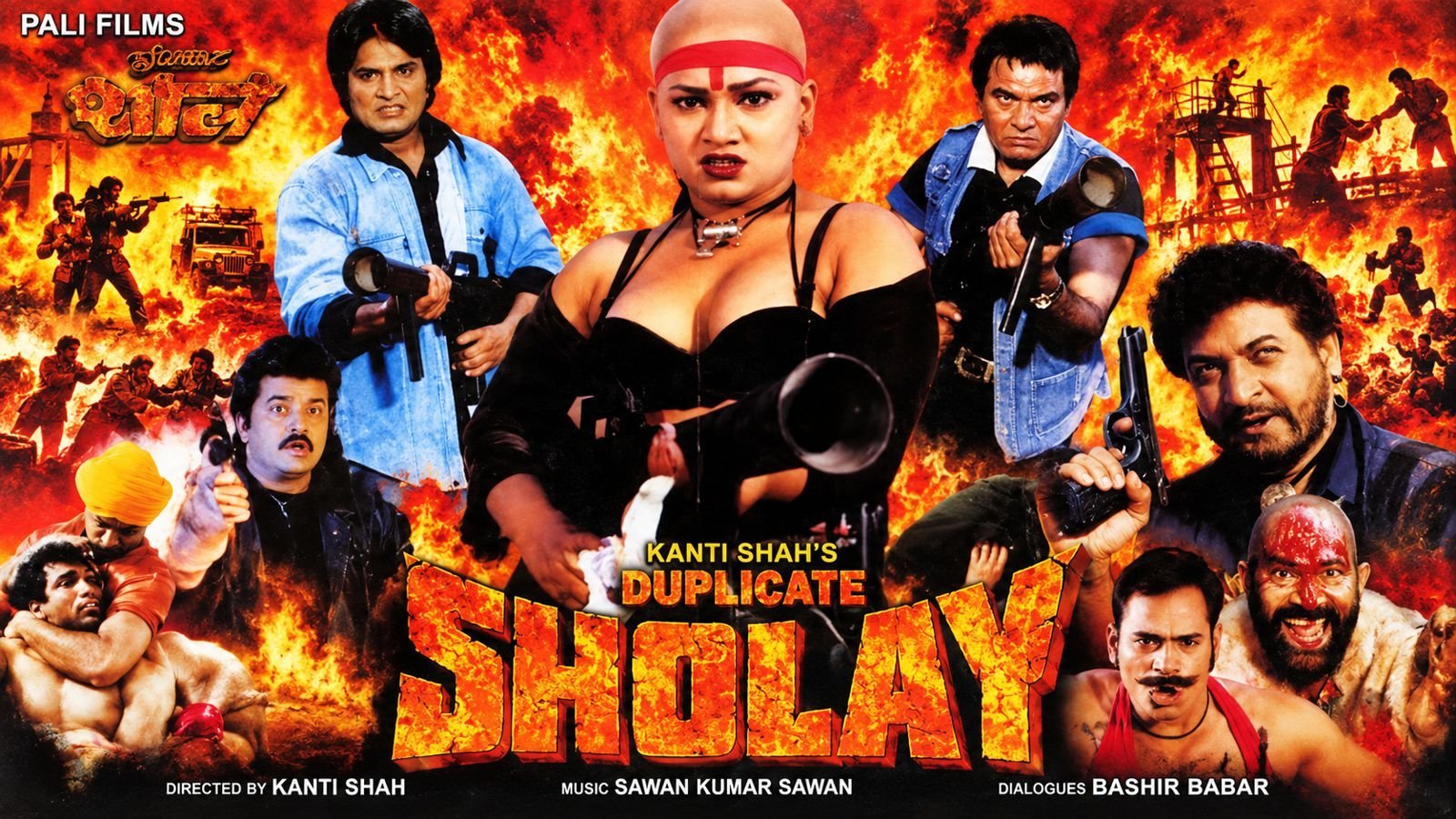
Duplicate Sholay (2002)
Cast: Dimple, Anil Nagrath, Vinod Tripathi, Robert, Praveen, Gurbachan, Arun Mathur, Seema, Shyam Bahadur, Sapna Sappu, Firoz Khan (Duplicate Amitabh), Dhananjay Singh (Duplicate Dharmendra), Tara Singh, Mithun
Director: Kanti Shah
Dialogues: Bashir Babbar
Nutshell: A quite magnificent, sprawling Epic pastiche and spoof of Sholay done with equal amounts of bad taste, style, vulgarity, enthusiasm and verve.
Review by Omar Khan
Duplicate Sholay has to be one of the most ambitious of all Kanti Shah’s endeavours over the years. It is a sprawling Spaghetti Western filmed on a lavish scale, boasting an impressive cast of Grade-A Z-listers alongside almost all the familiar Kanti Shah regulars. Their presence makes the film instantly accessible to anyone acquainted with his work and provides a peculiar sense of comfort. Sapna is here, along with Vinod Tripathi and Anil Nagrath, while much of the supporting cast consists of very familiar faces from the Sherni films and Munnibai.
The backdrop shifts from the lush jungles of the Sherni movies to a craggy, barren landscape where Gabbar Singh reigns supreme over his band of warriors. On the surrounding turf, adversaries with axes to grind wait patiently for their opportunity to avenge the atrocities they have suffered at his hands over the years.
Chief among them is Daku Chuttia, a fearless warrior who was ravaged by Gabbar and his men earlier in life. The formidable, bald warrior has vowed to remain bald until she has exacted revenge upon the beastly dacoit.
Gabbar spends much of his time delivering fiery diatribes to his associates, spewing threats and promising havoc upon anyone foolish enough to cross him. Unfortunately, he also suffers occasional bouts of terrible diarrhoea and is forced to empty his bowels in a nearby stream, causing considerable distress amongst his followers on account of the resulting stench. Nobody dares complain, naturally, because Gabbar has a dangerously short fuse and can fly off the handle at any moment.
He keeps the curvaceous and fiery Sakina as his plaything, although her duties extend far beyond merely entertaining him carnally. She doubles as a fearless warrior and is frequently dispatched across the landscape to deliver messages to his enemies. Sakina, in her flowing red dress, is a fetching sight, and it is hardly surprising that Gabbar’s fire is occasionally doused by her smouldering charms.
Early in the proceedings she is sent to deliver a message to Chuttia, only to receive a thorough thrashing and return home with her tail firmly between her legs.
Meanwhile, there is the local Thakur, a Sanjeev Kumar lookalike who wears a shawl draped over his shoulders exactly as Sanjeev did in Sholay. He cuts a permanently distressed figure: crestfallen, tormented, yet determined that one day he will finally get the elusive Gabbar behind bars. It appears to be the single overriding motivation of his existence.
Into this volatile landscape arrive two happy-go-lucky friends, Jai and Veeru—Amitabh Bachchan and Dharmendra lookalikes respectively. They are mercenaries prepared to undertake almost any assignment for a peti or a khokha—a lakh or a crore—and morality does not figure prominently in their choice of employment.
They are being escorted by the Thakur in handcuffs when Gabbar and his men ambush them. Jai and Veeru defend themselves and the Thakur valiantly and, more importantly, resist the obvious opportunity to escape. So, mercenaries they may be, but apparently there remains a shred of morality between them, and once in a while they are even capable of doing the right thing.
Impressed by their behaviour, the Thakur asks them to help him capture the beastly Gabbar and bring him to justice.
In flashback, we discover how Gabbar tortured the Thakur, and later comes the revelation that, although he possesses a perfectly functional pair of arms, he is in fact blind. Gabbar, in an act of particularly cold-hearted savagery, poked out both his eyes with his bare fingers.
Thus an alliance is formed between Jai, Veeru and the Thakur to apprehend Gabbar once and for all. It is not entirely a matter of honour, however: the two friends make it quite clear that they expect to be handsomely paid for the privilege.
Elsewhere, an assortment of characters hover around the periphery of the main storyline before eventually joining the battle against Gabbar when the chips are down. Among them are Mithun and Anil Kapoor lookalikes, while elsewhere the film unleashes substitutes for Sunny Deol, Sanjay Dutt and even a scintillating version of Amitabh Bachchan’s Shahenshah character.
There are also several gratuitous sequences devoted entirely to Gabbar’s bowel problems.
In one extraordinary scene, an emergency forces him to hurry down to the stream to relieve himself. Gabbar has developed the habit of listening to inspirational dialogue from Sholay on a cassette recorder while performing his ablutions, apparently finding himself incapable of proceeding with his excretions without it.
As Gabbar performs his Number One and Number Two in the stream, his entire entourage is forced to endure the immense stench rising from the vicinity. They accept their fate stoically, having apparently become accustomed—and perhaps even hardened—to the ordeal. Sakina, owing to her especially intimate relationship with the great man, naturally bears more than her fair share of the suffering.
Jai and Veeru meanwhile find romantic interests in Ramgarh, the village in which they have now settled: the feisty Basanti and a demure, silent, Jaya Bachchan-like beauty. There are numerous comic interludes parodying famous scenes from Sholay, all lovingly recreated and all contributing to the film’s formidable running time of more than 147 minutes—entirely appropriate, one supposes, for an epic on the grand scale of Duplicate Sholay.
Sadly, there is no proper credit or title sequence listing the film’s stars, making it frustratingly difficult to identify all the magnificent performers on display. The lookalikes are generally excellent, particularly the wonderfully convincing Mithun substitute.
The actor playing Sakina is also a tremendous scene-stealer. Several websites identify the performer as Joginder, but whoever is playing Sakina, it very clearly is not Joginder.
Bashir Babbar, an essential ingredient in Kanti Shah’s finest work, is once again in excellent form, and his dialogue is bursting with double entendres and vulgarity. Even so, it never quite descends to the almost heroic depths of absolute filth he achieved in Badla Sherni Ka.
Sapna is as dependable as ever, although this time she has considerably less scope than in many of Shah’s other films, simply because there are so many other major characters competing for screen time.
Vinod Tripathi does full justice to his duplicate Gabbar Singh, while the duplicate Jai is hysterically funny in his imitation of Amitabh Bachchan. The Dharmendra substitute playing Veeru is also impressive, although nowhere near as entertaining as his partner.
Several websites list Amit Pachori as either Shahenshah or Veeru, but I remain unconvinced. I do not believe he is playing either role—and I am not convinced he appears in the film at all.
Watching a spoof, pastiche and joke version of Sholay sprawling across more than 2 hours is undeniably a long haul, yet somehow the film just about manages to hold itself together without becoming unbearably tedious or flabby. It could unquestionably have benefited from some merciless editing, but for the most part it keeps moving and retains one’s attention.
Fortunately, Junior Jagdeep and his regular comic cohort are nowhere to be seen. Less fortunately, there is an appallingly ill-judged joke involving an AIDS patient that is in such atrocious taste that it fails to raise even the faintest smile. At the turn of the century, with people still dying from the disease in enormous numbers around the world, Kanti Shah and his scriptwriters evidently regarded the subject as suitable material for cheap comedy. It is a particularly ugly moment in an otherwise largely harmless exercise in idiocy.
For the rest of its gargantuan running time, however, Duplicate Sholay remains innocent enough and manages to become sufficiently ridiculous to provoke plenty of giggles and, every now and then, a genuine loud guffaw.
Duplicate Sholay is long, uneven and completely absurd, but somehow it holds together. It is so magnificently silly that even the most stoic viewer is likely to find himself squirming in his seat—whether from laughter or sheer agony.

0 Comments
Leave a Comment