
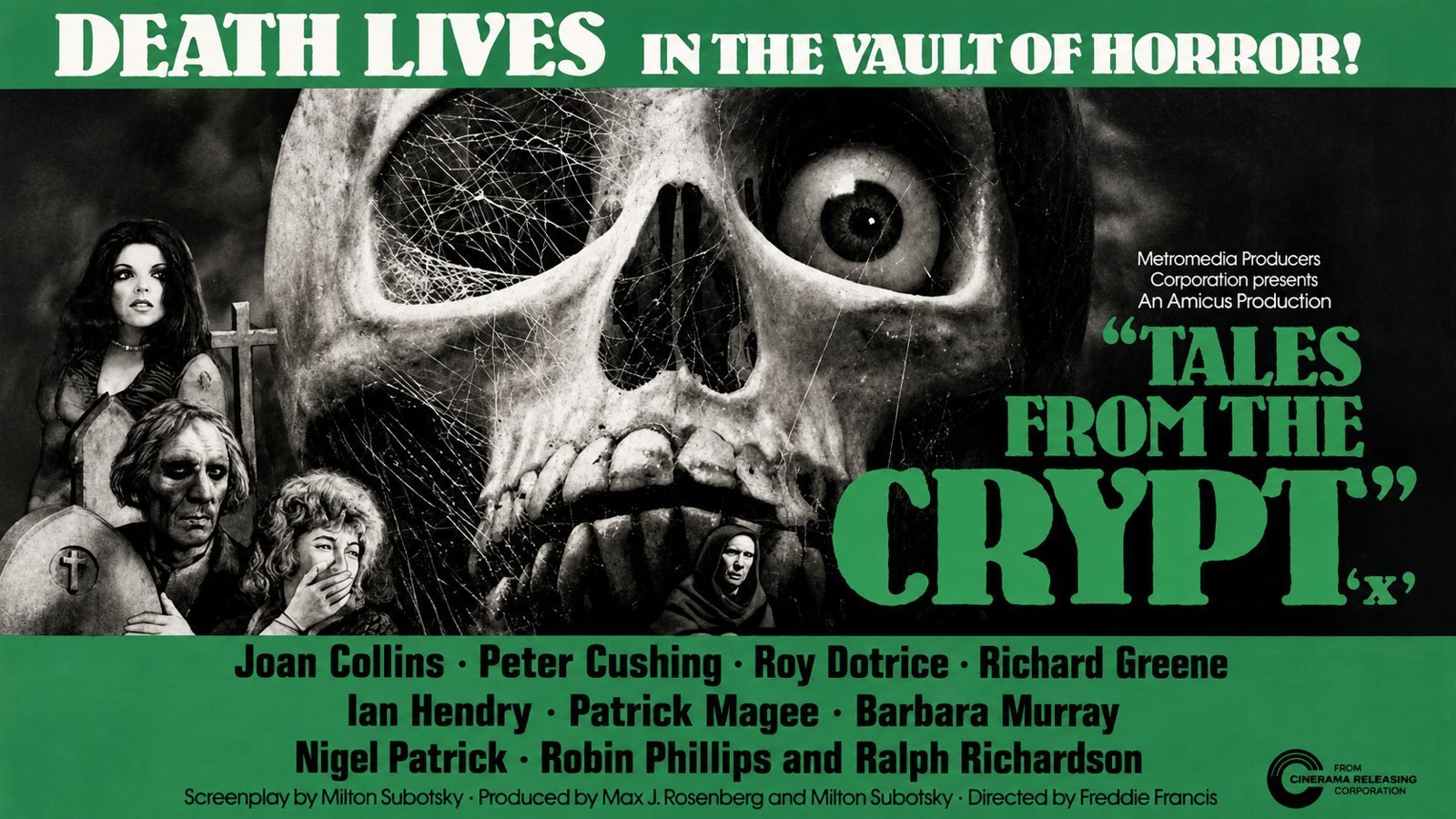
Tales from the Crypt (1972)
Starring: Joan Collins, Ralph Richardson, Peter Cushing, Nigel Patrick
Director: Freddie Francis
Synopsis: Superb horror anthology in the EC comics tradition
Reviewed by: Omar Khan
"It's put together something like the comic books..."
— Roger Ebert, Chicago Sun-Times (3/4 stars)
"Unfortunately, the only style exhibited... is in their dumb appreciation for ancient plot devices."
— The New York Times
"This excellent anthology of scares-with-a-smile..."
— Radio Times Guide to Films (★★★★)
"It has a certain magnetism about it that is hard to resist."
— Craig Butler, AllMovie
"A classic British creeper... an unrelenting study in the art of the macabre."
— Chris Alexander, Fangoria
"The greatest strength... [lies] in the rich stories culled from the comics."
— Anthony Arrigo, Dread Central
"fun-filled horror film" Creature Features
"knothing extraordinary" Maltin's
"excellent" Blockbuster Video
One of the finest horror anthologies ever made, Tales from the Crypt remains a glorious collection of macabre short stories capped by one of the genre's most satisfying final twists. Adapted from the legendary EC Comics that would later inspire Creepshow, this Amicus production is, in my view, considerably superior to its bigger-budget American cousin.
The five stories are consistently entertaining, and with perhaps one slight exception, each delivers its own memorable blend of suspense, irony and grisly comeuppance.
The opening tale, featuring Joan Collins as a thoroughly unpleasant wife whose murderous plans are spectacularly interrupted by an escaped homicidal maniac dressed as Father Christmas, remains an absolute classic. It is a deliciously dark and wonderfully ironic way to begin proceedings. Collins has always excelled at playing cold-hearted sirens, and here she does so flawlessly. There is, however, one amusing little technical blunder. At one point, while she is hiding beneath a window, the reflection of a cameraman taking publicity stills is clearly visible in the glass.
The second segment features Ian Hendry as a philandering husband who receives a rude awakening, followed shortly afterwards by a far deadlier shock. In true EC Comics fashion, the story comes satisfyingly full circle with predictably horrific consequences.
Equally unforgettable is the superb segment starring Peter Cushing as the gentle, long-suffering Arthur Grimsdyke. Subjected to relentless cruelty and humiliation by his wealthy neighbours, Grimsdyke returns from beyond the grave to exact one of horror cinema's most satisfying acts of supernatural revenge. The Valentine's card he delivers remains one of the great moments of British horror:
"You were cruel and mean from the start... now you really have no heart."
No prizes for guessing what rather lumpy object accompanies the greeting.
The final standout episode centres upon a sadistic superintendent of a home for the blind whose astonishing lack of compassion ultimately leads to one of the most chilling fates in the entire anthology. It is a fitting conclusion to a film built around poetic justice, where greed, cruelty and selfishness are invariably repaid in the most gruesome fashion imaginable.
Like so many of the finest Amicus productions, Tales from the Crypt succeeds because it places atmosphere, strong storytelling and memorable performances ahead of elaborate special effects. Director Freddie Francis keeps the pace moving briskly, while each segment builds neatly towards its own wickedly satisfying sting in the tail.
Ralph Richardson also deserves special mention as the mysterious guide who links the stories together, lending the film a wonderfully sinister presence. His quiet, dignified menace makes him one of horror cinema's most memorable supernatural hosts—you certainly wouldn't want to encounter him alone in a dark alley.
Having been unavailable for many years before its eventual reissue, Tales from the Crypt richly deserves to be rediscovered by a new generation of horror fans. Alongside Dead of Night, it stands as one of the very finest anthology horror films ever produced and remains one of Amicus Productions' crowning achievements.



0 Comments
Leave a Comment