
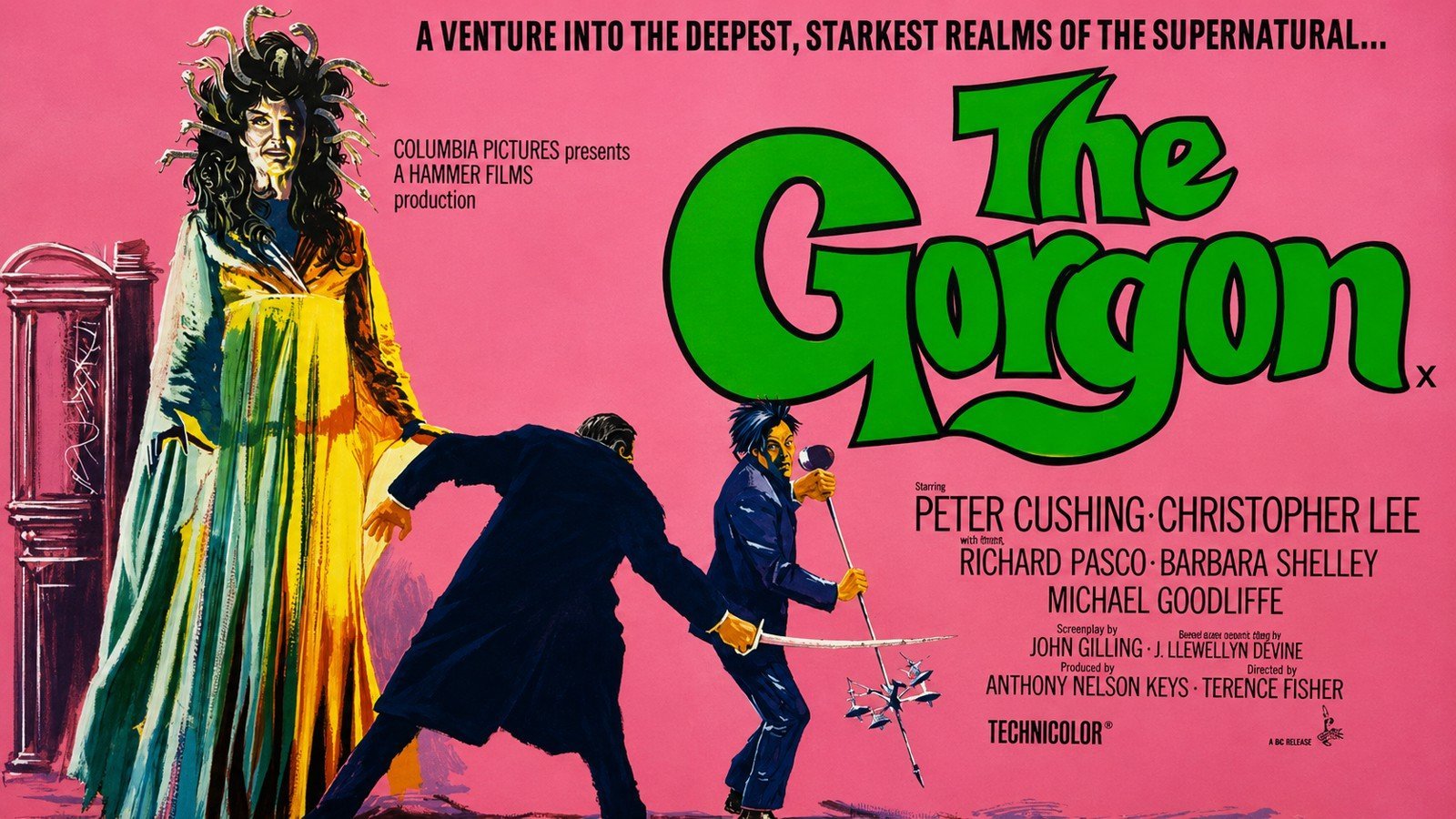
The Gorgon (1964)
Cast: Christopher Lee, Peter Cushing, Richard Pasco and Barbara Shelley
Director: Terence Fisher
Nutshell: Intriguing and sumptuously presented tale of a vengeful and deadly Gorgon. Hammer in fine form.
Reviewed by: Omar Khan
"A well-made, direct yarn that mainly gets its thrills through atmosphere." — Variety
"Terence Fisher's direction is restrained enough to avoid any unintentional yocks." — Variety
"The Gorgon myth does not fit happily into Transylvanian surroundings." — The Monthly Film Bulletin
"The monster's appearance is belated, vague and insufficiently spectacular." — The Monthly Film Bulletin
"Still, it makes a change from vampires... and it is quite well acted." — The Monthly Film Bulletin
"Atmospheric but uneven." — Leonard Maltin
"One of Hammer's most underrated fantasies." — Time Out
"Barbara Shelley gives one of her finest performances." — Time Out
"A melancholy fairy tale rather than a straightforward monster movie." — Kim Newman
"One of Hammer's most beautiful productions." — Jonathan Rigby
"The atmosphere is first-rate." — John J. Puccio (DVD Town)
"Cushing and Lee are, as always, a pleasure to watch." — John J. Puccio (DVD Town)
"An elegant Gothic mystery." — Empire
"Perhaps more tragic than terrifying." — Empire
Deliciously presented in the signature Hammer style, The Gorgon arrived at a stage in the studio's evolution when Hammer had already enjoyed enormous success with its classic monsters—Frankenstein, Dracula, the Werewolf and the Mummy—and was now searching for a new creature capable of carrying the studio through another decade of Gothic horror.
By this point Peter Cushing had grown increasingly wary of being typecast in horror films and had decided to move away from the genre, while Christopher Lee had recently relocated to Switzerland. Hammer was understandably eager to lure both men back, recognising that they had been indispensable to the studio's greatest successes. Fortunately, they succeeded. Cushing and Lee returned, joined by director Terence Fisher, whose influence had done so much to establish the classic Hammer formula.
Barbara Shelley was cast in the title role, although practical considerations led to alterations in the script because transforming her into the snake-haired Gorgon required hours in the makeup chair. There were also disagreements over the screenplay, with revisions leaving several participants less than enthusiastic.
A mysterious series of deaths has plagued the village—seven victims in five years—and in every case the unfortunate soul has been turned to stone. The local authorities have quietly suppressed the incidents, fearful of reviving ancient legends surrounding the dreaded Gorgon. When a young man is wrongly accused of the latest murder, his father arrives determined to prove his son's innocence. His investigations, however, bring him face to face with the terrible creature, whose gaze alone is enough to turn mortals into stone. Unable to avert his eyes in time, he soon joins the ever-growing list of victims.
In an enjoyable reversal of their usual screen personas, Peter Cushing plays the sinister village doctor responsible for conducting the autopsies while harbouring secrets of his own—and nursing a deep affection for his beautiful assistant. Christopher Lee, meanwhile, slips comfortably into Van Helsing territory, arriving from another town to help unravel the increasingly grim mystery.
The film is photographed with all the elegance and atmosphere one expects from Terence Fisher. Yet when the long-awaited climax finally arrives and the fearsome Gorgon steps fully into view, the payoff is rather disappointing. Instead of presenting the most horrifying sight imaginable, Hammer gives us what appears to be a rather unfortunate wig adorned with a dozen or so cheap rubber snakes—the sort normally found in the bargain bin of your local toy shop. Mounted on spring-loaded mechanisms, they twitch away with admirable enthusiasm but precious little menace.
Hammer wisely keeps the creature on screen for only fleeting moments, yet even those brief glimpses are enough to provoke smiles rather than terror. I would give anything for a wig constructed entirely of rubber snakes mounted on springs, bouncing around like overexcited jumping beans.
The Gorgon is certainly unforgettable—but almost entirely for the wrong reasons.
Sadly, this incarnation of the mythical monster inspires amusement rather than fear, and after such an effective slow-burning build-up the climax never delivers the satisfying payoff one hopes for. It is a considerable weakness because the film's defining moment simply fails to convince.
Fortunately, there remains much to admire. Cushing and Lee are, as ever, magnificent, while Terence Fisher directs with the assured Gothic style that became Hammer's trademark. James Bernard's unmistakably Hammer-esque score adds enormously to the atmosphere, and Barbara Shelley once again demonstrates why she deserves her place among the great leading ladies of British horror cinema.
Cushing perhaps takes the acting honours this time around, portraying one of his more intriguingly ambiguous characters, while Lee brings his customary authority despite comparatively limited screen time. It is simply unfortunate that the monster itself never quite lives up to the anticipation generated throughout the picture.
In many respects, The Gorgon functions more successfully as a tragic Gothic love story than as an outright horror film. The atmosphere remains rich and absorbing throughout, although the rather gloomy finale ultimately leaves a stronger impression than the monster itself.
There are, however, several beautifully realised moments. The scenes in which the Gorgon first appears only as a reflection in a pool of water or glimpsed within a mirror are wonderfully handled and considerably more effective than the eventual full reveal.
Personally, I find the creature rather delightful. Its gloriously goofy appearance places it alongside many of the lovable monsters that populated 1950s creature features. Unfortunately, I suspect this was not quite the reaction Hammer had hoped to elicit. By 1964 audiences had already witnessed Alfred Hitchcock revolutionise cinematic horror with Psycho. Times had changed, and painted old hags sporting animated rubber snakes were no longer quite enough to terrify contemporary audiences. Hammer itself would soon find that it too needed to evolve.
The film has recently been released on Blu-ray as part of Indicator's excellent four-film Hammer set, and the presentation is immaculate. Colours are rich and beautifully rendered, while the fluorescent test tubes in Cushing's laboratory positively glow. Grain is plentiful but entirely appropriate, preserving the texture and appearance of genuine film rather than scrubbing everything into digital sterility.
The commentary track, unfortunately, proves nowhere near as engaging as the excellent one accompanying Maniac. In fact, I found it irritating enough to abandon after little more than ten minutes. Aside from that disappointment, however, the supplementary material is informative and thoughtfully assembled. Indicator continue to produce exemplary special editions and remain a label well worth keeping an eye on.
0 Comments
Leave a Comment