
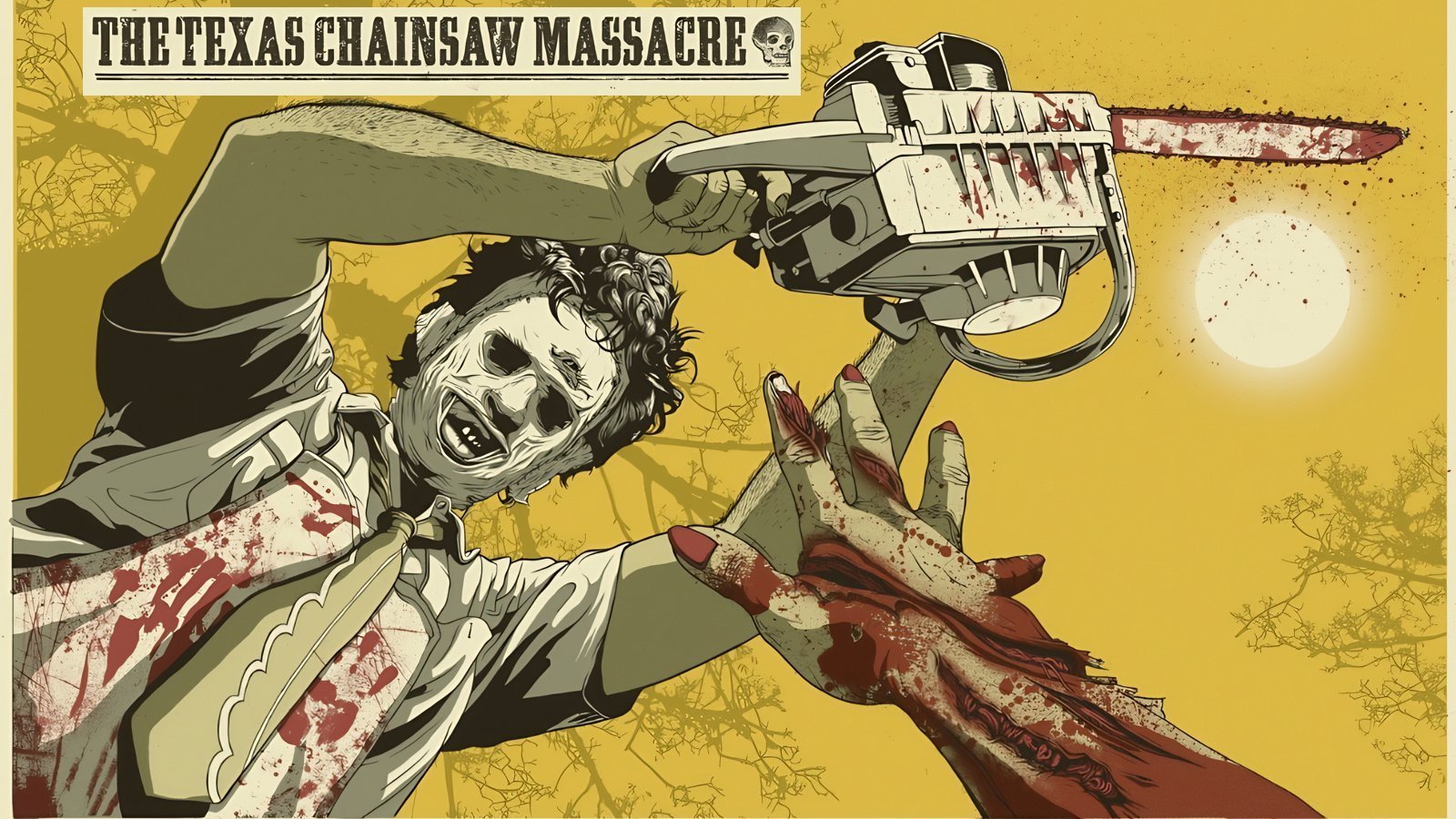
Texas Chainsaw Massacre, The (1974)
Starring: Gunnar Hansen, Marilyn Burns, Jim Siedow, Edwin Neal
Director: Tobe Hooper
Synopsis: A brilliant and intense horror classic... unmissable
Reviewed by: Omar Khan
Another film that has rightfully earned its place as one of the true landmarks of horror cinema—and for perfectly justifiable reasons. Quite simply, it is a masterpiece.
Watching The Texas Chainsaw Massacre for the first time is an experience unlike almost any other in the history of horror films. Few movies leave the viewer feeling quite so physically and emotionally exhausted, as though they have been dragged through a relentless ordeal of unbearable tension and unimaginable brutality.
That, however, is Tobe Hooper's greatest trick.
For almost fifty years audiences have emerged from The Texas Chainsaw Massacre utterly convinced they have witnessed one of the most graphically violent films ever made. They will swear they have seen atrocities almost beyond description. They will remember grotesque acts of sadism, endless bloodshed and shocking mutilation.
The remarkable thing is...they haven't.
When the film first appeared, it acquired a reputation unlike almost any other. It rapidly became regarded as one of the most depraved and disturbing motion pictures ever made. In Britain it spent decades effectively outlawed, becoming perhaps the most infamous of all the so-called "video nasties". For years it remained unavailable on home video and could only be discussed in hushed tones by horror enthusiasts who had somehow managed to catch rare screenings.
Millions accepted that reputation without question.
I certainly did.
When I first watched The Texas Chainsaw Massacre as a young man, I came away convinced that I had witnessed the most brutal film ever committed to celluloid. I was genuinely shaken. The violence seemed so explicit, so savage and so terrifyingly real that it left me wondering how anyone could possibly have been allowed to make such a film.
The experience was genuinely traumatic.
Yet repeated viewings gradually reveal something quite extraordinary.
Tobe Hooper has manipulated his audience with such astonishing craftsmanship that the violence exists largely inside the viewer's own imagination.
Take one of the film's most notorious sequences. A victim is repeatedly struck with a heavy mallet before being dragged away to be butchered with a chainsaw. We remember every horrifying detail. We remember the agony, the convulsions and the sheer brutality of the attack.
Except...
we never actually see it.
What we see are carefully chosen reaction shots, frantic movement, unbearable sound effects and our own minds eagerly supplying everything Hooper deliberately withholds.
The same is true of perhaps the film's most infamous image. A young woman appears to have a large meat hook driven straight through her neck before being hoisted into the air, squirming helplessly as she hangs there in agony.
Except that doesn't happen either.
Look carefully.
There is not a single shot showing the hook penetrating flesh.
There is not a single shot showing the hook protruding from her body.
There is barely a drop of blood.
All we actually witness is a terrified woman screaming and writhing in agony.
The horror is supplied almost entirely by our own imagination.
That is the genius of Tobe Hooper.
Rather than showing explicit violence, he creates the perfect circumstances for our minds to manufacture horrors infinitely worse than anything that could ever have been photographed. Through ingenious editing, extraordinary sound design, relentless screaming, the deafening roar of Leatherface's chainsaw and an atmosphere of almost unbearable oppression, Hooper persuades us that we have witnessed unimaginable carnage.
In reality, we have witnessed remarkably little.
It is one of the greatest acts of cinematic misdirection ever committed to film.
Perhaps the greatest masterstroke of all, however, comes before the film has even begun.
The title.
The Texas Chainsaw Massacre.
Three perfectly ordinary words.
Yet together they summon images of unspeakable slaughter long before the opening frame appears on screen.
"Massacre" immediately conjures visions of wholesale carnage.
"Chainsaw" is an instrument whose brutal mechanical violence almost makes one wince simply hearing the word spoken aloud.
Then there is "Texas", grounding the nightmare in somewhere tangible and real.
The title itself does half the work.
Long before Leatherface appears, the audience has already terrified itself.
That is masterful filmmaking.
The mythology surrounding The Texas Chainsaw Massacre became almost as powerful as the film itself.
I grew up at an age when movies like this were largely inaccessible. That, of course, only made them infinitely more fascinating. The very fact that adults seemed determined to keep us away from certain films gave them an irresistible mystique. They became whispered legends, spoken about with equal measures of excitement and horror.
Britain's censorship only added fuel to the fire.
For decades the film remained effectively banned throughout the country. The irony was that London occupied a curious position. Through the old Greater London Council licensing system, The Texas Chainsaw Massacre could occasionally be screened legally within Greater London, even though audiences elsewhere in Britain had virtually no opportunity to see it. Midnight screenings became legendary, breaking house records and drawing enormous crowds year after year.
It was one such late-night London screening that finally gave me the opportunity to experience the film.
Life was never quite the same afterwards.
Looking back now, however, one of my favourite memories isn't actually from the cinema at all.
It came from a telephone.
One of the cinemas at the old Swiss Centre in Leicester Square came up with one of the most ingenious marketing campaigns I have ever encountered.
In those days London had a weekly entertainment guide called What's On, listing everything from theatre productions to concerts and cinema screenings. Alongside the advertisement for The Texas Chainsaw Massacre appeared a telephone number for enquiries.
Naturally, I dialled it.
Then I dialled it again.
And again.
After several rings the line would suddenly connect.
There was no recorded announcement.
No helpful voice.
No information about screening times.
Instead, all you heard was the deafening roar of a chainsaw accompanied by the blood-curdling screams of a terrified young woman fighting for her life.
The recording lasted little more than a minute before the line went dead.
That was it.
It was absolutely brilliant.
The promotion worked for exactly the same reason the film itself worked. The recording gave you almost nothing. There was no story, no explanation and no images whatsoever. Yet within seconds your imagination began creating horrors infinitely more frightening than anything that could ever have been described.
The mind filled in every terrifying blank.
By the time you arrived at the cinema you had already started directing your own horror movie inside your head.
Once again, Tobe Hooper had frightened his audience without actually showing them very much at all.
It remains one of the cleverest pieces of film promotion I have ever encountered.
Time has thankfully been kind to The Texas Chainsaw Massacre.
Following the passing of James Ferman's extraordinarily narrow-minded censorship regime, calmer heads eventually prevailed. The film was finally granted a proper home-video release in Britain during the 1990s, more than two decades after those early London screenings.
The ban now seems not merely excessive, but utterly senseless.
Ironically, many of the critics who had once condemned the film as depraved and morally corrupt would later reverse themselves completely. Today The Texas Chainsaw Massacre occupies its rightful place among the true masterpieces of horror cinema and is regularly cited as one of the most influential genre films ever made.
History has completely vindicated Tobe Hooper.
The censors, on the other hand, have been remembered rather less kindly.
Of course, none of this would matter if The Texas Chainsaw Massacre simply failed as a horror film.
It doesn't.
It remains one of the most relentlessly terrifying experiences ever committed to celluloid.
The plot itself could scarcely be simpler. A group of young travellers make the unfortunate decision to stop in the wrong part of rural Texas. One by one they encounter a family whose relationship with the neighbouring slaughterhouse suggests that the local meat may contain rather more than beef. What follows is an increasingly desperate struggle for survival that gathers momentum until it reaches one of the most exhausting finales in horror cinema.
Hooper's direction is nothing short of extraordinary.
The film assaults the senses through atmosphere rather than explicit gore. Every frame feels grimy, oppressive and suffocating. The relentless Texas heat almost seems to seep out of the screen, while Daniel Pearl's remarkable cinematography captures a world that feels simultaneously authentic and nightmarish.
Then there is Leatherface.
Far removed from the wisecracking horror icons that would dominate the following decade, Leatherface is frightening precisely because he feels so unpredictable. He is not a supernatural monster or an indestructible killing machine. He is simply a huge, damaged human being driven by instinct and terror, making him all the more disturbing.
The famous chase through the woods remains one of the greatest sustained sequences of terror ever filmed. There are no elaborate visual effects, no computer-generated trickery and no grandiose action set-pieces—just unbearable tension, mounting panic and a director who understands exactly how long to keep his audience on the rack before granting even the briefest moment of relief.
It is relentless.
When the end credits finally arrive, they feel less like the conclusion of a film than the release from an ordeal.
Tobe Hooper never quite scaled these extraordinary heights again.
He would go on to direct the wonderfully deranged Eaten Alive, the hugely entertaining The Funhouse and the gloriously bonkers Lifeforce, a film that has deservedly developed an enormous cult following over the years. Each has its admirers—myself included—but none would ever achieve the cultural impact of The Texas Chainsaw Massacre.
That single film immortalised him.
I was fortunate enough to meet Hooper in 2003 at the Sitges Film Festival, where he was presenting his remake of The Toolbox Murders. It was hardly one of his finest achievements, yet standing in the presence of the man who had created The Texas Chainsaw Massacre felt rather like meeting horror royalty.
Some filmmakers make good films.
A precious few change cinema.
Tobe Hooper belonged firmly in the second category.
When he passed away in 2017, I felt I owed him a personal debt of gratitude. The day after his death I visited my tattoo artist and had a tribute etched permanently onto my arm: a large chainsaw accompanied by a severed limb. My tattooist looked at me with more than a little concern.
I never regretted it for a single moment.
Some films entertain us.
Some frighten us.
A very small number become part of our lives.
The Texas Chainsaw Massacre did all three.
Today it stands exactly where it deserves to stand: among the towering masterpieces of horror cinema. It remains essential viewing for anyone interested not merely in the macabre, but in the extraordinary power of cinema itself.
Watch it carefully.
You may well discover that one of the most terrifying films ever made barely shows you any violence at all.
And that is exactly why it remains so frightening.


0 Comments
Leave a Comment