
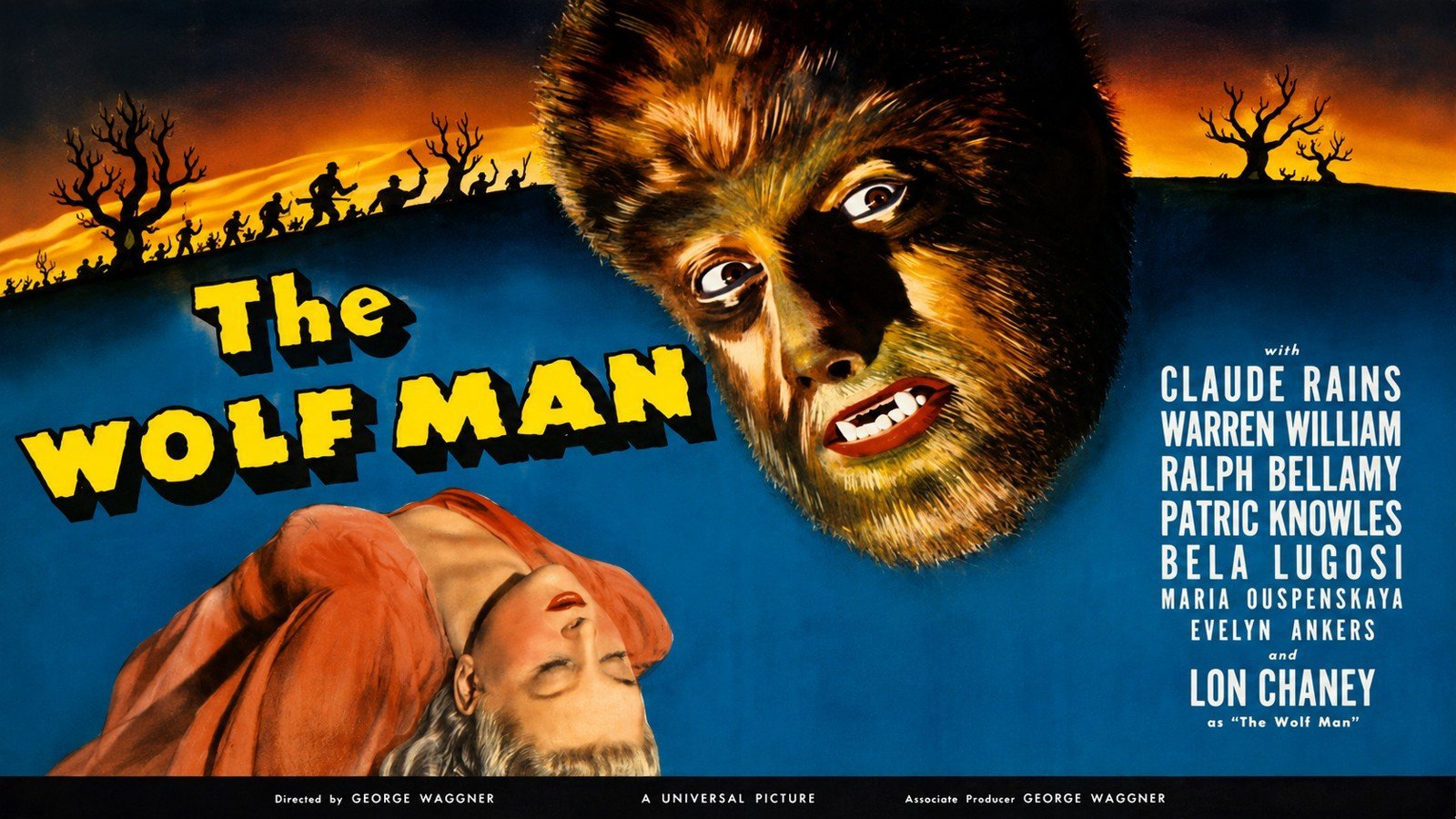
Wolf Man, The (1941)
Starring: Lon Chaney Jr., Evelyn Ankers, Claude Rains
Director: George Waggner
Synopsis: Another of Universal's classic horror films
Reviewed by: Ali Khan
"undeniable magic within" Time Out
"classic Universal thriller" Creature Features
"one of the finest horror films ever made" Maltin's
"one of cinemas best" Blockbuster Video
Universal's classic werewolf tale was only the studio's second venture into the genre, yet it remains the film that established much of the folklore and mythology associated with werewolves for decades to come.
Lon Chaney Jr. returns to his ancestral village—described in Universal's DVD notes as being in Wales, although the film itself never explicitly identifies the location. It is a mist-shrouded, timeless place where superstition and ancient legend still hold sway.
While taking a midnight stroll, Chaney's Larry Talbot is bitten by a werewolf and soon discovers that he has inherited the dreadful curse himself. Before long he begins transforming into a creature of the night, driven by an irresistible bloodlust that compels him to prey upon the unsuspecting villagers. Terror and tragedy inevitably follow as the frightened community sets out to destroy the beast.
George Waggner's direction wisely presents the Wolf Man as both hunter and victim. Talbot is very much a Dr Jekyll and Mr Hyde figure, fully aware that he will transform, powerless to prevent it and left to face the horrifying consequences each time another innocent victim is discovered. The tragedy of the werewolf curse is conveyed with considerable sympathy, giving the film an emotional depth that many later entries in the genre would overlook.
The atmosphere is one of the film's greatest strengths. Mist rolls silently through the valleys, gypsies recount ancient legends, the full moon hangs ominously overhead and the distant howl of a wolf is never far away. The screenplay also devotes considerable attention to the mythology surrounding lycanthropy, allowing the folklore to become an integral part of the narrative rather than merely a convenient plot device.
Interestingly, while Waggner chose to show the audience Talbot's transformation into the Wolf Man, screenwriter Curt Siodmak originally envisaged a more ambiguous approach in which it was never entirely clear whether Talbot had physically transformed at all or whether the murders had simply been committed by a man convinced he was a werewolf. It is a fascinating concept and one wonders how differently the film might have played had that idea been retained
Jack Pierce's make-up has long been regarded as the definitive cinematic werewolf design, influencing countless films that followed. Personally, it has never been my favourite interpretation. In fact, I find the Wolf Man considerably more frightening when he is kept partially hidden in the shadows than when he is fully revealed, shuffling into view with exaggerated movements and growls.
Lon Chaney Jr., despite never being entirely convincing as an Englishman—a concern even expressed by screenwriter Curt Siodmak because of Chaney's unmistakably American accent—nevertheless made the role his own and would reprise it in several subsequent Universal productions.
Despite these shortcomings, "The Wolf Man" remains the film that defined the werewolf for generations of filmmakers and audiences alike. In an era when elaborate visual effects often overshadow storytelling, it serves as a welcome reminder of a time when atmosphere, mythology and strong writing mattered every bit as much as the monster itself.
0 Comments
Leave a Comment