
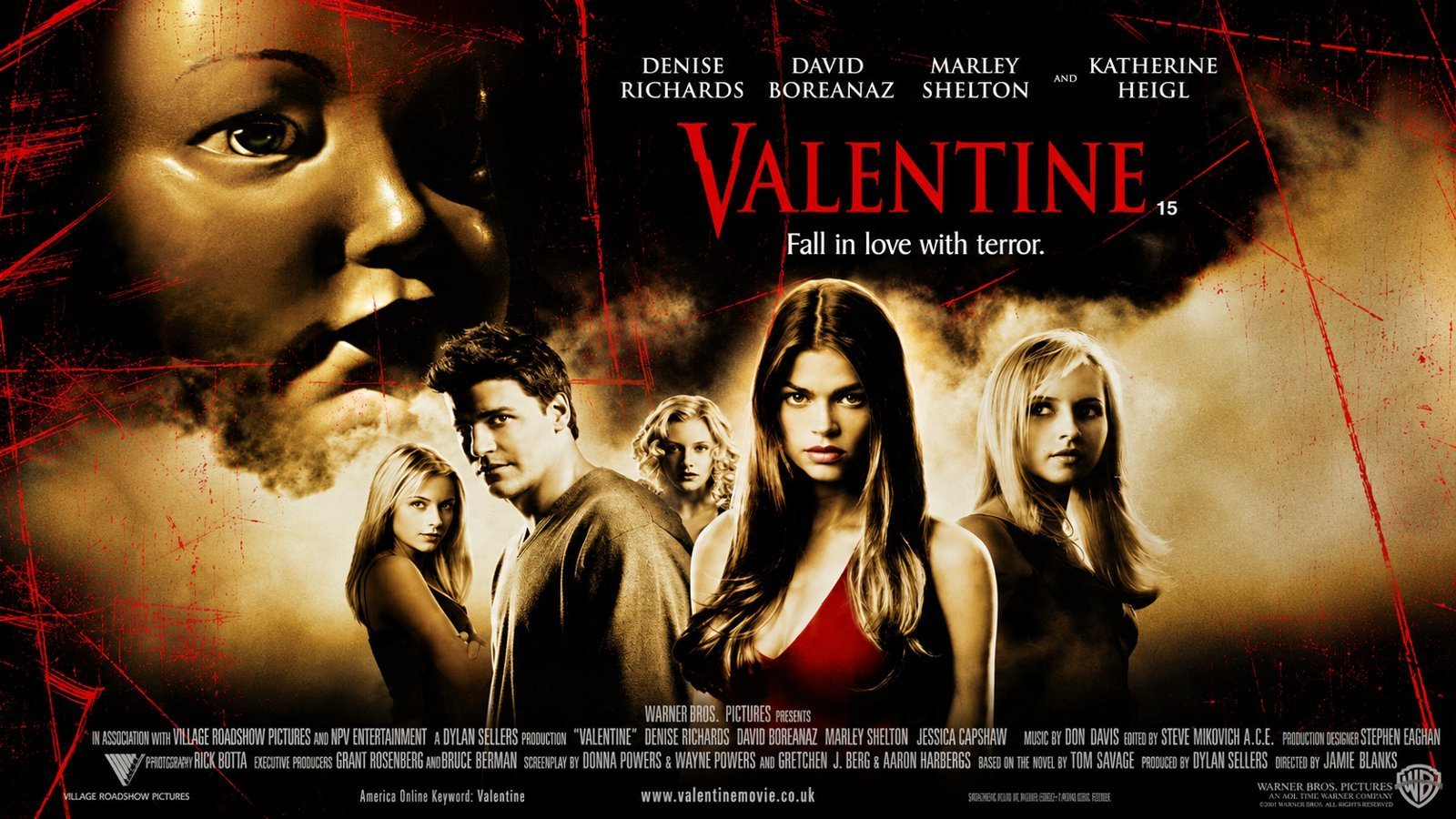
Valentine (2001)
Starring: David Boreanaz, Marley Shelton, Denise Richards, Jessica Capshaw
Director: Jamie Blanks
Synopsis: Wronged Geek returns from the dark past to exact revenge...again!
Reviewed by: Omar Khan
"should have gone for laughs" Empire
"shoddy" Total Film
"doesn't deliver the goods" Time Out
"Stylish, suspenseful revenge." — Los Angeles Times
"Acceptably scary until a weak finale." — Variety
"Valentine isn't scary, but it is unsettling... arresting in the moment." — San Francisco Chronicle
"Looking good but lacking much in the way of personality or grey matter." — Variety
"A stylish horror picture... offering a fresh twist on the reliable revenge theme." — Los Angeles Times
"A slasher flick has no heart." — San Francisco Chronicle
"Director Blanks offers up few surprises." — BBC
As if to prove that everything in horror eventually comes full circle, along comes Valentine, arriving almost exactly twenty years after its obvious inspiration, the excellent My Bloody Valentine. Indeed, the two films share considerably more than simply a near-identical title and holiday setting. Both were made on relatively modest budgets, and both feature an assortment of aspiring Barbie and Ken clones masquerading as actors (it later transpired that several of them had graduated from modelling to the natural next career move).
The film was directed by Urban Legend's Jamie Blanks and shot in just fifty-three days—though quite what occupied them for so long remains something of a mystery.
The plot is pure, vintage, dead-on-arrival masked slasher territory—staler than week-old socks and every bit as derivative as The Burning, Curtains, Prom Night, Friday the 13th Parts 3 to 9 and Halloween Parts 4 to 6 rolled into one predictable package.
It all begins when thirteen-year-old geek Jeremy Melton commits the ultimate act of social suicide by asking several of the prettiest girls in class to dance with him on Valentine's Day. One by one they reject him with suitable cruelty until the class "chubby" finally agrees. Moments later they are caught together by the school bullies. Horrified at the embarrassment, the girl promptly claims Jeremy attacked her. Our unfortunate young nerd is whisked off to reform school and, as fate would have it, grows up into a Michael Myers wannabe. The film then jumps ahead thirteen years.
The once bitchy schoolgirls have now evolved into an alarming collection of designer Barbie dolls—each one considerably more frightening than the masked killer who soon begins dispatching them, together with anyone else unfortunate enough to wander into his bloodstained orbit.
Ironically, the strongest sequence arrives before the first murder even occurs. The masked killer stalks his intended victim through a room filled with freshly laid-out corpses—a genuinely effective and atmospheric set-piece that briefly suggests the film might rise above its pedestrian origins.
Sadly, the optimism lasts all of five minutes.
One of the film's greatest problems is that none of the characters inspires even the faintest shred of sympathy. Quite the opposite—you actively find yourself hoping the killer invents increasingly imaginative ways of disposing of them. Unfortunately, Hollywood's post-Columbine squeamishness means almost all the violence takes place discreetly off-screen, depriving even dedicated gorehounds of their principal reason for watching. As predictable as they are, the death scenes remain the film's chief attraction.
The killer has evidently spent countless hours studying the movements and mannerisms of John Carpenter's immortal Michael Myers, shamelessly borrowing everything from his deliberate gait to his silent menace. It proves a futile exercise. About the only genuinely memorable aspect of the murderer is his appearance. The cherubic Cupid mask, ragged overcoat and permanently bloodied nose create a striking visual that deserved a far better film. The inevitable twist ending, meanwhile, is about as limp as they come.
One later learns that Warner Bros. gave the project the green light largely because television heart-throb David Boreanaz of Buffy the Vampire Slayer and Angel had agreed to star.
What a world.
What a world.
Yet despite all its obvious shortcomings, Valentine possesses an odd, undeniable charm for those of us who grew up on the slashers of the late seventies and early eighties. "Valentine serves as an affectionate slice of slasher nostalgia, dutifully ticking off every cliché in the handbook—and doing so with enough style and flair to make the ride surprisingly enjoyable." Whether intentional or not, the film works best as an exercise in nostalgia rather than horror.
Denise Richards, meanwhile, adds further weight to the long-standing theory that becoming a Bond Girl is often less a career boost than a kiss of death.

0 Comments
Leave a Comment