
The Long, Bumpy and Winding Road to Zibahkhana: Hell's Ground
Twenty years on, a personal look back at how Pakistan's first extreme horror film came to be.
Time for a little reflection on the little something we created twenty years ago.
I am sitting here in the room where all of our crew would gather. Not that much has changed. There are still dogs around me creating chaos, and I am still here, hair gone white but alive and kicking.
Back then, Pakistan was under General Musharraf and a make-believe democracy that never was; twenty years on, we are stuck in much the same rut. Sham elections, plenty of posturing and not much else has changed.
But this isn't about politics, though everything is about politics!
This is about looking back at how the film came to be. What motivated it, what provided the impetus, how it went through planning and, most importantly, what enabled it.
Life at the time was somewhat stable. The little ice cream business was ticking over, and the economy was just about holding together, though the cracks were evident and a crash always seemed to be looming on the horizon. The Pakistani rupee was artificially held at a rate that allowed those of us earning in the currency to dream, occasionally.
That façade of stability was unquestionably an enabler of dreams.
Another factor was a father who was churning out books regularly about his life and experiences, making sure he left his mark on this world before the sands in the hourglass ebbed away.
I felt it was time for me to leave a stain on the world as well. Something that might remain long after we were gone. Maybe ignored, maybe sidelined, maybe ridiculed, maybe abolished, but something that would continue to exist when we had long faded into oblivion.
The Horror Bug Bites
I had studied cinema academically, but more than that, I had been an avid devourer of movies—specifically horror movies—for as long as I could remember.
The very first blow came when my parents took their impressionable four-year-old to see The Wizard of Oz.
It didn't go to plan.
They had to abandon the cinema halfway through because their little Damien was awestruck and in hysterics. Crying, sobbing and yet delirious, I had been completely blitzed by Margaret Hamilton's portrayal of the Wicked Witch. My embarrassed parents gingerly made their exit.
That day was the beginning of my obsession with everything monstrous. I was drawn to monsters in awe but also in dread and fear. Equal amounts of love and overwhelming anxiety.
It wasn't fleeting. It became part of who I am.
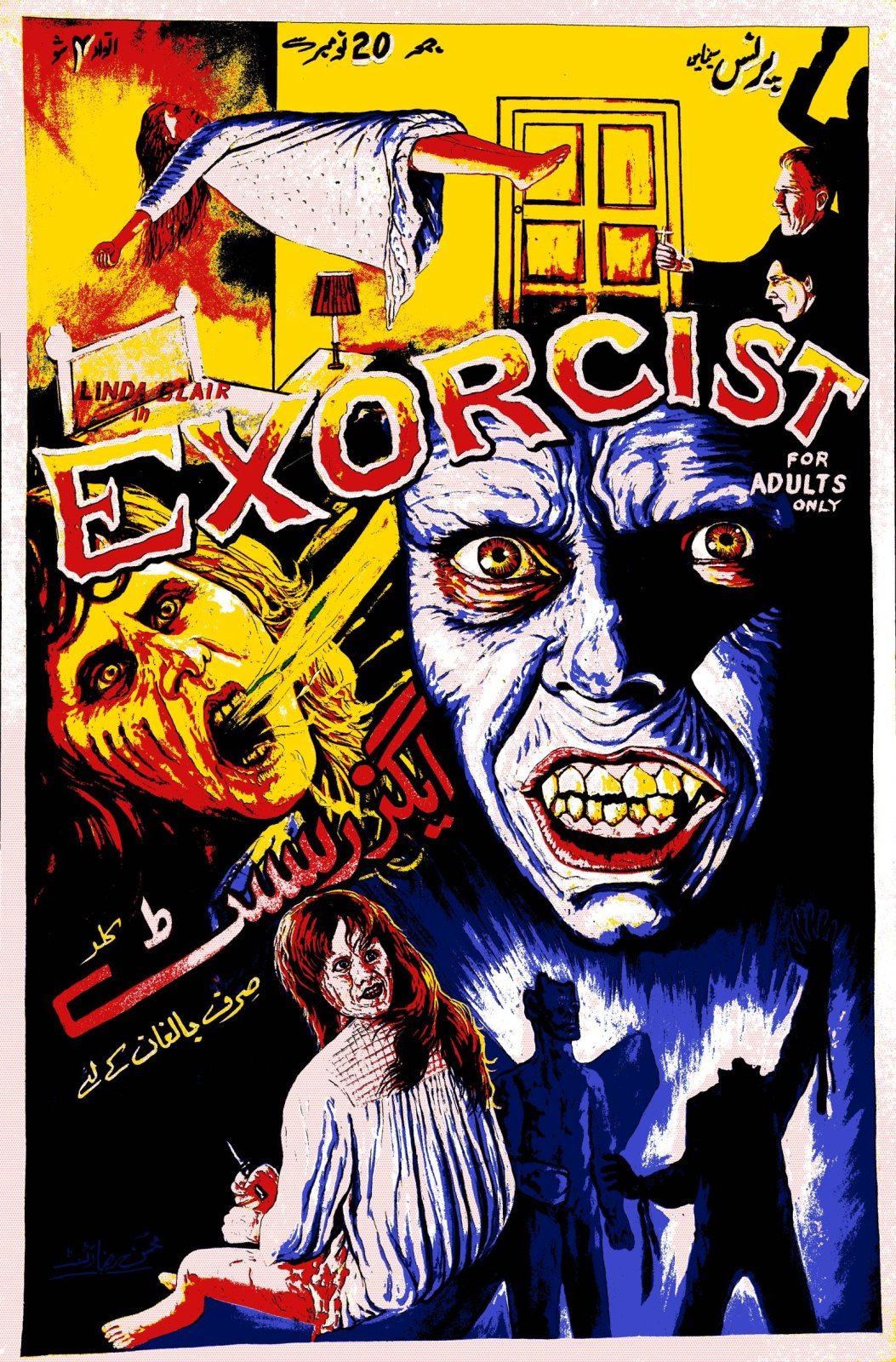
A few years later, I have vague memories of driving home after watching some typical Lollywood melodrama at the Novelty or Shabistan cinema and being entranced by the huge painted billboards outside the Naaz cinema on Murree Road. It was screening a horror film called Zinda Laash.
Huge 60-foot billboards showed a blue and purple-faced vampire, blood dripping from his bared fangs as he leered down lecherously; terrified women with frozen screams in their throats scrambling for cover; a dashing hero in a dungeon, fear etched on his face and dagger in hand, opening a casket and terrified of what lay within.
The horror, oh the horror!
I was mesmerised, but it was an Adults Only movie, and there was only so much my willing parents could do to indulge my fantasies. This one remained out of bounds, which of course made it all the more alluring and fascinating.
Forbidden fruit.
Another bizarre memory is of being at home in Islamabad, barely five years old, pestering an amazingly indulgent aunt to leave her office duties and deliver a nasty mask to me because I had to have it. She duly did.
I remember putting it on, looking in the mirror, and scaring myself half to death.
Abnormal is the word that comes to mind, ridiculously and incorrigibly so.
My brother and I would wait on Friday nights, desperately trying to stay awake for the Friday Night Horror Movie on British television. Films like The Mummy's Hand and other Universal classics with Bela Lugosi and Lon Chaney would be screened. The following morning my brother would shuffle around with bandages over his face and an affected limp, playing Kharis in search of his Tana Leaves.
Quite obviously, those Friday-night horrors—Universal, Peter Cushing, Christopher Lee—made a deep impression.
So did the nightmares that followed.
In those days toy shops stocked models and figurines you assembled and painted. Most kids bought aeroplanes, tanks or sports cars. Some of us were drawn to Universal's classic monsters: the Creature from the Black Lagoon, the Mummy, Frankenstein, Dracula and the Werewolf.
All my pocket money went on those things. I would assemble and paint them, then become so terrified by my creations that I had to keep them outside our flat in case they came to life and did some damage.
It was classic obsession.
I was magnetically drawn to the very things that traumatised me and fuelled my nightmares.
It didn't help that our father was a mad Alfred Hitchcock fan, so films such as Psycho and The Birds were rites of passage.
I remember staying up to watch Hammer's The Curse of Frankenstein and becoming paralysed with fear about twenty minutes into the film. When Peter Cushing maniacally brought his monster to life, it was all too much, and I scurried off to bed.
The damage had already been done. The imagery triggered a multitude of mangled, morbid thoughts.
Gradually I learned to withstand horror movies to their conclusions and, normally, with good triumphing over evil, they became a little less traumatising.
The real world, meanwhile, began revealing horrors of its own: war, violence, disease, poverty and famine. Hatred and racism too, particularly growing up in England as a person of brown skin. Racism at school, racism on the streets, hatred born from divisions created by faith and colour. Magazines filled with colour photographs of Vietnam and wars elsewhere in the world.
The lines between the horrors on screen and those outside it started to blur.
But by then the bug had bitten deep.
Horror movies were much, much more than a passing fascination. They had become part of my soul and have remained there for decades, even during periods when I thought the fire might finally be going out.
It hasn't.
Quite clearly, it never will.
I was also lucky enough to have a sports fanatic for a father who took me to Holland for the Hockey World Cup when I was about ten. The most memorable part of the trip, naturally, had nothing to do with hockey.
We nearly missed our flight back to the UK because I had insisted he buy me a coffin.
When a coin was placed on one part of it, a skeletal hand emerged and dragged the coin into the coffin.
He knew I had to have it. He went out of his way to return to an obscure shop we had passed earlier to buy it and bring it home.
We made the flight in the nick of time.
I was blessed to have a father who smiled at our quirks rather than frowned at them. Years later, it was his influence that led us towards films such as Don't Look Now. Our fanatic father would frequently take my brother and me to watch Alfred Hitchcock movies at Rep cinemas in London. The hunger for suspenseful cinema was cemented.
I also remember him puffing his evening cigar while watching Columbo or Kojak, and me asking him what all the fuss was about The Exorcist. Why were there ambulances outside the cinemas where it played?
By then I had discovered the wonderful world of Guy N. Smith and his Killer Crabs novels, laced with horror and sex. A whole new world was opening up to an impressionable young boy. Sax Rohmer's Fu Manchu books were equally compelling. Boys at school would have hushed discussions about them, particularly the naughty bits.
My obsession with Hammer continued to grow. If you lived in Britain, this wasn't difficult because those films were constantly turning up on television.
Hammer House off Wardour Street was sacred ground. Its glory days are long behind it now, but the history remains and the Hammer insignia survives.
Hammer itself faded quietly as its brand of horror struggled in an age dominated by a new realism and violence kick-started by George Romero's Night of the Living Dead. Suddenly Christopher Lee and Peter Cushing's style of horror seemed old-fashioned and genteel compared with Romero's zombies, Leatherface and The Exorcist.
Post-Vietnam horror had changed forever.
There was no going back.
Hammer may have faded from the scene, but at home we were recording our own songs with lyrics that were an ode to Chrissie and Pete:
"At you sharp fangs will soon poke, oh where to will you run…"
Our love and reverence for Hammer never faded.
By 1976 I had turned fourteen but looked considerably older, something I used to my advantage while trying to get into X-rated horror movies all over London. Once in a while it didn't work, but most of the time I had no trouble at all.
I flashed my opening-day ticket for The Omen at school and enjoyed being envied by my classmates.
This was the age when many of my schoolmates developed a new interest: girls.
I too was thunderstruck by a new girl in my life.
Regan MacNeil.
It was a balmy monsoon night in Karachi when my Hammer-duet-singing cousin and I went to see The Exorcist at the Palace cinema.
It was a night I shall never forget.
The cinema was packed to the rafters and then some. There wasn't a spare inch. Every seat was occupied by people from every walk of life, from the rich kids of Karachi to the man who laboured in the heat selling trinkets from a wooden donkey-driven cart.
All jammed together under one roof.
One of the great things about cinema in Pakistan—and cinema anywhere in the world—was the way it brought together people from every spectrum of life. It was one of the rare spaces where the most privileged could be seated alongside the least privileged members of Pakistani society.
For a few hours, everyone was equal in a society riddled with grotesque inequality.
I had read my Khala's paperback of The Exorcist, and it had left poor Guy N. Smith miles behind in the horror stakes. Smith was for spotty kids. Blatty was in another realm altogether.
The novel had set my imagination alight and provided horrors unlike anything I'd encountered before. Weeks later in Karachi, we arrived at the Palace primed for a cinematic assault, not knowing what to expect.
That is exactly what we got.
It was like a siege, with every sense attacked without mercy.
The film hadn't been mangled, amazingly generous of the Pakistani censors, and the man controlling the cinema sound added his own contribution by making Regan's voice boom at ear-splitting volume. Every scene of demonic possession was amplified by his insane handling of the sound system, the volume jacked up to ludicrous levels to deliver each shock with maximum impact.
It was movie viewing turned into a mad interactive rollercoaster.
Mercedes McCambridge's voice bellowed out towards the streets of Saddar as the audience was pulverised over and over again. More than 500 people gasped collectively for relief from the unrelenting horrors on screen.
Small wonder that The Exorcist went on to enjoy an unprecedented run of more than nine months at the Palace, unheard of for a foreign-language film.
Naturally, like a junkie, I had to have another fix the very next night.
After that I was traumatised for about a month. Turning out the lights triggered extreme anxiety and a wayward imagination. At fifteen, it took me weeks to recover from the battering inflicted by Friedkin, Blatty and the Palace cinema.
Isn't that why we watch horror films?
To be battered into submission, begging for release, only for the after-effects to haunt us for weeks afterwards.
Jaws had a similar impact around the world. Even getting into the bathtub could trigger tension. Rippling shadows in swimming pools had people screaming for cover, while swimming in the sea became a game of death.
Halloween did the same thing. Walking home at night along a quiet suburban street, turning a corner or passing behind a bush generated fear that was as irrational as it was delicious.
For an admittedly unbalanced horror fan, that is the ultimate goal: to be followed by fear long after the movie has ended. To hear Michael's breathing behind a bush and suddenly turn because there he is, silently lurking behind some foliage or a hanging clothesline.
Other memorable screenings followed, my brother Faiz almost always by my side. Flying in from Amman, I was taken straight from the airport to watch Eaten Alive, and weeks later we caught a midnight screening of The Texas Chainsaw Massacre, which left me feeling as though I had been put through the wringer and obliterated.
We watched every horror film to hit London, but eventually he got squeamish and I was left on my own. Later, he would add fuel to the fire by bringing home video nasties such as The Driller Killer, though he would no longer watch them himself. Probably a wise move.
My first trip to the USA and New York City coincided with it being around Halloween as well as the height of the horror boom. We stayed, much to my delight, at a seedy hotel bang in the middle of the theatre district where I was surrounded by theatres showing Schizoid, When a Stranger Calls, He Knows You're Alone, Mother's Day, Maniac, Terror Train, Motel Hell, Hell Night and Fade to Black. I thought I had landed in heaven!
A few years later I acquired a replica William Shatner mask and brought it back to safe, pristine Islamabad. I would wear it while driving around town.
Cars passing in the opposite direction would suddenly jam on their brakes in a delayed reaction after seeing something that represented sheer evil.
He came home…
To Islamabad!
The Hot Spot and a World Off the Beaten Track
We started The Hot Spot Ice Cream at a time when I was at a crossroads.
I had studied International Relations and Cinema at college and university but had no set plan for what I wanted to do with the future. I landed a job as a schoolteacher and sports coach, which I relished. It offered an opportunity to shape bright young minds, encourage them to question everything around them and demand answers.
Many parents didn't appreciate that.
Many did.
The motivating force was to prise impressionable minds away from a hugely indoctrinating society. It landed me in trouble from time to time because I questioned things that many people believed should never be questioned.
Those seven years produced elation and disappointment in equal measure, but it was highly rewarding in ways that had nothing to do with money.
Unfortunately, it didn't provide financial independence. I was still placing an unfair burden on my parents by draining resources I should have been generating myself.
Around this time, my younger brother Ali, then doing his PhD research, encouraged me to start an ice cream business. With equal enthusiasm and passion, we embarked on an experiment.
It flourished.
Maybe it was the right thing in the right place at precisely the right moment, but it enabled me to generate my own funds and finally become self-reliant.
Pakistan itself was changing. One authoritarian military regime had been replaced by the illusion of democracy, and young people who had been controlled with a vice-like grip were ripe for exposure to aspects of life they had been missing.
The world was shrinking. Satellite television brought information and entertainment into living rooms that had never previously had access to it. Everything accelerated.
Then something called the Internet appeared.
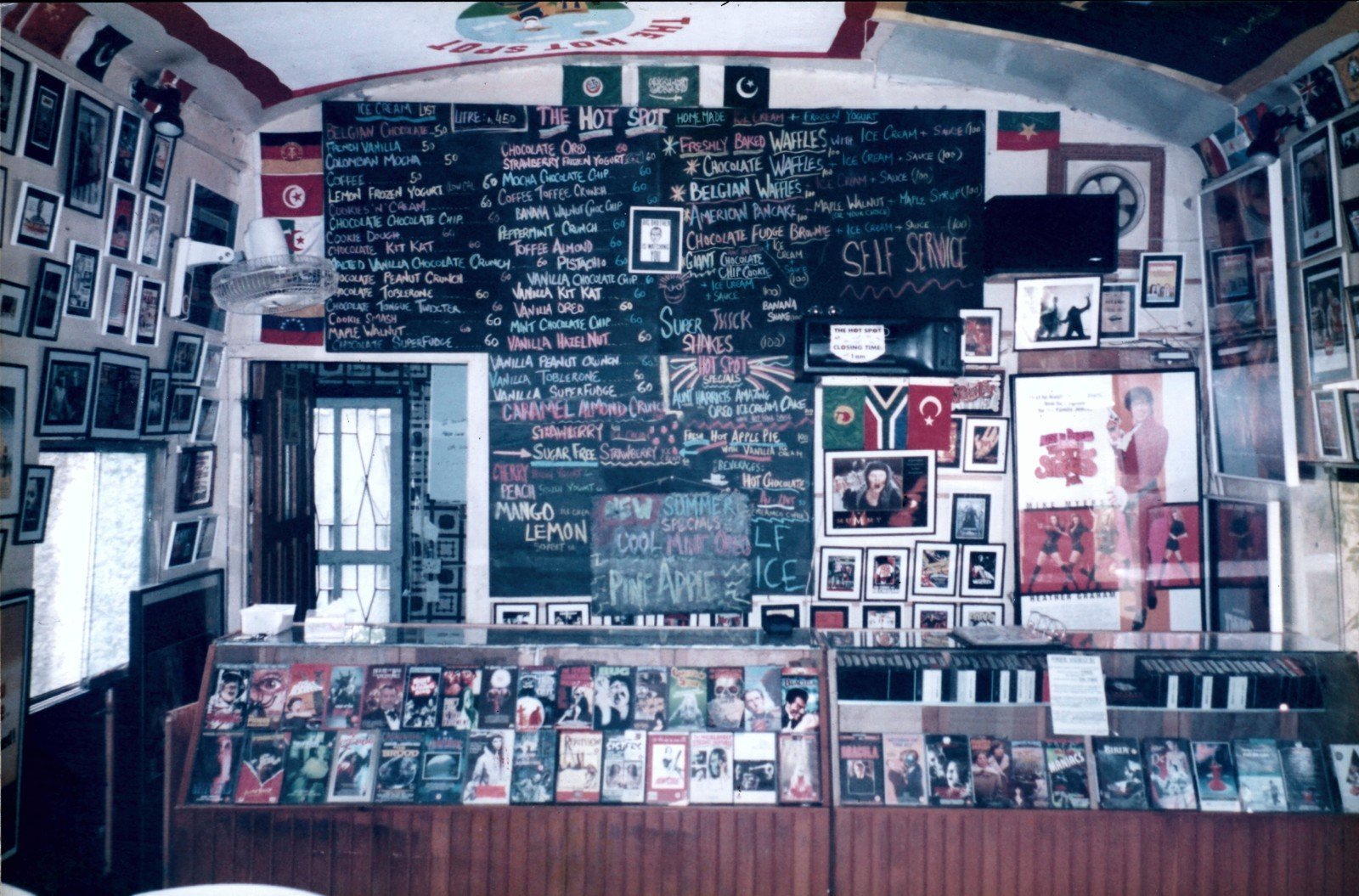
When we started The Hot Spot, we had no money. Once we scraped together enough to rent a space, we had very little with which to decorate it. I therefore fell back on the horror posters and film memorabilia I had collected whenever I'd had a little money in my pocket.
We filled shelves with VHS tapes of filmmakers who hadn't been accessible to previous generations of young people in the city.
We turned a generation weaned on the mainstream and James Bond onto films such as Eraserhead and The Texas Chainsaw Massacre. We held festivals screening horror movies from Japan, Korea and elsewhere.
Our music followed the same path.
Many old customers have since told us that The Hot Spot opened doors onto a world they hadn't previously explored. They didn't know Divine, Tobe Hooper, John Waters, William Castle or John Carpenter.
Their world had been dominated by the mainstream.
Ours tended to wander a little off the beaten track.
It wasn't to everyone's taste, but many relished the broadening of horizons and what The Hot Spot represented.
While Pakistan rocked to U2, we were playing early Britpop. U2 and The Police ruled; we played Prince and Little Richard. Bob Marley was universal, but we played Sly & Robbie, dub and early dancehall. Michael Jackson, ABBA and Boney M were huge; we played Stax, The Time, Cameo, Slave, The Gap Band, Kraftwerk, Tommy Boy, Wilson Pickett, Otis Redding, Aretha Franklin and James Brown.
While Nirvana and Seattle gripped the youth, we were all Oasis, Blur, The Verve and Pulp.
There were no cinemas in our cities then, so we screened obscure films: Hitchcock, Tod Browning, Terence Fisher, Dario Argento, Lucio Fulci and even Russ Meyer.
Again, it wasn't to everyone's approval.
We followed our path anyway.
Open the door of the Islamabad shop and one of the first things you saw was Divine extolling the virtues of being the Filthiest Person Alive.
Not everyone approved.
But this was us being us.
Take it or leave it.
Many left it, and that was their choice.
Diversity was encouraged, tolerance of different opinions and outlooks was nurtured, and creativity, freedom and individualism hung thick in the air.
We started a newsletter and began writing film reviews. Then the Internet arrived and we graduated to publishing online.
We covered all sorts of cinema, but with a particular emphasis on Cult and Horror from around the world—from North Korea's Godzilla movie to pre-1930s silent cinema, Herschell Gordon Lewis and the Ramsay Brothers of India.
We also wrote about Pakistani pulp cinema and had a significant hand in catapulting a handful of films into the realm of international cult movies.
Films such as Haseena Atom Bomb, La Khwar Lasme Spogmay, Hitlar and Adam Khor attracted attention, and people around the world began seeking them out.
Haseena Atom Bomb became far more famous internationally than many respectable Pakistani films. Hitlar became better known in cult circles than blockbusters such as Munda Bigra Jaye or Haathi Mere Saath or Heer Ranjha.
A handful of dreadful Pashto films ended up with more international coverage than some of our established "classics", largely because we had written about them on our website.
Cinema enthusiasts began taking notice. The Hot Spot Online became a resource for obscure, weird and wonderful Pakistani cinema rather than the kind our officialdom preferred to promote.
And then an email arrived.
We took it with a pinch of salt and ignored it.
Bringing Zinda Laash Back from the Dead
We began receiving emails from a company called Mondo Macabro. They wanted to talk to us about Indian horror movies we'd written about.
As it happened, The Hot Spot was preparing an exhibition of cinema street art in London, so we arranged to meet the dynamic duo behind Mondo Macabro, a boutique DVD company specialising in acquiring and releasing weird and wonderful cinema from the far-flung corners of the world.
It was very much a business driven by passion and love for its subject rather than simply chasing cash.
Our London exhibition took a surreal turn. Paintings that were bizarre, insanely over-the-top and comical suddenly became frightening reflections of brutality and terror because the opening coincided with one of the most shocking events in modern history.
As we completed preparations for the exhibition at London's Commonwealth Institute, news came in of disaster striking New York City.
The world changed overnight.
Everything associated with the Islamic world suddenly took on ominous and threatening tones.
An image of Sultan Rahi flying through the air with a baby in one arm and a bloodstained dagger in the other had previously looked like a bizarre madcap Pakistani Superman. Suddenly it appeared far darker.
Our exhibition of hand-painted Pakistani cinema posters was nearly cancelled.
It went ahead, but the humorous images were now viewed through a very different prism.
Meanwhile, the bonding with the Mondo Macabro team went spectacularly well. We had so much common ground.
Horror and Cult cinema dominated our conversations, and among the posters we'd commissioned for the exhibition was one for an old and largely forgotten Pakistani vampire movie called Zinda Laash.
I told Pete Tombs how the film had fascinated me as a child and how it had apparently vanished. Unlike most Pakistani films, it hadn't surfaced on VHS. It seemed to have slipped into an abyss and been lost forever.
Pete remarked that vampire films from anywhere in the world invariably fascinated movie buffs.
That conversation ended with me making a few telephone calls to Lahore and asking an associate to scour the studios for any trace of Zinda Laash.
A few days later I received a call.
Some grubby, rusting tins had been discovered among rubble and refuse in the bowels of Evernew Studios. We smelled deep, dark trouble just as Divine had in Pink Flamingos.
There was a glimmer of hope that they might contain Zinda Laash.
What remained to be seen was whether anything had survived and what would be left of it.
I was eventually informed that it was indeed Zinda Laash. It was battered and possibly far from complete.
When I returned to Lahore, we arranged to unspool whatever remained. In a tiny room, with equal amounts of excitement and trepidation, we threaded the film through a projector and hit the switch.
Miraculously, it flickered to life.
There was that glorious vampire film, unspooling before our eyes.
At any moment the film could have snapped, burned or disintegrated, but minute by minute it continued.
One or two sequences were extremely ropey, and the image threatened to collapse, but somehow it held together.
The first reel played.
Then the second.
Then the third.
Then the rest of the film.
Excitedly, we informed Mondo Macabro that the material had survived and set about sorting out the necessary legal documentation with the film's producers.
Papers were signed, stamped and registered through the courts, and before long those battered tins were on their way to England for an attempt to salvage a film that had been dead and buried for decades. Eerily reminiscent of Count Dracula's journey to England all those years ago.
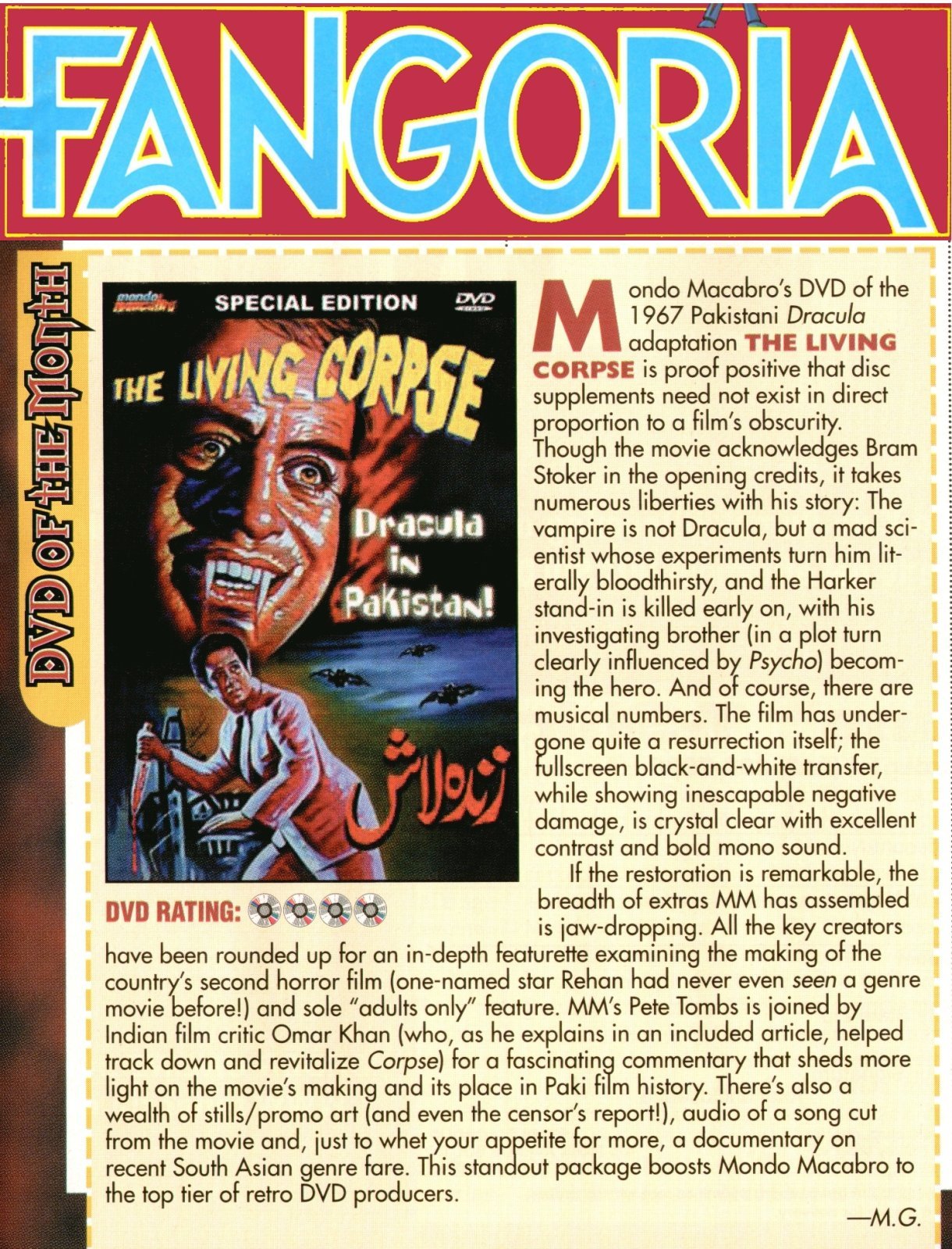
Mondo Macabro eventually cleaned it up and restored it to some semblance of health—enough for us to issue it in October 2003 as the momentous return of a long-lost Dracula movie from Pakistan.
The first Adults Only film ever made in Pakistan.
Now known worldwide as The Living Corpse and Dracula in Pakistan.
We recorded a commentary track using information I had gathered from the people involved in its production: Habib, the driving force behind the film; Rehan, whose imposing portrayal of the vampire became the heart and soul of the movie; and its director, Khawaja Sarfaraz.
I interviewed them all.
Each was thrilled that this forgotten film, largely ignored in Pakistan for decades, was finally going out into the world.
When the DVD appeared, the international horror fraternity embraced it warmly.
Fangoria, the bible of horror movies, named it DVD of the Month, while other respected publications and websites showered praise on the release.
It was heartwarming.
There was more to come.
Horror and fantastic film festivals wanted to present it, and Zinda Laash began screening at some of the world's most prestigious genre festivals.
Then I received an email from the Sitges Film Festival inviting me to attend a screening of Zinda Laash and to serve on the jury for the feature films in competition.
It didn't quite sink in.
Pete Tombs told me there was another Omar Khan from Colombia who wrote about film, and that they obviously wanted him, not me.
I agreed.
To make sure, however, we contacted Sitges.
They wanted the Omar associated with horror writing and Zinda Laash.
Me.
Upon arriving at Sitges, I was given more respect, love and honour than I could ever have imagined.
Mike Hostench and his team were incredibly generous and welcoming. The entire experience was surreal. Suddenly I was surrounded by directors, producers and actors I had idolised.
Eating, drinking and chatting with people such as Tobe Hooper, Screaming Mad George, Paul Naschy, Brian Yuzna, Craig Harrington and Takashi Miike.
Zinda Laash had led me towards some of the most incredible experiences of my life.
I dived headlong into them.
And that experience directly affected my life and the birth of the film that eventually became Zibahkhana.
One evening, while waiting for an in-competition film to begin, the usual banter among the jury members began.
One of them was the larger-than-life Hamish McAlpine, who had enjoyed enormous success with the Tartan DVD label, particularly during the wave of Asian cinema that flourished in the 1990s. He had significant influence in movie circles.
At one point I mentioned a script I had been playing around with.
In semi-jest, Hamish pulled out his chequebook.
It was precisely at that moment that Zibahkhana stopped being an amusing thought and became a goal.
And Then There Was Zibahkhana
There was another inspiration.
My father.
He was writing avidly and having his work published regularly.
It struck me that after a lifetime devoted to horror movies, Lollywood movies, studying cinema, writing about films and making atrocious little shorts on video, it was time to take some concrete steps rather than remain one of the millions who endlessly talk about making a movie but never actually make one.
A few lines scratched onto the pages of a notebook began to gain momentum.
The dream started to look like a distinct possibility, particularly with Pete Tombs avidly aiding and abetting me and eventually collaborating when my rough draft needed beating into something resembling a proper screenplay.
I deliberately shaped the film as a vessel for my love of all the horror movies that had shaped me.
Zibahkhana brimmed with nods, winks and tributes to the great maestros.
In the old hag Madam Zimba's lair, we placed three or four stone flamingos painted pink—a nod to the great John Waters.
When our Chainsawesque hitchhiker meditates inside his little hut of insanity, among the rubble is a 12-inch copy of Prince's Let's Work.
OJ wakes up in a room filled with horror paraphernalia: a Bride of Frankenstein mask, DVDs including a Ramsay Brothers movie and a poster for Joe Spinell's Maniac.
The soundtrack is littered with snippets of classic old-school Lollywood.
Hardly a minute passes in Zibahkhana without a little nod to filmmakers and movies I loved.
Then there was Hitchcock.
Adnan Malik was the best-known face in the film because he'd appeared in some prominent Pakistani advertisements.
He was our Marion Crane.
The potential hero felled long before his time.
There is another little nod to Psycho and Marion Crane's escape when Simon's father crosses the street and happens to recognise his son in a van and had lied about where he was going.
Zibahkhana became a love letter to the great horror movies that formed my world.
It breathed the same air as The Texas Chainsaw Massacre and The Evil Dead.
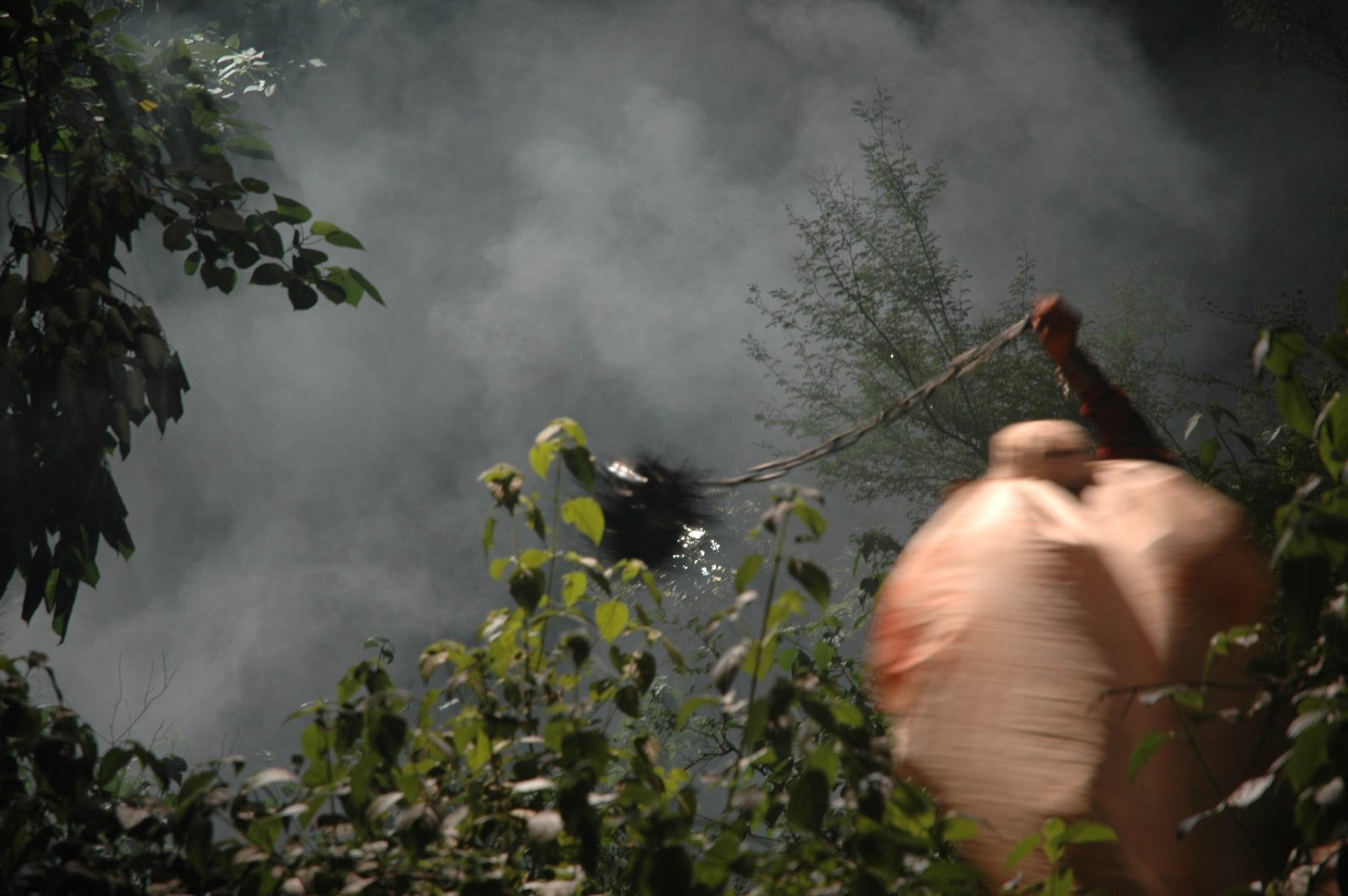
Our killer was going to be masked in the tradition of Leatherface, Michael Myers and Jason, but I had to find the right regalia.
What kind of mask could fit a slasher movie without becoming the usual Cupid mask or something bought in a supermarket, while still looking terrifying?
Then one night the bolt struck.
The Burqaman was born.
I knew a few feathers might be ruffled, but visually it was perfection. The motivation behind it had absolutely nothing to do with society or faith.
Another influence was a much more recent movie I had fallen in love with: Alexandre Aja's Haute Tension.
During the climax of Zibahkhana there is an extended chase inspired partly by Sally Hardesty fleeing her pursuer. Nobody could ever match the intensity of Tobe Hooper's masterpiece, but we tried our best to salute it.
In fact, the original ending we shot—which really ought to surface on a Blu-ray one day—would probably have produced groans from knowledgeable audiences because it wandered into Chainsaw territory to ridiculous levels.
Sense prevailed.
That ending stayed on the chopping block.
During our chase, however, our Final Girl fights back with a page borrowed from Aja: the tree stump wrapped in barbed wire, followed by a camera shot that, to my delight, captures the tone of his film for just a second.
George A. Romero also contributed his spiritual DNA and so did Lucio Fulci and his Zombie Flesh Eaters.
There was always one zombie in Dawn of the Dead who caught my eye—the Hare Krishna zombie. He was my favourite.
We decided we wanted a zombie who might similarly steal the audience's heart.
Miraculously, our dwarf zombie did exactly that.
The tributes, nudges and winks come thick and fast in Zibahkhana, but the film nevertheless has enough elements unique to itself to give it a distinct identity.
We played every classic horror trick.
One of the most copied sequences in slasher cinema comes when Laurie Strode stabs Michael Myers dead after their confrontation in the closet.
When Halloween established the rules of modern horror, one of the most important was simple:
The monster is never dead.
The audience foolishly assumes Myers is down and out.
Then he rises again.
That moment has been imitated endlessly since 1978.
We shamelessly had to pay tribute to it as well.
It had to be done.
Our hitchhiker was pure Chainsaw territory as he pulled the madness from his little sack.
Then viewers began finding references we'd never consciously put there.
Was the old hag a tribute to hagsploitation?
Was she a sari-clad Mrs Voorhees?
The truth is that despite overflowing with references to classic horror, Zibahkhana has its own sauce in the mix.
All these years later, any parallel somebody draws with a horror movie of the past—whether intentional or otherwise—I take as a compliment.
The bats flying through the air as dawn arrives after a night of terror: was that a nod to Hammer?
Sometimes the choice exists entirely inside the viewer's mind.
There are parallels people have found that we never intended. If they exist somewhere in the subconscious of the film and canny viewers pick them up, so be it.
It adds to the texture.
Finding Our Victims
Preparing Zibahkhana was a long, arduous and winding road, but we had committed to the journey.
There was no turning back.
Pete Tombs' knowledge of screenplay construction was invaluable. He beat my very rough script into something coherent, and thanks largely to his advice we tried to follow the movie-making manual.
Not one role was handed to a friend or family friend.
Every part was auditioned.
We began in Islamabad with people from the local theatre scene.
Osman Khalid Butt had become a creative force in the capital and, importantly, was a horror buff. He was enormously helpful in many ways, not least because his creative insight was always welcome.
We also found our Final Girl in Islamabad.
Rooshanie Ejaz had merely tagged along with her sister and hadn't intended to audition.
We liked her sister very much but somehow felt that her poise and polish lacked the vulnerability we needed.
Rooshanie was persuaded to give it a try.
We loved her.
I took all the audition tapes to London and shared them with Team Mondo, and their reaction confirmed my own. Rooshanie had exactly the vulnerability and natural quality we were looking for.
We moved on to Lahore, where aspiring drama students came forward. One or two made a strong impression.
Simon was cast through auditions held in the basement of The Hot Spot, my little ice cream business that enabled this entire project.
Then came Karachi, where there was a more established acting scene than in either Islamabad or Lahore. We auditioned people with television, music-video and commercial experience.
Some excellent performers came through those auditions.
Several whom we didn't cast subsequently enjoyed hugely successful careers.
Others were simply too stylised by the prevailing television-drama style.
That wasn't what we wanted.
We wanted performers free of affectation, people who could stutter and stumble like ordinary kids rather than deliver dialogue like Amitabh Bachchan complete with those famous calculated pauses.
That style simply didn't work for us.
Adeel Hussain was an actor we particularly liked and hoped to cast, but ultimately our budget couldn't accommodate him. He was our first choice for one of the main parts, but it wasn't to be.
Rubya Chaudhary had caught my eye during an earlier visit to Karachi and I'd actually imagined her while writing the screenplay. It was satisfying that she was available and affordable, and she did complete justice to Roxy, our mean girl.
Saleem Meraj gave a brilliant audition and was already a serious actor on the scene. His intensity and commitment were admirable.
He has since underlined his credentials as one of Pakistan's finest character actors in television and cinema. It was a privilege to work with him.
One unintended consequence of Zibahkhana was that he was subsequently typed somewhat as a manic personality along the lines of his character in the film.
Ali Kazmi auditioned and was very impressive, but we couldn't accommodate him.
Danish Taimoor also auditioned before his career took off and he became a major star. His performance style, however, had already been heavily shaped by the demands of television drama and was incompatible with what we were looking for.
We wanted imperfect young people who spoke naturally.
I had to tackle the local government authorities to secure a permit to shoot a film in Islamabad. When asked what the film's subject matter was, I gingerly offered that it was a documentary-style film on local folklore!
A blatant half-truth if there ever was!
We got our paperwork signed through tact rather than fact.
Many reviewers subsequently complained about the acting in Zibahkhana, but the irony is that we had always wanted our cast to be imperfect and to speak like real people rather than seasoned performers.
I've always felt that dialogue delivery in our films and television dramas is so stylised that it becomes unnatural, yet audiences have been conditioned to applaud precisely that style.
Think Amitabh Bachchan or Shatrughan Sinha, Mohammad Ali or Waheed Murad, along with a plethora of television actors.
We wanted raw kids.
I wanted them to be awkward, to stutter, to hesitate—not to deliver every line with polish and fluency.
Many viewers saw this as a weakness.
I saw it as a strength.
There is a particularly awkward exchange involving Simon and Rooshanie that has had audiences cringing.
It is cringeworthy.
But teenagers are cringeworthy. Teenagers are awkward, particularly in a society where the sexes are often segregated and young people don't necessarily know how to express themselves confidently.
Viewers in Pakistan especially have hated scenes like that.
Yet to my mind they were as awkward as we intended them to be.
It was what the script demanded, not a failure of the performers.
Severed Heads, Chocolate Blood and Guerrilla Warfare
I went on a buying spree.
I invested in two HD cameras that, by today's standards, probably look worse than the average mobile phone.
I also started shopping around for limbs.
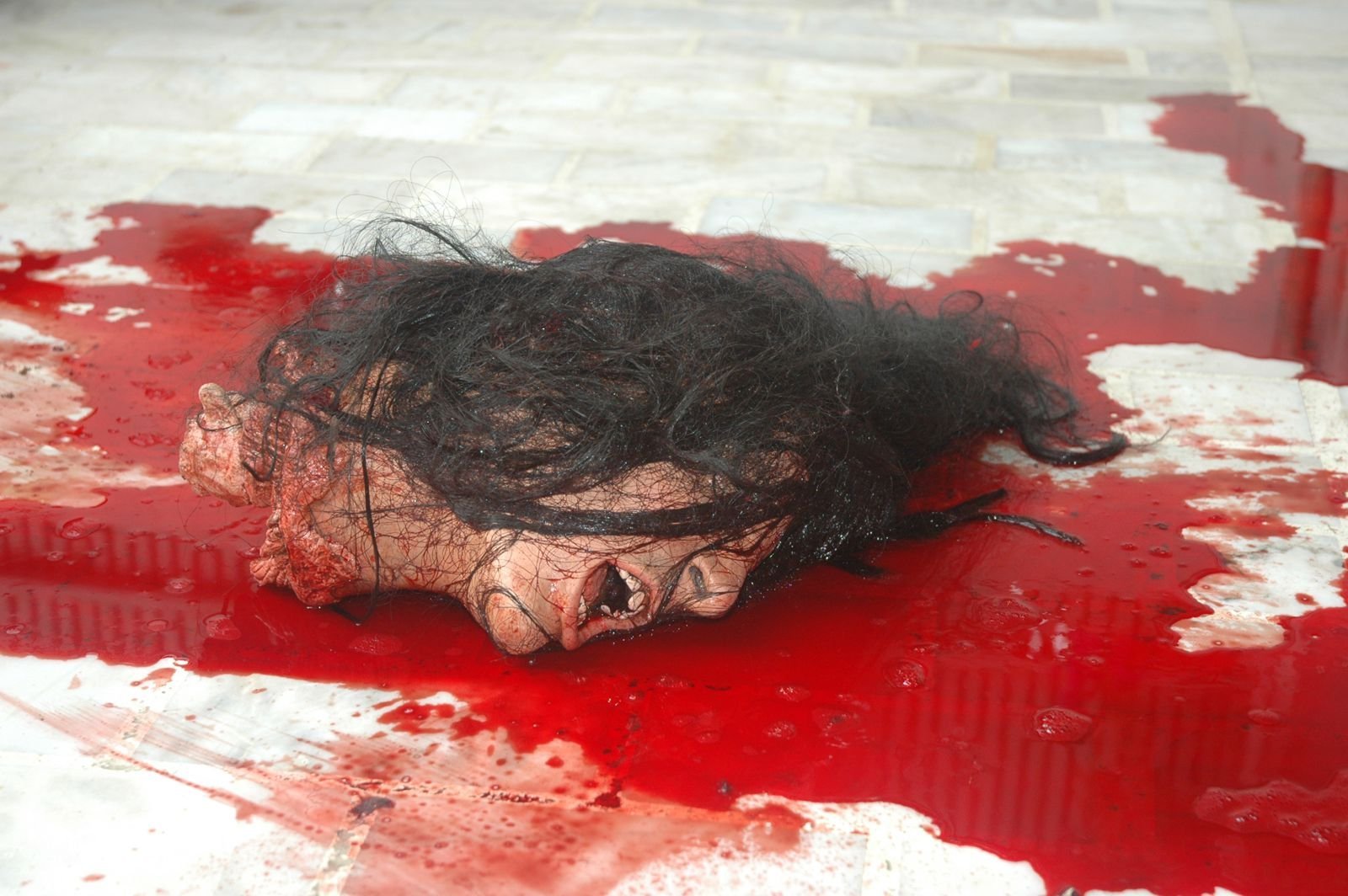
eBay proved useful when we began hunting for severed heads.
We found two.
One was slightly puny but reasonably convincing. The other was apparently discarded from some horror production and looked much more impressive.
Perhaps the most absurd and delightful memory of the entire Zibahkhana process happened at Heathrow Airport while I was carrying these props back.
Security decided to inspect my luggage.
A female security officer opened the suitcase and found a severed head.
Intrigued, she asked what it was.
I gave her the obvious answer.
"It's a head."
She laughed, zipped the suitcase shut and sent me on my way.
With heads, limbs and various other necessities packed into my luggage, I headed back to Islamabad as the shooting schedule loomed.
The auditions had gone well.
We had our cast and crew.
Karachi-based Najaf Bilgrami had been handed the arduous responsibility of the camera.
Had he bitten off more than he could chew?
Initially it looked as though he might have.
He arrived with assistants who relished the chance to work on something completely removed from the television dramas and music videos they normally shot.
The cast bonded quickly, while some experienced character actors came in from Lahore's theatre scene.
They were hardworking and dedicated, though completely unused to anything as ghastly as Zibahkhana.
They attacked the work with admirable enthusiasm. It helped tremendously that Andy Starke of Mondo Macabro had flown in for a week to hold my hand during the initial week of the shoot. Stoic and supportive though nearly wilting in the extreme heat.
I had also befriended veteran actor Rehan, the great vampire from Dracula in Pakistan, and pleaded with him to emerge from a very long retirement for a small but important role.
Our work together on the Zinda Laash DVD had created an excellent rapport.
He agreed, somewhat gingerly.
Making the movie itself became guerrilla warfare.
We fought mosquitoes, intense heat and the oppressive humidity of July's mid-monsoon season in an Islamabad that had not yet been shorn of so much of its jungle and greenery.
On the first day, everything that could go wrong did.
I nearly electrocuted myself and became momentarily stuck to the mains board before managing to free myself.
Literally a shocker of a start to the movie.
Not particularly auspicious.
Our lighting was woefully inadequate. The early footage looked fuzzy and dim.
Najaf was feeling the heat.
He'd hoped to make the film a showcase for his abilities and felt the situation was letting him down badly.
We shot ropey footage until the early hours, but however hard we tried, everything remained underexposed.
The next day followed much the same pattern, with Najaf practically tearing out what little hair he had left.
That night's shoot ended in tears.
He felt he'd failed everyone.
We sent an SOS to Evernew Studios in Lahore asking them to provide a crew with proper lighting so Najaf could achieve what he knew he was capable of.
The tears dried.
After two extremely dodgy days, we finally started shooting the film in earnest.
Then another problem began brewing.
Our assistant director, with well-meant but misguided enthusiasm, started imposing new ideas onto a screenplay that Pete and I had already agreed upon.
At the beginning of each schedule there seemed to be another plan for how the movie should be shot. It increasingly irritated me because it undermined everything we'd discussed and prepared.
Eventually I'd had enough.
I suggested that my assistant director take his admittedly inspired ideas and use them in a film of his own.
Ten days into production we lost the assistant director, who returned to Karachi with his lovely wife and her very talented sister, who had been serving as our art director.
Once that excess baggage was offloaded, the spirit of the shoot improved tenfold.
Everyone threw themselves into the work with gusto.
One of our key roles was the Burqaman.
For the part we signed an actor from Punjabi cinema who had worked as Sultan Rahi's stunt double.
Sultan Billa required coaching, so we showed him The Texas Chainsaw Massacre and told him to study Leatherface's body language.
It didn't take him long.
He delivered a spectacularly solid performance.
Rehan initially struggled to shake off decades of rust, but after two or three shots the old sparkle came flooding back.
He tucked into his role as a desi Crazy Ralph with relish and imposed himself on the movie as only he could.
After the initial scenes around the house and city streets, we set up home in the Rawal Lake area. At the time it resembled thick forest, exactly what the script required.
One afternoon two pangolins appeared.
Sadly, that endangered species has since been virtually wiped out from the area.
We also had a moment of panic when two enormous monitor lizards graced the production briefly before disappearing into the foliage.
One member of the camera crew came down with dengue, but generally things proceeded according to plan, with delays here and there but nothing catastrophic.
Shoots frequently dragged on until dawn.
Local policemen would often sit around enjoying their chai and watching us work as free entertainment.
Then came one particularly unfortunate experience.
For the Burqaman's lair we had practically emptied half a butcher's shop to create the appropriate nastiness.
Unfortunately, the meat began to rot.
The stench was horrendous.
We had also found the rotting carcass of a cow and suspended it above the Burqaman's butcher's table. Visually it looked spectacular—straight out of The Texas Chainsaw Massacre.
It came with side effects.
Maggots.
The carcass was infested with them, and during one shoot they got inside my clothes and chewed the hell out of me.
I had to flee, leaving Najaf in charge of wrapping things up.
A suitably ghastly experience.
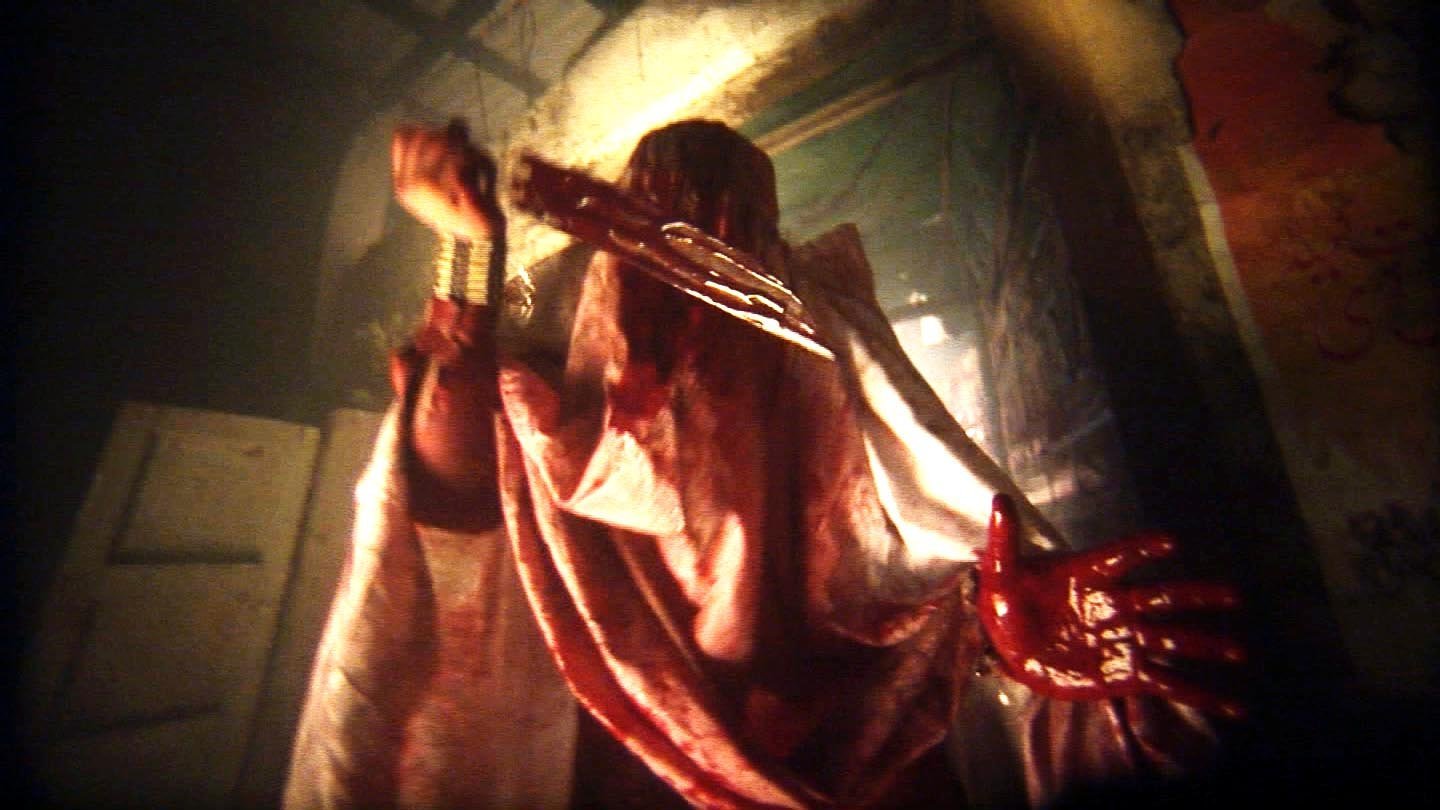
I must admit, however, that I remain particularly proud of the blood.
I'd read Tom Savini's books on make-up and gore and used them as a guide.
I've watched countless movies before and since Zibahkhana. Given our minuscule resources and budget, most are films we could never hope to compete with.
But I will stand by our blood.
It remains some of the best I have seen in a lifetime of horror viewing.
My concoction included chocolate sauce among its ingredients.
A personal triumph!
The final scenes involved another tricky bit of smuggling. In Islamabad, horse driven carts are not allowed entry so we had to smuggle ours cloaked in darkness and using the back streets to make it to our shooting space. Eventually all the horse cart scenes were never used in the final cut of the film, but more on that later. Those scenes with Rooshanie making her getaway, Osman as a Fulciesque zombie and the Burqaman battling it out were the last scenes of the initial Zibahkhana shoot.
By the first week of August 2006, the shoot was finally over.
Everyone went home exhausted and sleep-deprived for a well-deserved rest.
The effort had been magnificent, every member of cast and crew giving their best and then some.
The camaraderie survived, and once we had shed our excess baggage ten days into production we were tension free.
A couple of people emerged as heroes in my eyes.
Nawab Saghar had spent his life doing make-up, including the very occasional horror film in Pakistan. He was a quiet man who gradually emerged from his shell and began relishing what we asked him to do.
He had never received any meaningful recognition for his work in Pakistan.
He lived close to poverty, simply trying to remain employed.
I've always believed that had he been born into another, more appreciative environment, he might have developed into someone on the level of Tom Savini.
At first the demands of Zibahkhana overwhelmed him.
We made him watch horror classics featuring extreme gore and make-up, and some of it unnerved him.
He also felt intimidated by people making demands without properly walking him through the process.
Once we settled down and removed the unwanted advice, his confidence blossomed.
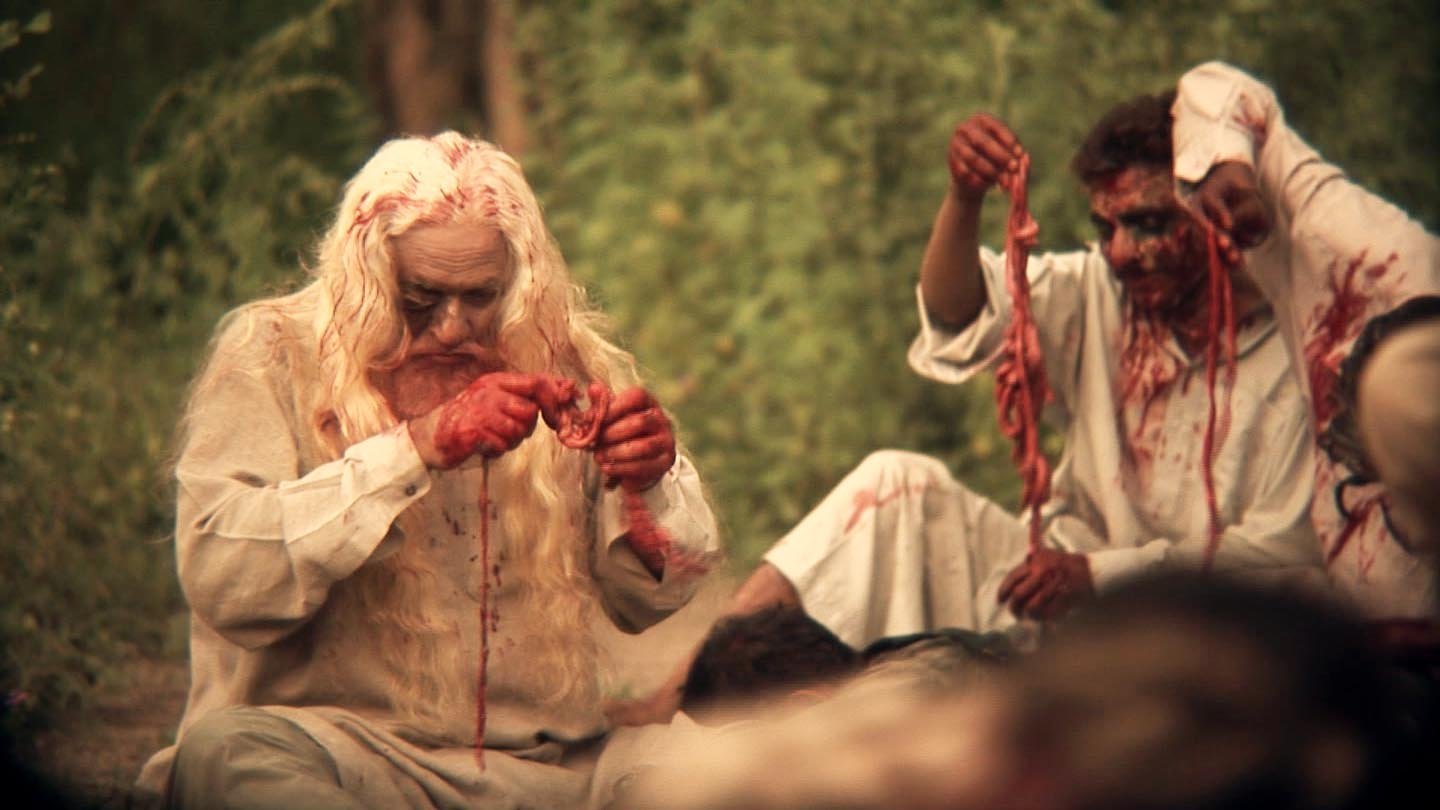
His finest hour came during the zombie shoot.
With next to nothing—paint, oil, gauze and Vaseline—he created astounding results.
He followed instructions precisely while ensuring that every zombie looked slightly different.
The bearded zombie with the eyeball hanging from its socket, the dwarf zombie, the female zombies—all spectacularly transformed by a man who rose to the challenge and exceeded every expectation.
Nawab Saghar's effort, his gentle manner and his devotion to his craft became a very special ingredient in Zibahkhana.
He and his contribution remain alive in my memory.
Another champion was Najaf Bilgrami, who put in a Herculean effort despite the setbacks and challenges.
Initially distraught because he believed he couldn't raise his game to the level required, he eventually gritted his teeth, embraced the challenge and did an extraordinary job in incredibly difficult conditions.
When many of us were flagging, Najaf drove us forward.
As his confidence grew, it carried the rest of us with him.
His work speaks for itself.
Zibahkhana had no right to look as good as it did.
Najaf did our zero-budget Grindhouse roots proud
 .
.
Finding the Film in the Editing Room
Later, when Andy Starke and I began editing the footage, I was embarrassed.
To my eyes I'd presented him with a jumbled mess of badly thought-out material.
Andy breathed life into something we didn't know was there.
He gave it momentum.
He gave it energy.
He gave it an edge.
Most importantly, he removed all the self-indulgent flab I would never have had the courage to chop away myself.
From that mass of raw footage Andy shaped a film that moved at a snappy pace and rarely gave the audience enough time to dwell upon its shortcomings.
I could hardly believe that Andy had transformed an impossible situation and suddenly this shambolic mess resembled a real movie.
A movie with character and energy.
That in itself was an enormous achievement.
We did have to reshoot the climax.
Our original ending—with a horse-drawn carriage, a confrontation between the zombie and Burqaman and the final escape—was worship of The Texas Chainsaw Massacre taken several steps too far.
We went back and modified it.
Nawab Saghar once again worked his magic.
We also had to gather the main cast to dub the film, as all our filming had been done with a power generator running, making the "live" sound unusable. Fortunately, all the dialogue was fresh in memory, and it proved remarkably smooth to fix the audio track. I went around Lahore and Karachi collecting sound bites from all the other performers, and we had everything that we needed for Andy to work his magic, which he duly did.
By the end of the year, the film was complete.
Now we had to unleash it upon the world.
The response would include the good, the ecstatic, the horrible and the very, very ugly.
Unleashing the Monster
Our world premiere took place on March 30, 2007, at the NatFilm Festival in Copenhagen.
It wasn't a horror festival, which made us rather nervous about how people would respond.
A Pakistani man living in Denmark who ran an encyclopaedic website devoted to Pakistani cinema contacted me and said he would attend.
He never materialised.
Or perhaps, more likely, he was thoroughly embarrassed by what he saw, because Zibahkhana was indigestible for many people weaned on "proper" Pakistani cinema.
It ripped up the conventions.
Many Pakistani viewers hated the film precisely because it dared to depart from the norm.
In that sense it did exactly what it was designed to do.
It was made with passion and exuberance, but underneath all that gore was an intention to shake up a film industry stuck in inertia, churning out the same safe, pedantic and sterile product year after year in relentlessly formulaic fashion.
Zibahkhana was supposed to be the cat among the pigeons.
It was supposed to gate-crash the party and shake things up violently.
A little like the Sex Pistols of Pakistani cinema.
It was created to ruffle feathers.
At Copenhagen I remember looking at the film blown up onto a large cinema screen and becoming increasingly concerned about just how ropey it looked.
This was no 4K sharpness.
It was fuzzy, brash and nasty.
How on earth would the world react?
Fortunately, those who understood Grindhouse and loved their Chainsaws immediately understood where the film came from and where it belonged.
The Pakistani website man was apparently so offended that for years he refused even to list Zibahkhana as a Pakistani feature.
It was as though the old school couldn't accept that Pakistani cinema might also be represented by something so subversive and shameless.
Our film certainly wasn't a depiction of the nation and its people in the way the state liked Pakistan to be represented.
I frequently received angry comments accusing us of misrepresenting the country.
But Zibahkhana was never supposed to be the prescribed advertisement for life in Pakistan.
It was a fictional horror movie, not an advertisement for Naya Pakistan!
It wasn't polite.
It wasn't pretty.
It wasn't socially or politically correct.
Many people hated that.
The following week, our North American premiere was in Philadelphia.
My great friend Hussein Ibish, a partner in crime and long-suffering companion through scores of trashy horror films, drove up from Washington DC to see it.
I wasn't sure how the screening went down, but the festival organisers seemed pleased. Better still, a Philadelphia-based DVD label acquired the home-video rights.
Again, this wasn't an exclusively horror festival. Respectable filmmakers and stars were wandering about.
One morning I foolishly asked a young man sitting in a lobby what he was doing at the festival.
He said he'd brought a film over.
Later I discovered that the young man was Jonny Lee Miller.
I felt rather foolish.
But it was wonderful spending time with Hussein.
He probably knows and understands my psyche unlike anyone else on the planet. I have enormous love and respect for a friend who has always been true.
A couple of months later we headed for the New York Asian Film Festival.
Pete and Andy—the Mondo duo—would be there, so at least I had accomplices with whom to share the notoriety.
The day before the screening we were appearing at a horror convention in the city.
I was enormously excited because the bill was shared with Betsy Palmer, one of horror cinema's icons after playing Mrs Voorhees in Friday the 13th.
The convention was tremendous fun, with people connected to all manner of classic horror films milling around.
Meeting Betsy became one of the cherished moments of my life.
I'd brought a Pashmina shawl from Pakistan for her. Once I'd summoned the courage to introduce myself and give it to her, we got on like a house on fire.
She was exceptionally warm.
We nattered about her films, and I bought several signed photographs from her, particularly one showing her head inside the refrigerator in Friday the 13th Part 2.
She also showed me photographs from an entirely different phase of her career, when she'd been a gorgeous young actress playing opposite Ronald Reagan as his romantic lead.
Then came another surreal moment.
After appearing in front of a large crowd at the convention, I sat signing autographs until my hand began cramping after a few hundred.
Total madness.
Among the people waiting for an autograph was one of my former students from Islamabad.
That was a lovely surprise.
It was the week of the Fourth of July, and everyone seemed in high spirits, and our film poster was proudly displayed in the lobby.
People chuckled at the trailer, particularly when my grave voice announced:
"Pakistan's first extreme horror movie."
Every time they heard the word extreme, there were giggles and muffled laughter.
The word had acquired an unfortunate additional meaning in those days.
No fault of mine!
I also spent an afternoon with Frank Henenlotter.
We talked horror and ate pizza.
It was an enormous honour that our New York screening was taking place at the iconic Waverly cinema, where his own cult classic Basket Case had opened all those years before.
Frank was a charming man. He attended our screening and very kindly refrained from saying anything nasty about the film.
He also gave me a disc of Black Devil Doll from Hell from his collection, for which I remain eternally grateful.
The screening itself became a day whose memory I will cherish until my last breath.
It began like any other.
Pete, Andy and I were sitting in the Village drinking coffee when we asked one of the festival organisers how many tickets had been sold for that night's Zibahkhana screening.
He congratulated us.
Fourteen.
It didn't seem like very many, but we were pleased that fourteen people were willing to come.
An hour later the figure was thirty-one.
When we'd finished our coffees, we wandered over to the Waverly.
There were no tickets left.
Sold out.
I returned to where I was staying with a man who was like a father to me but also an extraordinarily highbrow cinema watcher.
Mr Iqbal Riza would never be caught dead watching a Hollywood movie. His universe consisted of highbrow art cinema from around the world.
Hollywood didn't figure.
I showered and got myself ready for the screening on the night of July 3.
When I arrived, the scene was overwhelming.
A queue stretched around the block despite every seat already being sold.
As the film was about to begin, people rushed for any available space. Chairs were brought into the auditorium in violation of Fire Regulations. People sat in aisles and even on the floor.
Pete, Andy and I gave up our seats and sat on the floor ourselves for half an hour, trying to gauge the audience's reaction.
New York seemed engrossed.
They laughed, shouted and screamed in all the right places.
The three of us eventually slipped outside for a drink, partly to calm the nerves and partly to pinch ourselves.
It was a night to remember. - eternally grateful to Grady Hendrix and the Asian Film Festival crew.
What an audience.
The icing on the cake came when I stood onstage to introduce the film and spotted Uncle Iqbal Riza among the crowd.
He wore the biggest smile.
His eyes were twinkling with pride.
It was an incredibly special moment.
That night I walked about fifty blocks home, my feet barely touching the ground.
The next morning Monsieur Riza delivered his critique. He was perceptive enough to pick up on all sorts of subtext buried between the lines.
He loved it.
Life was beautiful.
After New York came Toronto and then dozens of festivals around the world, though sadly I couldn't accompany the movie much beyond those early screenings.
Zibahkhana travelled from continent to continent.
Loved and hated in almost equal measure.
One of the more irritating reviews came after Toronto.
The reviewer was perfectly entitled to hate the movie. What annoyed me was his claim that the characters constantly switching between Urdu and English was a cheap, cynical device designed to broaden the movie's international appeal.
Had he done the slightest research, he might have discovered that young people in the large cities of former British colonies routinely mix Urdu, Hindi or Bengali with huge quantities of English in ordinary conversation.
It is simply how we speak.
Yet here was someone attacking the film for doing precisely that.
We received plenty of poor reviews.
That's fine.
This particular one stayed with me because the criticism came from ignorance masquerading as insight.
Later that year, my brother was hosting a university film festival at LUMS in Lahore.
I asked him to throw the Zibahkhana trailer onto the screen at the end of one evening to test the waters.
He called the next day.
The reaction had been off the charts.
We hastily decided to hold the Pakistani premiere on the closing night of the LUMS festival.
Team Zibahkhana congregated in Lahore.
There was a palpable buzz outside the auditorium. Guests from the Lollywood establishment appeared, along with representatives from major media houses.
I introduced the film.
Every seat and practically every inch of the auditorium filled within seconds.
Fortunately, I had additional copies.
We opened a second auditorium.
That filled.
Then a third.
That filled too.
This was becoming ridiculous.
A fourth auditorium opened.
Packed to the rafters.
My brother asked whether I had another copy.
I had one.
A fifth auditorium opened.
Five simultaneous screenings of Zibahkhana were now taking place inside the LUMS complex.
Pandemonium.
I'd originally planned to sit quietly in a corner and observe how one audience responded.
Now there were five halls full of people.
I sat outside and judged the reaction by the laughter, hooting, screams and, occasionally, the moments of silence.
It went beyond anything we'd imagined.
And at that moment I had my answer.
We needed to try to release the film commercially.
Young people were clearly fascinated by it, and I believed audiences deserved exposure to something as radically different from the norm as Zibahkhana.
That meant entering another chamber of horrors.
The Pakistani censorship system.
Censors, Cinemas and Disaster
I began the process of acquiring a censor certificate and completing the paperwork necessary for theatrical release.
Pakistan's fledgling multiplexes were just appearing and dominated by mainstream Bollywood and Hollywood films, with the occasional Pakistani movie thrown in.
Punjabi cinema wasn't part of multiplex culture.
A few major players controlled access.
Convincing them to give a tiny unknown horror movie screen time would be difficult.
Cinepax in Rawalpindi was a welcome recent addition, doing brisk business in a country starved of decent cinemas.
First, however, came the Censor Board.
We persuaded them to arrange a screening.
I waited outside wondering what on earth their reaction would be.
I knew they'd be shocked. The film bore almost no resemblance to the image of "culture", lifestyle and cinema that the state liked to present.
On the appointed day, not one member initially arrived.
Eventually a black Mercedes appeared and deposited a bigwig from the state apparatus.
Half an hour later he emerged fuming.
How could such a monstrous film have been made?
How could it possibly be allowed to exist?
Not one other member attended.
Fortunately, I'd done my homework.
I'd read their rules.
Whether a censor liked a movie wasn't one of the criteria for refusing certification.
Pakistan's antiquated censorship regulations laid down certain boundaries.
Our film didn't contravene them.
I had also watched enough gratuitously violent Punjabi and Pashto films over a lifetime to know what these same censors had happily certified.
Movies filled with rape, revenge, murder and mayhem. Films dripping with hatred towards other cultures and faiths.
I refused to go away.
Every time they objected, I returned with an answer.
My film wasn't intended as a promotional advert for Pakistan.
That didn't mean it violated their own rules.
A few elements undoubtedly pushed boundaries.
Open drug use.
Curse words.
But according to their written regulations, there wasn't much else they could reasonably object to.
I told them to give it an Adults Only certificate.
I didn't want children watching it either.
Then came another excuse.
They claimed they couldn't certify a digital film because their jurisdiction covered film prints.
Back I went to their own regulations, which referred to images displayed on a screen, regardless of the means by which they were delivered.
Eventually the Censor Board became so thoroughly fed up with my daily visits and arguments that, perhaps believing nobody would ever screen the thing anyway, they gave us a certificate.
They requested about half a dozen cuts to moments of gore.
I knew nobody would check.
I didn't make a single one.
Emerging with an Adults Only certificate felt like a major triumph.
Besides, an Adults Only certificate merely added to a horror movie's allure.
Who wants to see a horror movie that children are allowed to watch?
Now came the next mountain.
Finding a cinema.
We had no backing.
No publicity campaign.
No trailers running on television or inside cinemas.
Nothing.
I started knocking on the door of Cinepax Rawalpindi.
Its owner, Arif Baig Mohammad, was Harvard-educated, which gave me some hope that he might be less myopic than most.
I called him.
He politely asked me to send over a copy and said he'd get back to me.
I thought that was probably as good as it was going to get.
A few days later he telephoned.
He'd enjoyed the movie.
He'd screen it.
Suddenly, our independent film, totally unconnected to media houses and without any institutional backing whatsoever, was heading to a multiplex.
There was one technical problem.
Back in 2007, the cinema couldn't project our digital format.
I had to provide them with a projector.
Once we'd sorted that out, I delivered a single poster to advertise the film.
The rest was up to fate.
Zibahkhana opened with a couple of shows each day.
I went along to see whether there would be an audience at all.
This was the true litmus test.
Not university students.
Ordinary cinema-going punters from different backgrounds and age groups, each with their own ideas about what they did and didn't want to watch.
The first good sign was that the auditorium was fairly packed.
I'd estimate about 90 per cent full.
For a film with virtually zero publicity or public awareness, that was encouraging.
We were competing against the usual Indian films, a Disney release and, if I remember correctly, one of the Bourne movies.
The film began.
There was laughter, plenty of groaning, some silence, a scream or two.
As the audience emerged, reactions ranged from people who'd had a thoroughly enjoyable time to those disgusted by what they'd just experienced.
Fair enough.
A week later, Arif sent me a message saying we'd sold out several shows.
Then during the second week came another message.
Zibahkhana had beaten every other movie in the complex for admissions.
I could hardly believe it.
The film kept playing.
Every week we expected the run to end.
It soldiered on.
After about six weeks, the schedule tapered down to a single late-night screening.
Zibahkhana eventually ran for 11 weeks at Cinepax.
Arif Baig Mohammad proved a man of his word and paid our share exactly as agreed.
It wasn't a fortune.
That didn't matter.
Our tiny film had enjoyed a run beyond anything we had imagined and held its own against productions with budgets thousands of times larger.
Then, about two weeks into the Rawalpindi run, representatives from GEO, one of Pakistan's major media conglomerates, contacted me.
They insisted I give them the rights.
When I explained how happy I was with Arif and Cinepax, they promised massive television support, red carpets, industry bigwigs—the whole machinery.
I was conflicted.
I spoke to Arif.
He generously told me that if I believed going with them was best for the movie, I should do so.
I made an enormous mistake.
I signed with GEO, specifically its youth-oriented subsidiary, AAG.
From that moment, Zibahkhana's theatrical fortunes in Lahore and Karachi took a nosedive from which they never recovered.
One catastrophe had absolutely nothing to do with GEO.
Benazir Bhutto was assassinated just as the Karachi and Lahore releases were getting underway.
The entire country's mood became sombre. Cinemas closed in mourning and out of respect.
Zibahkhana disappeared completely from its Lahore programme without playing a single show.
Karachi turned into a different kind of disaster.
A red-carpet premiere had been arranged.
Najaf and I attended, excited to share our movie with an audience in Pakistan's biggest city and among the glitterati of the official media world.
Then the film appeared on screen.
Our jaws hit the floor.
Only about half the picture was visible.
The top and bottom had been chopped away.
You could see the actors' torsos but not their faces or anything below their knees.
It was an utter disaster.
We ran to the projection room and pleaded with the projectionist to stop the screening, correct the image and restart.
He claimed there was very little he could do.
So the film continued like that.
Nobody seemed particularly bothered.
Least of all the people who had supposedly invested in its release.
Najaf and I wanted the floor to open and swallow us.
People emerged politely telling us what a good movie it was when half of it had literally been missing from the screen!
Total disaster.
The film lasted a day or two before disappearing.
I bitterly regretted not remaining with Arif and Cinepax rather than being seduced by the big guns.
I regret that decision to this day.
Worse followed.
A month or so later, a Karachi shop dealing largely in pirated DVDs and music telephoned me.
Zibahkhana had arrived in the pirate market.
What should they do?
It was decent of them to call, but there was nothing I could do.
Once something was out there, it was out there.
I bought a copy of the pirate disc myself.
AAG's logo was burned into the print, suggesting fairly clearly where the source had come from.
After that, I decided never to deal with these media giants again.
I had written regularly for some of them as well, and years later, I was still owed money for articles that had never been paid for.
It was a bitter lesson in the morals—or lack thereof—pervading some of our supposed pillars of morality.
Lesson learned.
Never deal with these people unless you are prepared to get burned.
And I take the blame.
I should never have allowed myself to be sucked into it.
I did.
The film paid the price.
India and the Release That Never Happened
A few months later, during the summer of 2008, we were invited to Delhi for a screening at the Osian's Film Festival.
I was fascinated to discover how a Pakistani independent splatter movie would fare at an Indian festival where pseudo-intellectual cinema was more the norm.
Ramchand Pakistani, the perfect festival movie, had been received warmly.
We were scheduled a day or two later.
Once again, I was delighted to find a large crowd filling the hall for Zibahkhana. Lots of young people, some who looked like beatniks and many who appeared curious.
Exactly the right audience, I thought.
Before the screening, a man associated with the local Jamia Masjid accosted me and attempted to fill my ears with some gibberish I had no intention of taking seriously.
The movie played.
It went down extremely well.
The Delhi audience connected with it, laughing loudly in all the right places and seemingly enjoying something as subversive and unexpected as Zibahkhana, with no overt political or social sermon attached.
Those things were buried between the lines.
They were never intended to be preachy.
The screening was a major success.
We went home elated, though not before the Jamia Masjid gentleman accosted me again.
This time he was mortified.
How could I possibly have made a film as offensive as this?
I took that as an honour.
I explained that Zibahkhana didn't represent the state and wasn't supposed to.
It was fictional horror.
Its purpose was to entertain, not preach.
The following day, my mother, who had accompanied me on the trip, and I battled Delhi's suffocating traffic to have dinner with some of my father's close, very dear relatives.
When we arrived, I was deeply touched.
Nawab Mansur Ali Khan and his lovely wife had taken the trouble to collect newspaper cuttings about the Zibahkhana screening for me.
It was such a warm gesture.
I will never forget it.
Aunty Rinku—Sharmila Tagore—strongly encouraged us to fly to Mumbai and approach the major movie companies about releasing Zibahkhana in India.
We took her advice.
An appointment was arranged with PVR.
Their executives had already heard about the buzz surrounding the movie.
Although we told them we intended to meet other people, they insisted that PVR had both the structure and the will to release it properly.
To our delight, papers were signed.
We had a deal.
The plan was to open Zibahkhana in approximately fourteen cinemas across selected Indian cities where PVR believed it would connect best with an urban audience.
We were elated.
Unlike my experience with GEO, these people seemed genuinely engaged. Their intentions were clear; they understood the movie and knew exactly who its audience was.
They also understood how to market it.
There was only one delay.
PVR was in the process of upgrading cinemas for the growing number of digitally projected films, and they wanted to release Zibahkhana around Halloween, when interest in horror would naturally rise.
It seemed like a plan.
Emails went back and forth regularly.
As the proposed release approached, so did my excitement.
I started dreaming about Zibahkhana opening a door into an entirely new vocation.
Then fate intervened with a sledgehammer blow.
The Mumbai terrorist attacks occurred only weeks before our planned release.
Communication stopped.
The Zibahkhana trailer remained on PVR's YouTube page, but the dates and plans were postponed.
And postponed.
That is where they remained.
The film was never released.
The Mumbai attacks killed and traumatised people on a scale against which the release of a little horror film is utterly insignificant.
Yet somewhere among the countless repercussions of those terrible days, our tiny independent movie, standing on the brink of its biggest opportunity, lost its chance as well.
I hold nothing against PVR.
They had been courteous, efficient and clear-headed throughout.
Then the line simply went dead through no fault of theirs.
Alongside so many infinitely more terrible losses, a little indie horror movie was also obliterated in the flames of hatred.
And that was that.
The Film That Wouldn't Die
But Zibahkhana kept travelling.
Festivals continued to screen it in different corners of the world, and some of the recognition that came was almost impossible to absorb.
That blood I'd concocted from chocolate sauce and assorted other ingredients received recognition at a genre festival in Austin, where the film was honoured for its gore and make-up effects.
That award meant considerably more because of Nawab Saghar.
I telephoned him when the news arrived.
He was absolutely elated.
Nobody in Pakistan had ever given the man the recognition he deserved. Having his work acknowledged by people thousands of miles away was very special.
He died not long afterwards.
His work lives on.
Had he been born somewhere else, I suspect he might have enjoyed a comfortable life and considerable professional acclaim.
In Pakistan, he struggled to make ends meet and lived in near-squalor.
I remember him not merely as a fine human being but as a master craftsman in his chosen field.
Najaf, too, deserved recognition for what he achieved.
But Pakistan remained far too conservative to digest a movie like Zibahkhana when it came to official film awards.
The film didn't receive a single nomination at the national awards.
The usual clique celebrated its own.
You have to pander to the clique if you want the clique to acknowledge you.
None of us was prepared to do that.
The recognition from Brazil and Houston was validation enough.
Both our Best Film awards came from Brazil.
I remember receiving a telephone call late one night telling me we'd won.
I treated it like a crank call.
"Pull the other one."
Eventually it dawned on me that the call was genuine.
I received Best Film trophies from RioFan in Rio and Fantaspoa in Porto Alegre, and they remain prized possessions.
One of them was shaped like Coffin Joe.
What could be better?
It cemented a bond with Brazilian horror audiences who had been remarkably generous towards our little film.
My only regret is that I couldn't be there in person to receive the awards.
Since then, Zibahkhana has acquired a reputation as something of a cult classic in these parts.
Plenty of people still hate it.
Others embrace it.
It never was, and never will be, a film designed to please everybody.
I like to believe that it connected with people of a certain mindset.
It wasn't meant for everyone.
That is perfectly fine.
To have made a horror film that, all these years later, still stands apart from everything else produced in Pakistan is a feather in my cap and in Mondo Macabro's.
I think the effort deserves that.
We didn't become rich from Zibahkhana.
But one way or another, we made our mark.
There are moments when a thought gnaws at me that I wasted an enormous amount of energy and my own savings making the film.
Then something happens.
Zibahkhana headlines the Trash Film Festival in Tokyo.
RioFan and Fantaspoa give it Best Film awards.
The Andy Warhol institution screens it in New York City—an honour I could never have dreamed of.
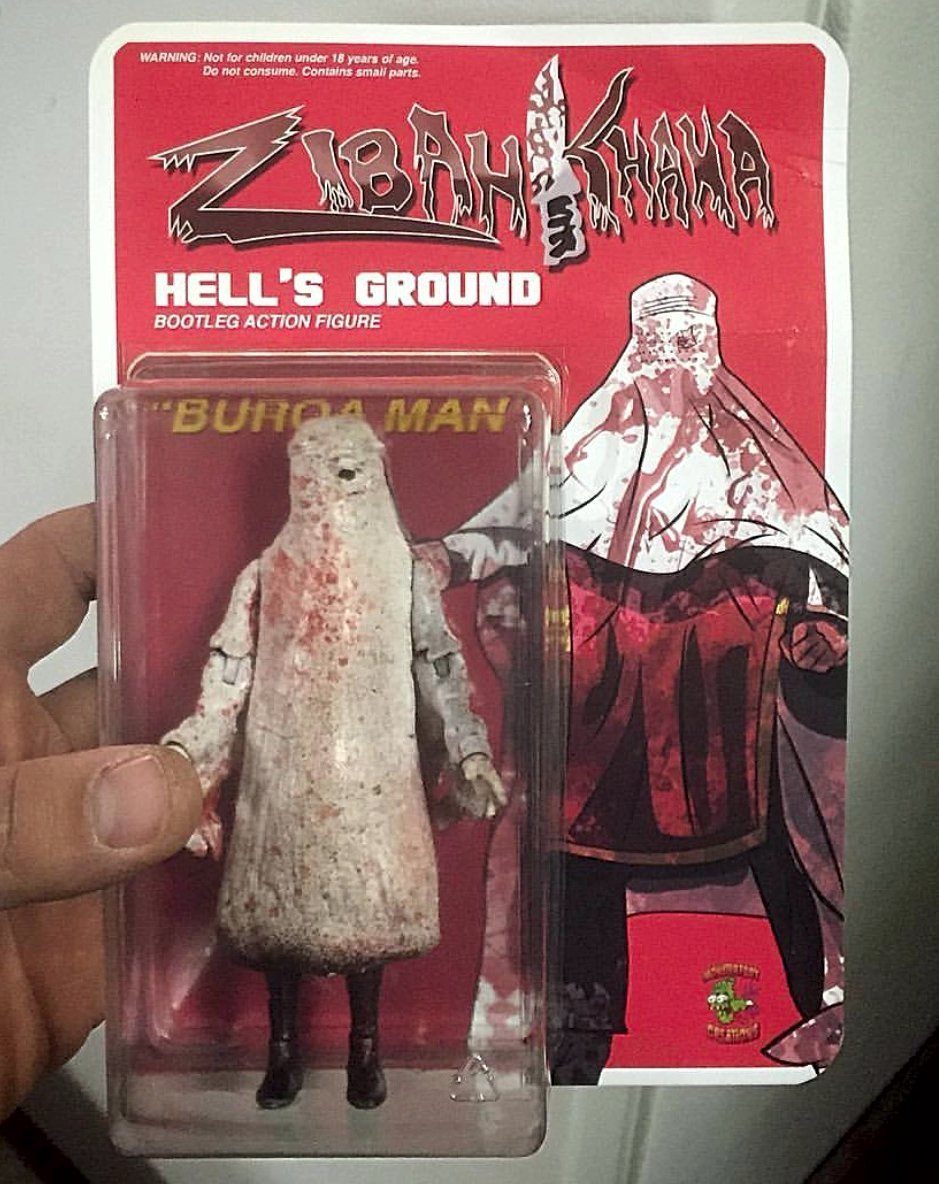
Someone in America who makes figures of famous movie monsters creates a Burqaman doll.
And suddenly it all seems worthwhile again.
Money would have been nice.
But the love, hatred, arguments, memories and appreciation generated by the film are compensation enough for a lifetime.
Finally, my beloved father is no longer here.
But he survives in memories, and the books he wrote will remain.
He was a quiet but constant supporter throughout this whole strange process.
I remember the laughter we shared while subtitling Zinda Laash.
I remember him sitting proudly at LUMS when I first presented Zibahkhana to those students, beaming even though slasher films could hardly have been further from his own cup of tea.
All those years ago, watching him write his books helped plant the idea that perhaps I, too, should leave something behind.
A stain on the world.
Something that might remain after I had followed my beloved Mian's lead and moved on.
I think I managed that with Zibahkhana.
Long after I am gone, somebody somewhere will discover it, dissect it, discuss it, hate it or love it.
And that, in the end, was the whole idea.
And.........one aspect of Zibahkhana I am immensly proud of is that our final girl was played by someone who is of the most gorgeous olive brown skin tone. Sadly, when you watch Pakistani TV shows and films, you will notice that only women with the whitest skin are portrayed positively. Almost 99.9% of our female actors, anchors, models are whiter than white and if they arent, they are plastered with foundation that makes them appear white (often with blue, green, or light grey contact lenses as well). To stand against this offensive racial bias and stereotype is something Zibahkhana is immensely proud of.
At this point, I would like to salute some of Team Zibahkhana, who were so much a part of the journey and will always be, even though their time with us is no more.
My dear friend and poster artist Sattar Masih, who contributed the hand-painted Lollywood imagery emblazoned across the Scooby-Doo-style van we used in the film.
Rehan Sahib, with whom I developed an incredibly strong bond.
Nawab Saghar, whose extraordinary work remains there on the screen for everyone to see.
Najma Malik, who lit up the darkest and dampest early-morning sessions with her spark.
Shaharyar M. Khan—Mian—who was never anything but encouraging and supportive as were my siblings. Loving and supporting little sister Faiza and my brothers Faiz and Ali.
And George A. Romero and Tobe Hooper. For Zibahkhana to be mentioned in the same breath as their masterpieces is about the greatest honour I could ever ask for.
I wear my chainsaw tattoo with reverence, honour and pride.
Lastly, an apology to a little sister who was barely 5 and born into a house of horror. Hardly a day went by when we weren't indulging in some sort of bloodbath or the other. She survived, admirably.
And.........one aspect of Zibahkhana I am immensly proud of is that our final girl was played by someone who is of the most gorgeous olive brown skin tone. Sadly, when you watch Pakistani TV shows and films, you will notice that only women with the whitest skin are portrayed positively. Almost 99.9% of our female actors, anchors, models are whiter than white and if they arent, they are plastered with foundation that makes them appear white (often with blue, green, or light grey contact lenses as well). To stand against this offensive racial bias and stereotype is something Zibahkhana is immensely proud of.
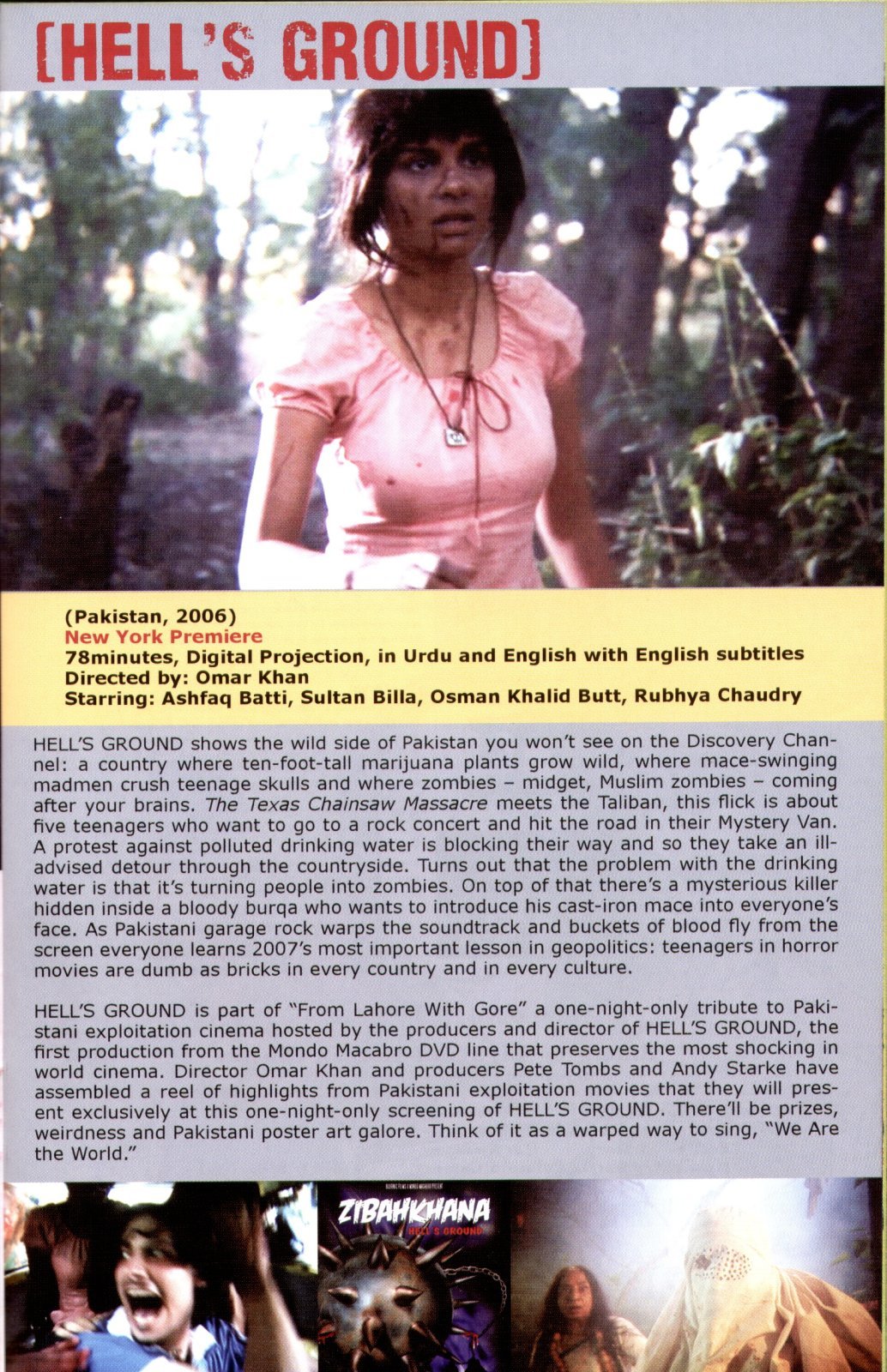
0 Comments
Leave a Comment