
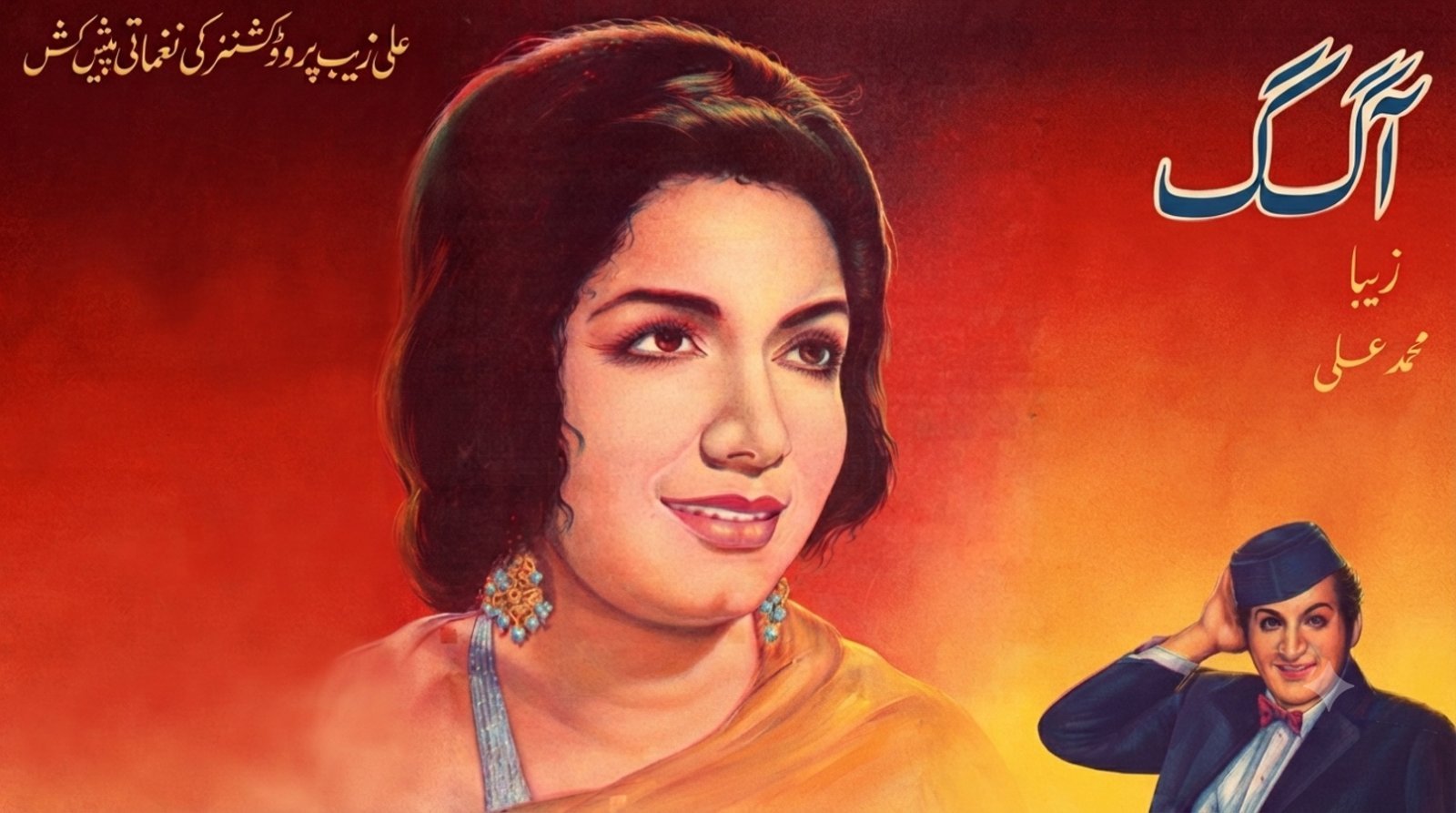
Aag (1967)
Cast: Zeba, Mohammad Ali, Tarannum, Lehri, Aslam Parvez, Tarana, M. Ismael, Talish, Meena Shori, Seema, Shakir, Chham Chham, Murad, Sabiha, Santosh, Zeenat, Saqi
Director: S. Suleman
Synopsis: Classic old-school musical romantic melodrama with Mohammad Ali in top form.
Reviewed by: Omar Khan
Aag was a sizeable hit upon release in 1967, driven by a family friendly plot and some of the finest music of the era. Mohammad Ali and Zeba head the impressive cast and serve as film producers, tailor-made to showcase the stars as the perfect couple, on-screen and off. Aag celebrated a “golden jubilee” in the cinemas of Karachi and was one of the big commercial successes of the year. The songs from the film have become some of the everlasting classics of Lollywood, and deservedly so.
The film starts with Mohammad Ali as a loveable prankster, constantly playing tricks on his adoring aunt, Sabiha Khanum. The little kids in the neighbourhood adore him for his warmth and childish pranks; indeed, he is genial and charming and able to put a smile on any face he happens to come across, except that of Zeba. He accidentally bumps into her, only for her to let fly with an “Ay Mr. Nazar nahin aata, andhay ho?” (Are you blind?). He responds by pretending to be blind therefore gaining her apology and sympathy. Later he comes across her at an “Old Boys” reunion and continues to play blind, and upon being invited to an after-party, he charms the guests with the gorgeous Mehdi Hassan song, “Yun zindagi ki raah mein.” But, Zeba being Zeba, will not smile.
Mohammad Ali keeps trying to gain her attention and heart, but she is the ultimate sour puss, constantly complaining and whining. It takes poor Mohammad Ali the best part of an hour and a half and several songs to break the ice and gain her affection finally, and once that is done and dusted, the film can start to get complicated as it must. First, they perform another impressive number with Zeba and Mohammad Ali romping around the Murree snow. A lovely, unspoiled Murree, a far cry from what it has become. “Mausam Haseen hai lekin” remains lodged in the memory decades after watching the film as a kid.
Mohammad Ali tales off to look after an ailing benefactor Talish, who has virtually adopted him as a son. The ailing Talish starts to recover once Mohmmad Ali arrives and is soon back to his cheerful self, even if a dark secret lurks in the dungeon. Talish’s wife has gone stark raving bonkers and lives in the basement with her long, unkempt tresses and dishevelled robes to remind you that she is cuckoo, just in case you thought otherwise. She also tends to laugh a lot and has twitching fits occasionally.
Talish has a wayward daughter, Tarannum, who hangs out with dubious party animal friends such as Kitty (Tarana) at the local dance and liquor club, trying to pick up wealthy daddies. She is having a torrid affair with Aslam Parvez, who has professed undying love. Still, a knowing audience will realize that Parvez is the Cad of Cads, never to be trusted.
Things start turning nasty when Talish decides to marry off his errant daughter to Mohammad Ali, not knowing that she is already
Aag romantically entangled with the slimy Aslam, nor that Mo Ali is madly in love with Zeba. He approaches his daughter Tarannum and is stunned and disappointed when she reminds him of his lifestyle spent at parties, functions, and dalliances with numerous women. The lifestyle drove her mother to insanity and a life confined to the basement. She questions his double standards of enjoying a modern life for himself, but when it comes to her, he insists on imposing the old ways, and she tells him where to shove his argument and plans. He responds by having a terrible heart attack and forcing poor Mo Ali to pledge to marry the errant daughter regardless. A poor Mohammad Ali is powerless to disagree.
So just as Mohammad Ali and Zeba appear to have things sorted out, all their plans and hopes are scuppered, with both singing songs of gloom and lost love, pining for each other and yet bound by their solemn promises.
The dramatic heat increases to a boiling point as Kitty makes revelations about Aslam. Meanwhile, the promise to Talish shackles poor Mohammad Ali, leaving plans to marry Zeba in tatters. In a typical ‘60s melodramatic style, things get from bad to worse, and just when there appears no way out, Allah finds a way, and true love conquers all.
Aag is a predictable romantic drama dominated by Mohammad Ali’s winning performance. Zeba plays to type; the total sourpuss, party-pooping, goodie two shoes, devoid of any sense of humour and a dark cloud but a pretty face. The first three-quarters of the movie focus on Mohammad Ali wooing Zeba, with some comic interludes from Lehri. There are some vintage tunes, but the accent is clearly on light, frothy, fun romance. The last quarter is when the spanner is thrown into the works and, finally, to the climax, sees the unravelling of the tangled threads.
It’s pretty typical dramatic fare and doesn’t break any new ground. Still, the music, Mohammad Ali’s charm, some solid acting, and decent pacing keep the film from losing its way and maintaining the audience interest. Of the actors, other than Mohammad Ali, who dominates this film, Lehri is as polished as he always was, while Sabiha and the support do a good job. Tarannum is fine as the club-going daughter, and Talish is ever-efficient. Zeba plays a role that was to become her stereotyped screen persona, and it doesn’t challenge her acting skills. She is all too familiar with this avatar throughout her long career, a very safe and unchallenging part. Mehdi Hassan is sublime, and Nisar Bazmi’s compositions are top-notch and significant to the film’s success.
Aag is a reasonably entertaining, light-hearted showcase for the dynamic duo of Ali-Zeba. Together with the music and the supporting cast, it rises above the predictability factor to good effect.



0 Comments
Leave a Comment