
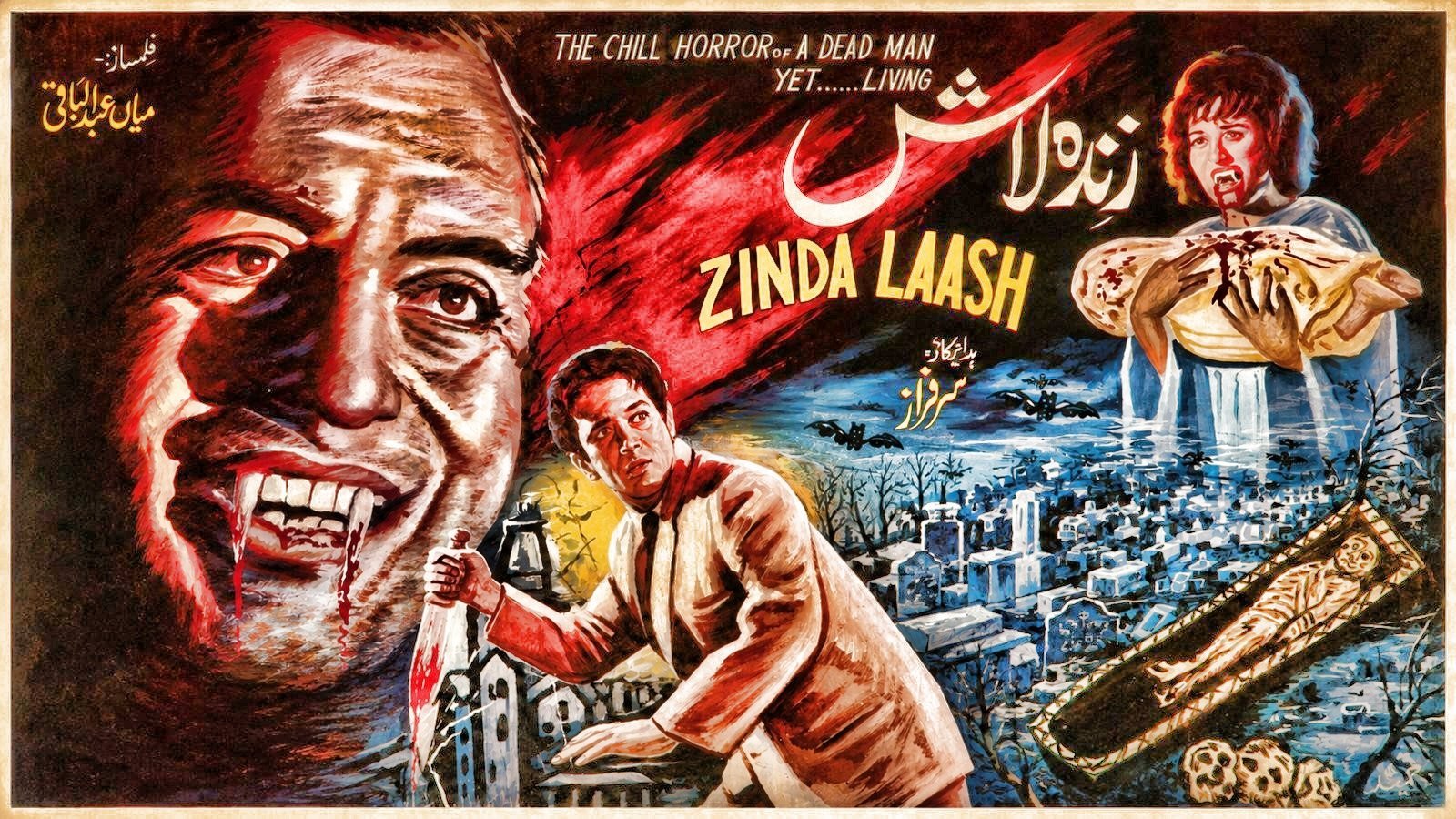
Zinda Laash, AKA "The Living Corpse" And "Dracula In Pakistan" (1967)
Cast: Deeba, Yasmeen, Habib, Asad, Alauddin, Talish, Rehan, Nasreen
Director: Khwaja Sarfraz
Synopsis: Lollywood interpretation of Hammer’s Dracula is surprisingly effective.
Reviewed by: Omar Khan
Lollywood’s forays into the realm of horror have been few and far between (unless you consider those Pashto monstrosities as a terrifying sub-genre of horror), and one must go back years and years to discover even one.
Jasoos from the late ‘70s is a weird slasher/stalker thriller that employs horror techniques and is an enormously enjoyable, albeit bewildering experience. While Jasoos was essentially a murder mystery, Zinda Laash is an out-and-out horror film—Lollywood’s interpretation of Hammer’s classic Dracula with Rehan slipping into Christopher Lee’s role as the Zinda Laash of the title and doing a rather fine job.
The ‘60s black-and-white production starts with an unstable mad scientist type (Professor Tabani) working profusely in his Hammeresque lab. Test tubes bubble away furiously, and the distinguished Professor pours himself a beaker of a very strange-looking substance and proceeds to knock it back. The following day, an assistant finds the Professor’s corpse lying crumpled up and a note which explains what had caused it.
After the Professor is buried, the potion starts to take effect, and he is abruptly woken from the sleep of the dead and returns to the animate world as the Living Dead. Fortunately for him, he appears to have been buried in a coffin with a lid that opens very easily as he is out and about searching for victims within moments of reawakening. He finds his buxom accomplice (Nasreen, aka Salma Agha’s mum) reclining and does not waste much time jabbing those fangs into her fragile neck and feasting on her blood.
A while later, we are shown a weary traveller cum investigator (Asad Bukhari—aka Harker) who is badly in need of shelter, some food, and water. He stumbles upon the Professor’s sprawling decayed mansion amidst the barren wasteland. He enters to find sustenance and an imposing host who suddenly appears to greet him.
The first signs of trouble are when the doctor handles the stranger’s luggage as if it weighed a grain of salt while carrying it upstairs to the guest room. Tabani catches a glimpse of the photograph of the visitor’s wife and immediately likes her neckline.
That night, a mysterious beauty appears and begins to enchant the stranger with an intoxicating dance number. With cat-like grace and voluptuous sensuality, she draws closer to the stranger and bares her hideous fangs. There is a standoff as Tabani appears to feast on what he considers his rightful victim. The scene is a direct lift from Hammer’s film where an irate Christopher Lee confronts Barbara Shelley for attempting to partake in his dinner feast.
Tabani bites the wanderer, who manages to ward him off momentarily and returns to the safety of his room. However, the damage has been done, and the stranger is destined to join the ranks of the undead. Eventually, the stranger’s young accomplice, himself a Dr, goes on the hunt for his partner, and it does not take him long to find Tabani’s mansion, the beauty’s grave, and the stranger’s corpse. The young Dr. (Habib) returns to town to inform his trusted in-laws about
Zinda Laash, AKA “The Living Corpse” And “Dracula In Pakistan”
the horrors he had witnessed, and the two of them return to confront Tabani and destroy him.
Yet the evil Professor Tabani has plans of his own and slowly spreads his wings of terror upon an unsuspecting household. And where once there was frolic and laughter, now there is darkness and gloom.
The best thing about the film is that it is not padded out for hours with unnecessary songs and fight sequences. Also, there is not much irritating comedy either. The film gets down to business from the opening scene and does not stray off course.
Rehan makes an imposing Dracula and does an impressive job while living in the shadow of Christopher Lee. Deeba does well in a brief but memorable role as the young wife targeted by the “Khabees” undead. She has a great, almost Frankenstein-like scene with a young niece upon whom she plans to feast, having already left the corpse of another child lying in the local graveyard, drained of every drop of blood.
Another intense scene is where the wife of one of our heroes is called late at night and told that her husband had suffered an accident. She goes hurtling off in a taxi through a dark, stormy night while her husband returns home unhurt and unharmed, having not suffered any accident. Then, who is the figure driving her to oblivion?
The special effects are far from disastrous as could have been expected of a film so old, which is also a Lollywood creation. Overall, it is a commendable effort with far superior production values and background music, which suggests a marked deterioration in standards over the years.
Zinda Laash is not very frightening by modern standards—yet it must have caused a few sleepless nights in its day. The film was withdrawn after a week of exhibition as the government found it too “corruptive and evil” for the innocent audiences of the nation. The movie was then restored to cinemas when the producers pleaded with authorities that the imported version of Dracula had played without any cuts, and this version was milder, if anything, than Hammer’s version. The argument worked, but the film had to carry an “A” certificate, thus strictly for above 21-year-olds.
The movie may not be a classic, but it is a minor masterpiece compared to some of the dirge that Lollywood spews up regularly. At least it can claim to be the best Horror film ever produced in Pakistan and compares favourably with anything made by the Ramsays, Bhakris, or Talwars of Bollywood.
Zinda Laash is a worthy Lollywood interpretation of Bram Stoker’s classic, with an excellent performance by Rehan in the title role. Deeba’s, too, is memorable as she transforms from a loveable, playful nymph to a haunted, craving, blood-lusting creature of the night. Habib cuts a dashing figure, and Asad does a fair job in the Harker role —props to the cameraman and lighting crew for conjuring a film as visually compelling as any from Pakistan.
Though the music has been largely pilfered, it’s well incorporated other than the bit at the climax, which seems a touch OTT. The producers meanwhile remind patrons in the official program of the film to “remember it is a SCREEN ENTERPRISE terrible presentation”.
The movie opened to big crowds on July 7th, 1967, as curiosity levels had reached fever pitch. The film was the only local release awarded an “Adult Only” certificate. The clever advertising had filmgoers lining up to see why the film was deemed a threat to society’s fragile moral fiber!
Thirty-five years on, Zinda Laash remains the only local film ever certified “For Adults Only”. In 2022, Joyland joined the club.
0 Comments
Leave a Comment