
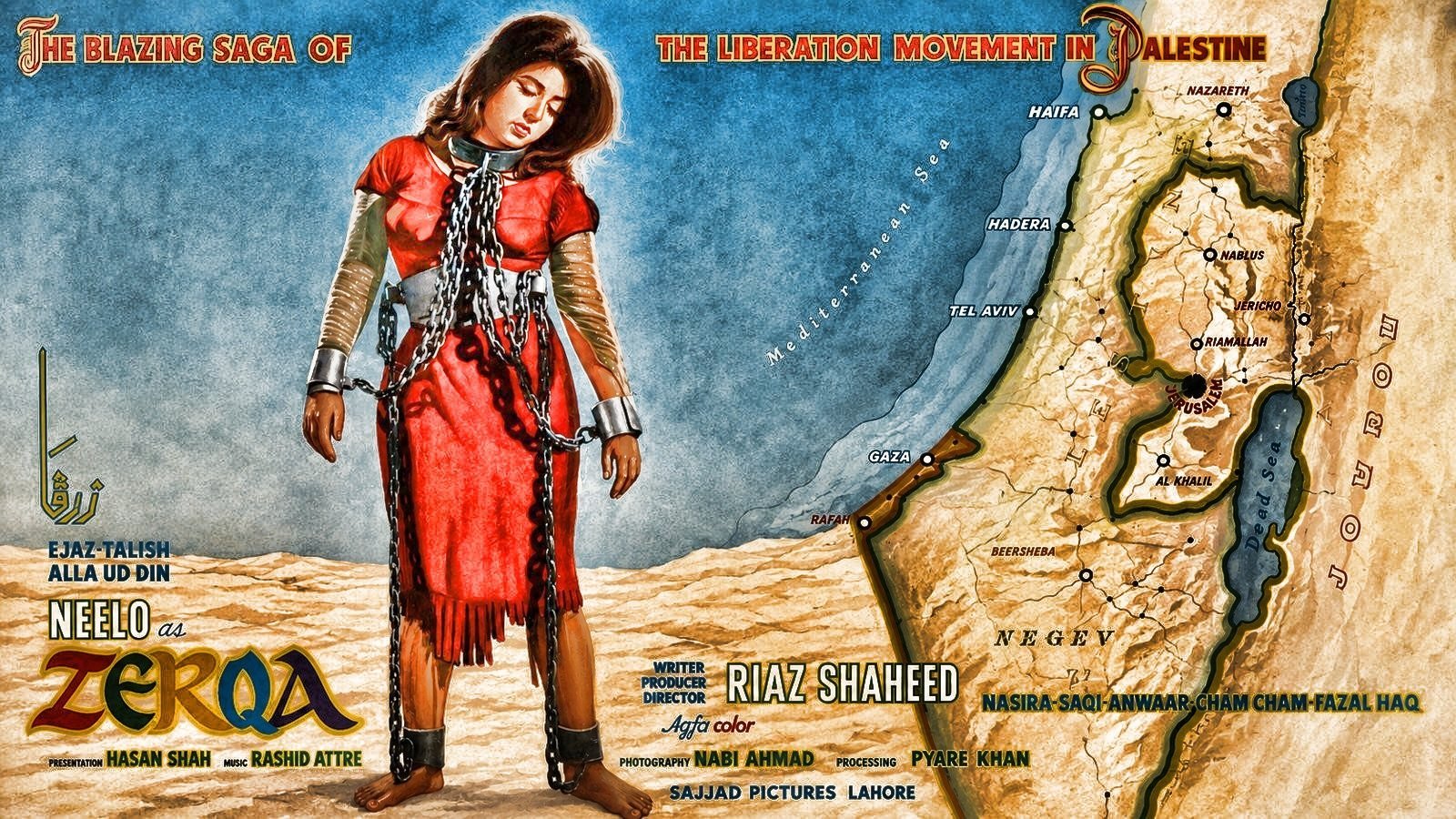
Zerqa (1969)
Cast: Neelo Shahid, Ejaz, Allaudin, Saqi, Nasira, and Talish
Director: Riaz Shahid
Synopsis: Ambitious and resoundingly successful tale of Palestinian martyrdom.
Reviewed by: Omar Khan
Zerqa was a thundering success when it was released, with the public turning out in their multitudes and making the film a box office champion. Film Critics cheered the movie on as a prime example of how far the local film industry had progressed. Riaz Shahid’s ambitious attempt to provide something different from the norm gave filmgoers a much-needed breath of fresh air.
The film is set in 1949 when Palestinians discovered that they had been stabbed in the back by their Anglo-American friends, and found that shiploads of settlers from the Jewish exodus had suddenly seized their beloved land. Through no fault, the Palestinians had their homeland carved up and suddenly found themselves aliens within their home. This is the background within which the story of Zerqa is set.
She is a simple village girl, feisty and strong-willed, but largely oblivious to the struggle for freedom that is going on around her. Her father is avidly involved in the liberation movement and is brutally slaughtered by the marauding Israeli security on a search for the “terrorists”. As he dies in his daughter’s arms, he tells her what her mission in life should be. At first, Zerqa is shunned by the Liberation movement for being a mere woman who could hardly withstand the rigours of guerrilla warfare. She soon proves her detractors wrong and gains respect within the group of dedicated freedom fighters led by Allaudin.
Later, in a moment of naivety, Zerqa and Ejaz become responsible for the capture of their comrades. This devastates Zerqa, who seems to slip into a trancelike state after the event with only one goal: liberating her homeland.
It was a masterstroke by director Riaz Shahid to silence his wife Neelo, as her dialogue delivery in the early parts of the movie is simply horrid. When Zerqa lapses into her vengeance-filled trance, the film moves up a dramatic gear or two.
Talish represents the murderous Israelis in a knockout performance as Major David, and Nasira as his wife, Angela. Both are as fascinating characters as any in the movie. Their exchanges, in front of their large portrait of Lenin, make for fascinating viewing. Why Riaz Shahid used a picture of Lenin to decorate the home of the devout Zionist, Major David, remains one of the unexplained mysteries of the movie. Perhaps the filmmakers didn’t want to miss out on a chance to trash communism while they were at it, even if the chances of Lenin appearing on the walls of a devoted Zionist are pretty minuscule.
The film picks up after intervals with some of the most dramatic sequences filmed in Pakistani cinema history. The sequence when Zerqa is forced to dance by the sadistic Talish to Mehdi Hassan’s anthemic “Raqs-e-Zanjeer” remains one of the most memorable scenes in the history of Pakistani cinema and is inspired by an incident that involved Neelo in real life.*
It may not be subtle cinema, but it is highly charged, compelling, and conveys raw emotion. The following torture scenes are similarly charged and manage to arouse passion precisely as intended. The film builds to a rousing climax that is drenched with emotion.
Zerqa Riaz Shahid ends his movie on a tremendous emotional high, arousing the audience to an emotional crescendo. There’s not a dry eye in the house as the movie’s credits roll. It’s not a brilliant movie and may have numerous technical shortcomings, overtly jingoistic, and two-toned. Where it does succeed is that it manages to entertain, involve and delivers a massive emotional punch to the gut that is difficult to resist. It’s not the finest movie ever made, not by a long shot, but it is undoubtedly one of the few Pakistani films the Lollywood industry can feel proud of and with good reason. Zerqa was showered with 8 Nigar Awards for 1968, including Best Film and Actress.
The event that inspired the Raqs-e-Zanjeer scenario was based on a factual incident, when the government summoned Neelo to perform for the visiting Shah of Iran. Neelo refused to perform and took sleeping pills instead in the face of ugly threats from the government. However, she didn’t give in, and her husband, Riaz Shahid, used the incident as inspiration for the rousing song from Zerqa.


0 Comments
Leave a Comment