
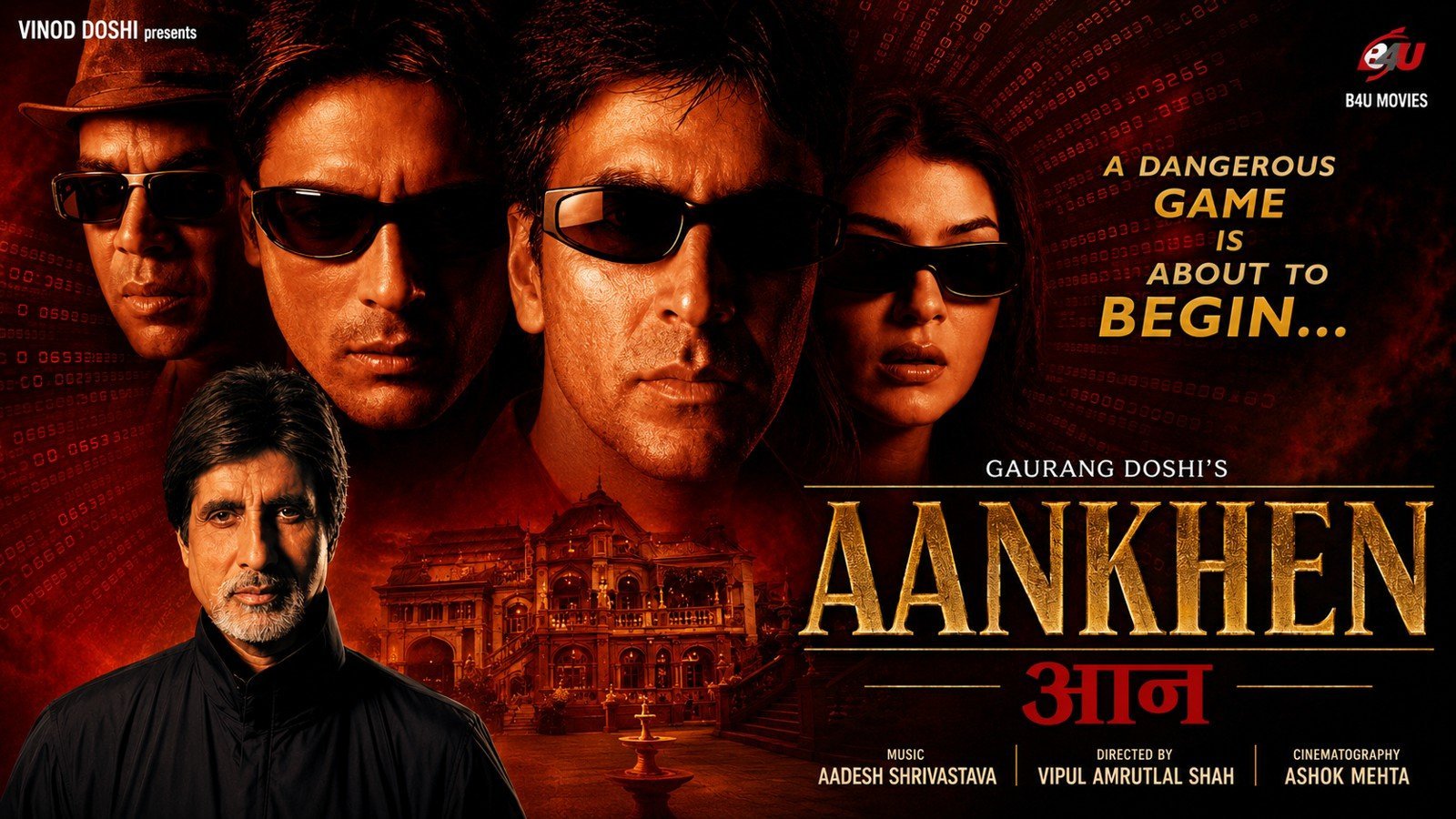
Aankhen (2002)
Cast: Amitabh Bachchan, Akshay Kumar, Arjun Rampal, Sushmita Sen
Director: Vipul Shah
Music Director: Aadesh Srivastava
Synopsis: an exciting if improbable thriller - flawed but stylish and entertaining
Reviewed by: Faiz Khan
The film's publicity proudly proclaims:
"A dangerous game is about to begin."
More accurately, a dangerous gamble is about to begin.
Not merely within the story itself, but behind the camera.
With Aankhen, Vipul Shah attempts something that mainstream Hindi cinema had rarely embraced at the time—a polished, high-concept thriller that places suspense ahead of melodrama and spectacle. It was a bold commercial risk, and while I suspect the film's unconventional approach may have limited its appeal with sections of the audience, Shah deserves enormous credit for attempting something refreshingly different.
Mr Rajput (Amitabh Bachchan) is the respected manager of the Vilasrao Jefferson Bank.
He also happens to be dangerously unstable.
After discovering one of his employees stealing a mere hundred rupees from a customer's account, Rajput flies into an uncontrollable rage and beats the unfortunate man senseless. Unsurprisingly, the bank dismisses him.
Rajput does not take rejection well.
Consumed by humiliation and revenge, he devises an elaborate plan to destroy the institution that discarded him.
His chosen weapon?
The perfect bank robbery.
Except this is no ordinary heist.
Rajput kidnaps the younger brother of Neha Srivastava (Sushmita Sen), a teacher at a school for the blind, and forces her to recruit and train three blind men capable of carrying out what should be an impossible crime.
Her reluctant recruits are Arjun (Arjun Rampal), Ilyas (Paresh Rawal) and Vishwas (Akshay Kumar), the latter having lost his sight only a few years earlier but possessing an uncanny instinct that allows him to sense danger long before others recognise it.
Rajput imposes one crucial condition.
The trainees must never know he exists.
Thus begins an unusual and surprisingly engaging training exercise.
Ilyas joins out of greed.
Arjun through compassion for Neha.
Vishwas because his instincts tell him that someone else is manipulating events from the shadows.
Repeated failures gradually give way to confidence as the impossible slowly begins to look achievable.
Naturally, no carefully constructed plan ever survives contact with reality.
When the robbery finally takes place, events spiral rapidly beyond anyone's control.
This is where Aankhen should become a truly exceptional thriller.
Instead, it becomes merely a very entertaining one.
The screenplay is unquestionably the film's weakest element.
It asks the audience to accept several rather implausible developments, but the greatest weakness lies elsewhere. The entire premise depends upon Rajput kidnapping Neha's brother in order to secure her cooperation—a device so overused in commercial Hindi cinema that it immediately feels disappointingly routine.
One cannot help wishing the writers had found a more imaginative means of drawing her into the conspiracy.
The brief romantic subplot between Arjun and Neha is equally unnecessary.
When Arjun solemnly declares, "Aur main tumse pyaar karne laga hoon," one can almost hear the screenplay pausing dutifully to satisfy Bollywood convention.
The line arrives not because the story demands it...
but because Hindi films apparently feel obliged to include one.
Fortunately, the romance occupies only a small corner of the narrative.
More problematic are the liberties taken during the climax, where logic begins to surrender to fantasy. The conclusion undoubtedly entertains, but it also stretches credibility well beyond breaking point.
Yet for all these flaws...
Aankhen remains consistently enjoyable.
Vipul Shah directs with confidence and assurance, maintaining a brisk pace and giving the film a slickness rarely encountered in Bollywood thrillers of the period. The production possesses an unmistakably Hollywood flavour, and it is easy to imagine the material functioning extremely well as a tightly constructed stage play. One can almost see the theatrical origins in the confined settings, carefully orchestrated suspense and dialogue-driven confrontations.
The adaptation to the screen is not flawless, but it is considerably more successful than one might initially expect.
Performance-wise, the film is a delight.
Amitabh Bachchan delivers one of the finest performances of his later career. Rajput is simultaneously intelligent, menacing, wounded and completely unhinged. Watching Bachchan here also serves as a reminder of how frequently his earlier career confined him within the "Angry Young Man" persona. Given opportunities such as this, he demonstrates once again what a remarkably versatile actor he has always been.
Matching him almost scene for scene is Akshay Kumar.
This may well have been the performance that first hinted he possessed considerably greater acting ability than many had credited him with. His restrained portrayal of Vishwas provides exactly the emotional anchor the film requires, and his growing confidence throughout the story is entirely convincing.
Arjun Rampal is less successful, partly because his rather passive character never develops sufficient dramatic weight, while Paresh Rawal occasionally allows broad comedy to overpower what might otherwise have been a more nuanced performance.
Sushmita Sen, however, deserves considerable praise. She more than holds her own opposite Amitabh Bachchan, and the scenes between the two crackle with tension. At no point does she appear overshadowed by her legendary co-star.
Technically, Aankhen stands head and shoulders above many contemporary Hindi productions.
The cinematography is polished, the production values are consistently impressive and Shah displays an unexpectedly assured command of visual storytelling.
Ironically, it is Bollywood's familiar commercial obligations that occasionally let the film down.
The songs feel hopelessly misplaced.
The guest appearance by Bipasha Basu serves little purpose beyond temporarily halting the narrative, while the Kashmira Shah number could disappear entirely without affecting the story in the slightest. If anything, these diversions interrupt precisely the point at which the suspense ought to be tightening.
Musically, there is little of lasting value. Phatela Jeb possesses a certain novelty appeal, but it is hardly the sort of soundtrack likely to live long in the memory.
Ultimately, Aankhen succeeds because it dares to be different.
It is not without flaws. The screenplay takes too many shortcuts, the climax asks for more faith than logic can comfortably supply, and Bollywood convention occasionally intrudes where restraint would have served the film far better.
Yet Vipul Shah delivers a polished, stylish and consistently entertaining thriller that feels refreshingly unlike the mainstream Hindi cinema surrounding it.
For that reason alone, he deserves considerable applause.
Aankhen may not quite pull off its dangerous gamble...
but it comes impressively close.

0 Comments
Leave a Comment