
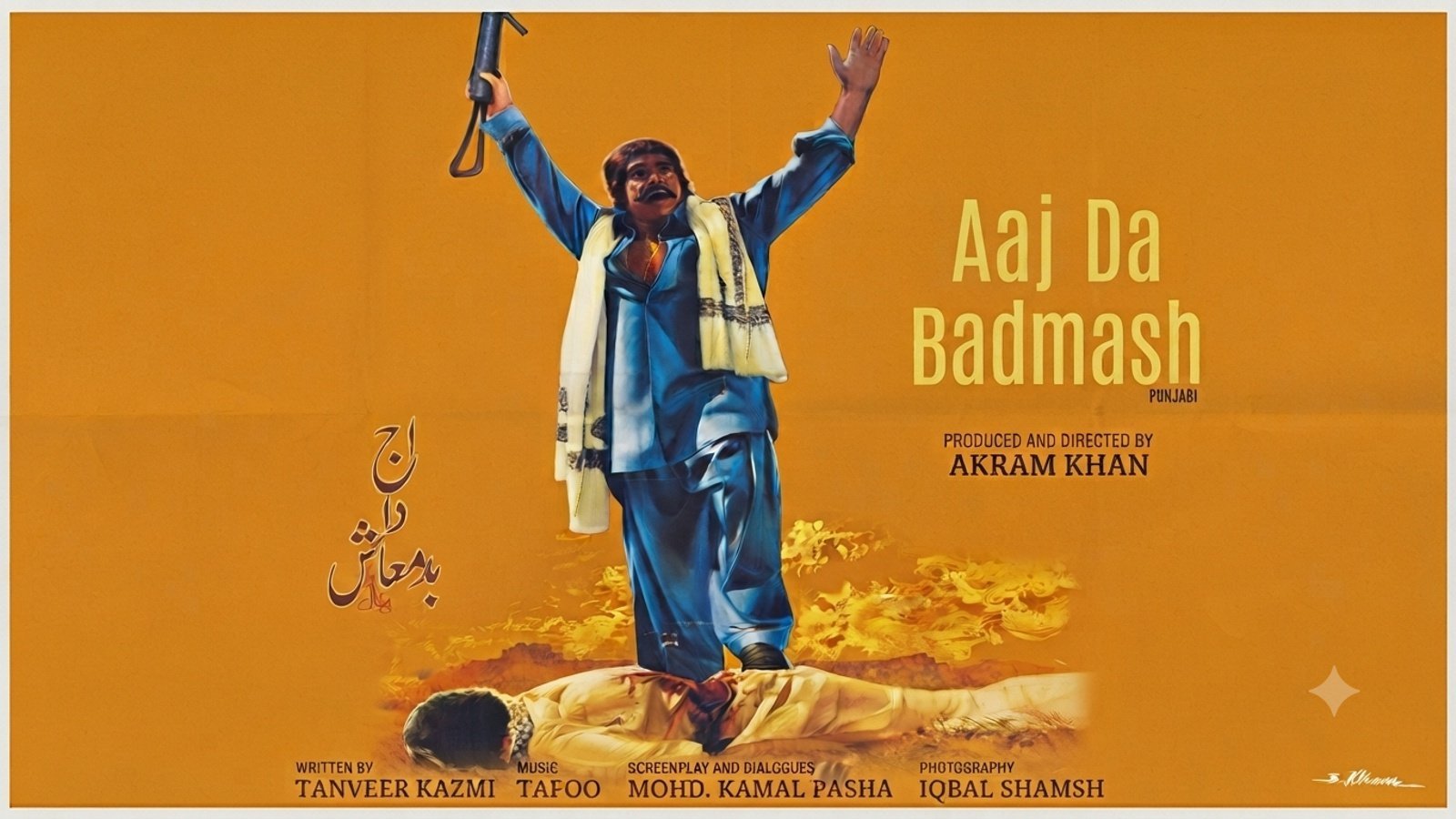
Ajj Da Badmash (1976)
Cast: Sultan Rahi, Aasia, Najma, Perveen Boby.
Director: Akram Khan
Synopsis: Crude potboiler for the masses; features the usual vengeance and saucy bits.
Reviewed by: Omar Khan
Akram Khan is a master of the typically hackneyed vengeance potboiler. Khan’s leading talent lies in making masala movies of the lowest common denominator. Movies specifically designed to appeal to the least discriminating frontbenchers. Occasionally, his films have hit the jackpot Box Office wise, therefore, sustaining a career of remarkable ordinariness.
This film offers delicious spicy masala with the requisite saucy dance numbers for a bit of zest. Akram Khan is trigger-happy with the zoom lens in the finest sleazy Lollywood tradition. His lens appears to linger endlessly on the female posterior, another endearing and familiar local trait.
A starry-eyed, rustic, salt-of-the-earth type of husband lies on his charpoy, contentment twinkling in his eye. He is much loved and respected in the local community. An affable, if typically, bellicose, blimpish, moustachioed village hunk. He explains to his somewhat mystified wife about his BFF representing the cat’s whiskers regarding loyalty.
The wife’s intuition warns her otherwise, proven when the socalled mate turns on his “friend,” sending him packing for a crime he didn’t commit. Worse still, he goes to his mate’s house and rapes his wife to prove a point. Then there is the usual murder and mayhem, with a young child witnessing the brutal murder of his father and swearing revenge. Led away to prison, he grows up five minutes later as a young, virile, and furious Sultan Rahi.
Meanwhile, the big nasty villain has trained his two sons to rule as the worst dons in town. He is also canny enough to groom one as a respectable goon and the other son camouflaged as a fully trained lawyer. Later, Sultan Rahi returns from jail to seek and destroy the “peo de qatils” (dad’s murderers). A familiar macho posturing and schizophrenic fight scenes, interspersed with the occasional extra hot club dance, make up most of the following two hours.
Excitement mounts to a fever pitch as a delectably fabulous cheap dance to the song Kadh Le Kadh Le makes an appearance. Pindi Wal, another saucy potboiler, contains the same dance diligently spliced into the film. Officially, it’s on the Ajj da Badmaash Soundtrack. Back then, it was standard for producers to borrow songs and scenes from one film and add them to another. The most popular splicing material is porn.
Ajj Da Badmash is the most stripped-down, basic, and crude filmmaking. There isn’t the slightest semblance of polish to proceedings, and in keeping with the Rahi style of Punjabi films, characterized by trademark belligerence and insanely high decibels of ranting and shouting. The movie bounces along at a furious thrust with rapid-fire comic-book violence served up in copious amounts. A cocktail of violence typically associated with the Punjabi vengeance action potboiler genre. A typically zany psychedelic background score featuring a furiously busy organ backs up the action superbly. The frenetic organ
Ajj Da Badmash going haywire was a staple and majestic template of Lollywood scores from the ‘70s and ‘80s.
Sultan Rahi bellows aggressively, looking very cross indeed and packs a lethal right hook. Rahi also performs a rare song and dance scene, an amusing rarity. Aaj Da Badmash doesn’t spring any surprises and follows a well-worn path down familiar turf, with its story cast in some stale formulaic stone within fifteen minutes of the titles. The remaining two hours and 30 minutes are devoted to the tediously predictable unfolding of the revenge scenario! The Kadh Le dance is Club high-fashion, with its tighter-than-tight crotch bell bottoms embracing every curve, crack, and crevice. This piece of Lollywood couture was the delight of any smut peddling Punjabi producer from the glory days.
Ajj Da Badmash has its moments, but its successful box office run is almost solely due to the superlatively smutty club dances and Tafo’s excellent tunes, performed expertly by Nahid Akhtar in full-on debauched mode. The heart of the film beats in a cheap, seedy club, which elevates the movie from the run-of-the-mill. This pure Pre-Zia certified gold contains intoxicating numbers like Pa Pum Pa Pa Paaaa and The captivating Kadh Le Dance, with the Fashion Forward tightly fitting bell bottoms.
Aaj Da Badmash’s highlight is the smoldering club dance that is Kadh le, while another gem featuring three beauties crooning in schoolgirl frocks is money well invested. A dance that features men in their undies smeared with grease, posturing as an African tribal warriors can’t be all bad.
Akram Khan’s enjoyable, chaotic romp has severe deficiencies and is too predictable. It also subscribes to some very twisted morality. To defeat hoodlums, one has to become a kingpin hoodlum oneself. Yet, having said that, would we have our Lollywood Punjabi films any other way? Doubtful.
The saucy club numbers and stunning songs more than compensate for any inadequacies, and the dress designer and weave in charge have done a sterling job on a limited budget. Finally, let’s hear it for another appearance by the Nation’s finest ever Psychedelic, Progressive Rock Club Dance Rock N Roll band, the immortal Stylish Batch.


0 Comments
Leave a Comment