
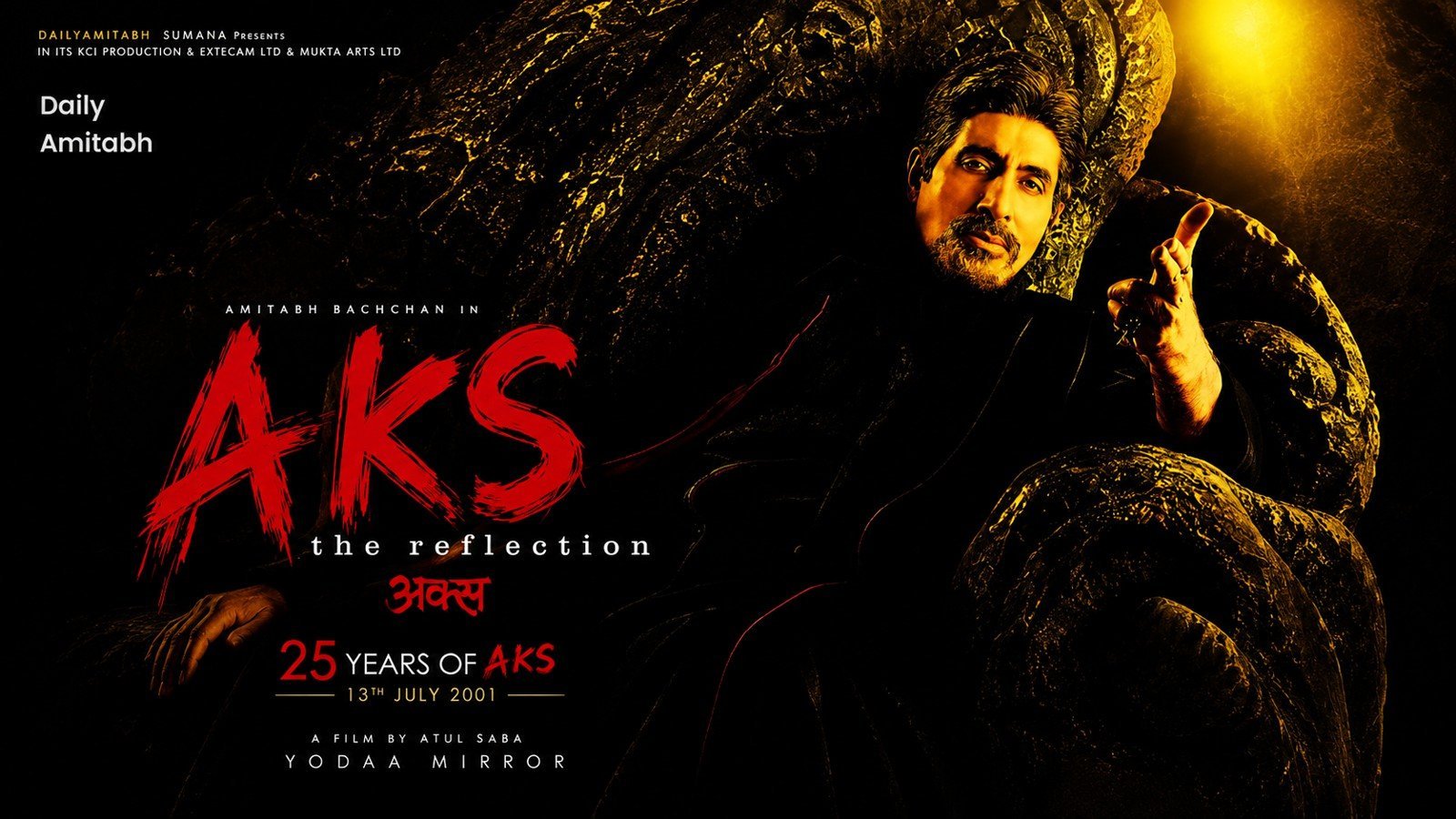
Aks (2001)
Starring: Amitabh Bachchan Manoj Bajpai Nandita Das Raveena Tandon
Director: Rakesh Mehra
Music Director: Anu Malik
Synopsis: The Gita meets The Devil’s Advocate in another case of style of matter
Reviewed by: Faiz Khan
Hazy church bells ringing through Budapest herald the opening scene. From a distant rooftop, a gun is trained on a passing cavalcade. A government minister arrives to collect a floppy disc containing details of a plot to assassinate the Indian Prime Minister. Manu Verma (Amitabh Bachchan), head of his security, appears to betray him, shooting the minister and stealing the disc.
Moments later...
another Amitabh Bachchan calmly walks into the office.
The first tears off his face to reveal the evil Rajvan (Manoj Bajpayee).
It is an intriguing opening to what promises to be a gripping thriller.
Unfortunately...
the promised roller-coaster ride never quite materialises.
The action shifts to India, where Manu Verma is now serving with the Crime Branch. Summoned to investigate a brutal murder, he immediately recognises Rajvan's trademark calling card—a small mask hanging from a chain.
Determined to catch his old adversary once and for all, Manu moves his family to Delhi and begins tracking the elusive killer.
A lengthy game of cat and mouse follows.
After displaying almost Spider-Man-like abilities while dispatching much of Manu's police force, Rajvan is eventually cornered. Justice appears to have prevailed when he is sentenced to death. During a desperate last attempt to escape, both men shoot at one another. Rajvan dies...
or so it seems.
Soon afterwards, Manu begins behaving rather strangely, and it gradually becomes apparent that Rajvan's evil spirit has found a new home inside him. From then on, Manu periodically transforms into the sadistic killer, unleashing violence both on the streets and within his own family.
Rakesh Mehra borrows his central idea from the Bhagavad Gita, exploring themes of immortality and reincarnation while combining them with the familiar notion of spirit possession and the "bhoot savaar" syndrome.
On paper, it is a fascinating concept.
In execution...
rather less so.
The film ambles along at an exasperatingly leisurely pace, relying heavily on repeated scenes of Bachchan battling his inner demon. Before long the novelty begins to wear thin. There is simply too much Bachchan and not enough of anyone else. Once Manoj Bajpayee exits the story, the film loses much of its energy, leaving Bachchan to shoulder almost the entire burden alone.
Mehra undoubtedly creates an unsettling atmosphere, but his relentless focus on Bachchan eventually makes the film feel repetitive and strangely monotonous. There are shades of The Devil's Advocate lurking beneath the surface, and one has to admire the ambition of attempting something rather different for mainstream Bollywood.
Whether the deeper philosophical ideas were ever successfully communicated, however...
rather passed me by.
Amitabh Bachchan is occasionally irritating in the central role, although credit should certainly be given to him for attempting something outside the dependable patriarchal roles that had increasingly become his trademark. Manoj Bajpayee, meanwhile, is tremendous fun, chewing the scenery with obvious relish. For once he abandons realism entirely and embraces the role as evil incarnate. It is gloriously over the top, but entirely appropriate for the character.
Raveena Tandon has very little to do beyond dancing through a succession of songs as Rajvan's lover and nightclub performer, although she does make an impression during the few dramatic scenes she is given. Nandita Das fares even worse, saddled with a role offering virtually nothing of interest.
Anu Malik contributes an excellent background score and, with lyrics by Gulzar, most of the songs work rather well. The exception is the thoroughly risible Ramleela number, which could easily have been excised without anybody noticing. The Hariharan song is absent from the final cut, which is probably just as well considering the film already feels considerably overlong.
Technically, Aks is impressive in almost every department.
Sadly, it remains a classic triumph of style over substance.
I cannot honestly see the film appealing either to the average cinema-goer or to the more intellectual audience it appears to be courting.
A brave attempt, Mehra...
but better luck next time.

0 Comments
Leave a Comment