
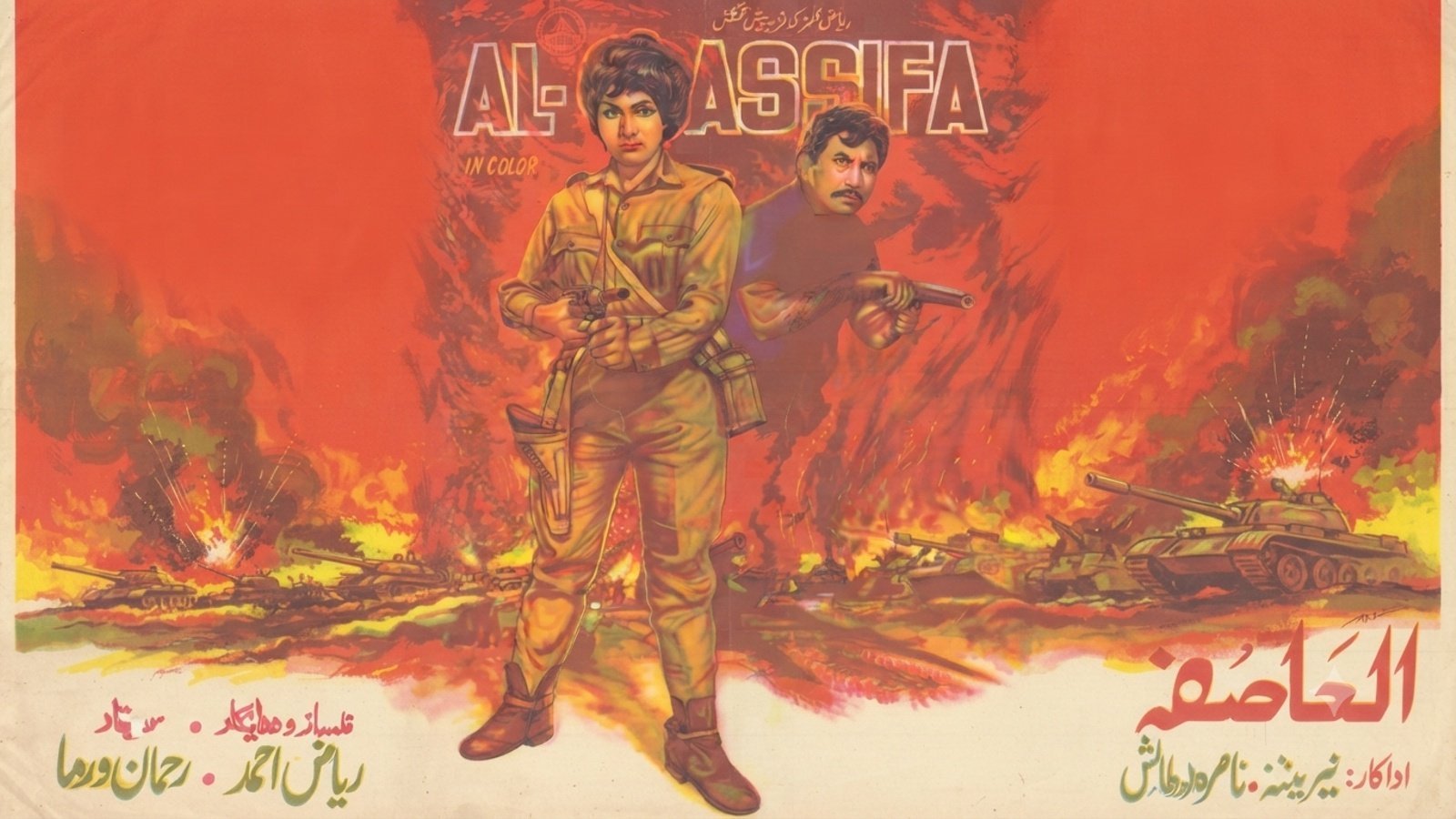
Al-Assifa (1971)
Cast: Naghma, Sudhir, Haider, Afzal Khan, Nabeela, Aslam Parvez Director: Riaz Ahmed
Synopsis: Zerqa’s poor cousin is a spectacularly blatant rip-off and a miserable successor to an established classic.
Reviewed by: Omar Khan
In 1969, producer-director Riaz Shahid scored one of the biggest successes in Pakistani cinema history with a powerful story of a struggle for freedom under brutal repression. Whether you agree with Zerqa’s political orientation or not, there can be no denying that it carried a mighty emotional punch, drawing the masses to the ticket counters as never before. In Karachi, the film became the first-ever in Pakistan cinema history to cross the 100-week barrier, a Diamond Jubilee in local parlance.
The direction was astute, and the cast in top form with Allauddin and Talish in legendary roles and Neelo, the director’s wife, producing arguably her finest ever work. In its sheer drama, storytelling, and emotional impact, Zerqa is unquestionably a masterpiece by Pakistani cinema standards. There was no dry eye in the house when thousands left the theatres as the film reached its memorable climax. Nasir Adeeb wrote Al-Assifa as his debut feature film, which has a similar tone to Riaz Shahid’s classic. Talish, whose role had been such a force in Zerqa, is repeating himself with no conviction.
Al-Assifa contains large amounts of stirring, hard-hitting dialogues from the onset, but after a while, they wear thin and appear almost comical and cliché to the point of farce. The wartime backdrop, supposedly somewhere around the Golan Heights, appears more like somebody’s backyard with mountains drawn on pieces of cardboard, and the shrubbery seems to be random twigs attached by Scotch tape. Due to budget limitations, almost all the footage is of individual soldiers ambushed and jumped. Some tanks appear during the movie’s latter half but look suspiciously like stockfootage.
There is a tremendous amount of huffing and puffing about gallantry and honour and martyrdom, the usual thing. It quickly gets very repetitive and loses whatever impact it may have had. This film was a shameless attempted cash-in at the Box Office on the coattails of Zerqa. Still, it’s so much like a homemade episode of infantile “Cowboys and Indians” that even a reasonably naïve cinema-going public saw through the shameless rip-off and chose to save their money; the film failed miserably at the Box Office.
Zerqa’s template is closely aped but without any impact. The film plays like a hammy kindergarten version with clichés about Shaheeds, ghazis, gustaakhs, yahudis, and Watan ka Lahu flying thick and fast and production values that may be embarrassing for a school show. Sudhir plays the leader of one faction of the freedom fighters, and Naghma, disgusted that her father turned out to be a backstabbing traitor to the cause, joins the freedom fighters and has more than a soft spot for Sudhir.
Naghma does her best to look fierce and determined and grimaces at various tortures meted out to her by the brutal General played by Talish. In one scene, he wrenches off her nails one by one as she refuses to cough up vital information. Several other women also display their gallantry and fearlessness during the movie, and when spirits are
Al-Assifa down, all it takes is an inspirational song to up the recruitment drive again.
Al-Assifa is thoughtless, and it has to be said, a brainless attempt at cashing in on the massive success enjoyed by Zerqa, which had just left cinemas when Al-Assifa’s promos started appearing. The film lacks anything besides bombastic cliché dialogues and a lot of hot air, and the action and war scenes are stagey and unconvincing.
Even without the comparison to Zerqa, the film fails as a confused infantile caper with a bunch of Lollywood extras playing, let’s pretend, Cowboys and Indians. Still, in this case, the scenario happens to be the Palestinian-Israeli conflict. Al-Asifa tries hard to be Zerqa, but it is a pathetic, anaemic imitation. While Zerqa is still talked about today, absolutely nobody but a few hardcore Lollywood historians have even heard of Al-Assifa. Ironically, the film hit screens in 1971, the year of Black September, in which Pakistan played a significant and unfortunate role.



0 Comments
Leave a Comment