
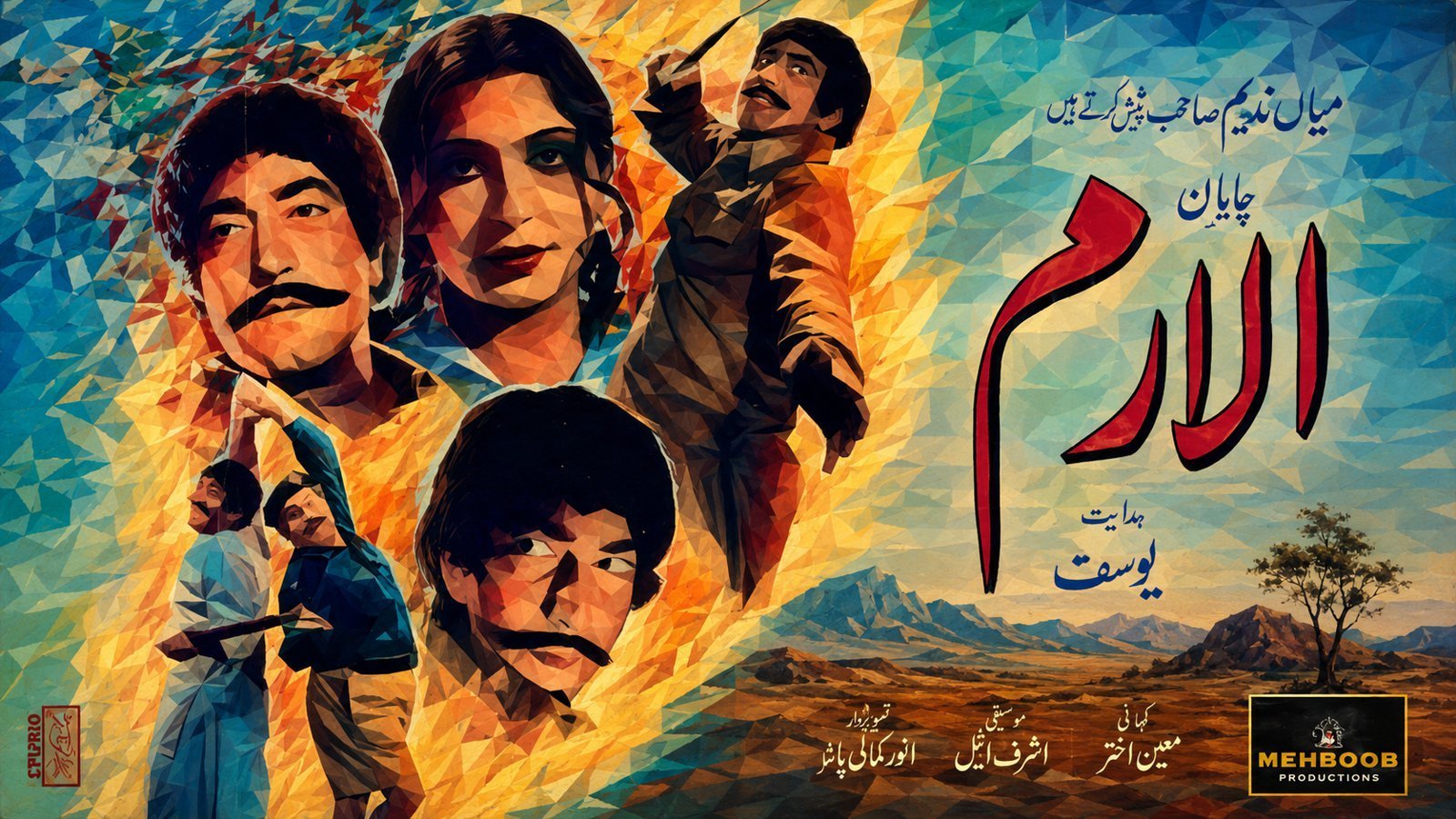
Alarm (1978)
Cast: Mustafa Qureshi, Aslam Parvez, Najma, Chakori, Bahar, Adeeb, Talish
Director: Daud Butt
Music Director: Tafo
Synopsis: Vendetta, mayhem, blood feuds, sirens, action...the usual masala and more!
Reviewed by: Omar Khan
Another muggy, miserably hot monsoon day and nothing much to do other than waste away in air-conditioned apathy—body and mind slowly atrophying into spam-like blubber. Just when I was in danger of wallowing into oblivion, the last few functioning brain cells came up with what seemed like a lifeline to survival, mentally if not physically.
The answer was simple.
Adrenalise the rapidly depleting grey matter with a hefty dose of gloriously electrifying Lollywood Punjabi cinema from the golden era of the 1970s.
In my current state of inertia, only a high-voltage injection of vintage Lollywood lollipop Punjabi style could possibly blow away the miserable monsoon blues.
So, with purely medicinal intentions, I ventured into the dimly lit room where my mountain of Lollywood VCDs lies stacked in glorious disorder, searching for the one title capable of working a miracle.
The selection criteria were surprisingly scientific.
Firstly, an English title for a Punjabi film always earns extra points. Secondly, the director had to possess impeccable credentials in grit, action and sleaze. In other words, an Akram Khan sizzler that had somehow slipped through the cracks, a Hyder Chaudhary masala extravaganza or, better still, something directed by the undisputed king of cinematic sleaze, Daud Butt.
The choice was almost embarrassingly rich.
Black Warrant, Sergeant, Warrant, Cobra, Accident, Lathi Charge and Gunda Tax all briefly came under consideration before Alaram finally emerged victorious.
It ticked every conceivable box.
Mustafa Qureshi headed the cast, Najma was on hand to provide her customary fiery dances and saucy glamour, while Bahar, Aslam Parvez and the magnificent Chakori completed a formidable supporting line-up. Best of all, the film was directed by Daud Butt himself, a man whose reputation alone promised something deliciously disreputable. Throw in music by Tafo and atmospheric black-and-white photography that only enhances the grit and grime, and expectations were understandably high.
Alaram opens in a village where Bahar—sporting a wig at least two sizes too large—erupts with delight upon hearing that her notorious son Badshah has once again escaped from prison.
Audiences familiar with Punjabi cinema require no further explanation.
If Bahar is the mother...
her son can only be a legendary Punjabi anti-hero.
For years she virtually monopolised the role of the long-suffering yet fiercely defiant mother, producing an endless succession of angry, revenge-driven sons, most famously Sultan Rahi. Ironically, in Rahi's greatest triumph, Maula Jatt, the honour of playing his mother fell to Seema, presumably because Bahar was already booked solid elsewhere.
Mustafa Qureshi is magnificent as Badshah, and it is difficult not to view the character as a dress rehearsal for his immortal portrayal of Noorie Nut in Maula Jatt. Alaram was released a year earlier, and the similarities are striking. The swagger, the booming dialogue, the volcanic temper and larger-than-life charisma are all firmly in place.
Then again...
don't most Punjabi films happily recycle the same ingredients?
The plot certainly does.
Personal vendettas, corrupt authority figures, police persecution, injustice and impossible odds all combine into another familiar Punjabi potboiler in which our hero battles overwhelming adversity before eventually restoring the natural order through a succession of increasingly absurd yet enormously entertaining confrontations.
Talish delivers one of the film's most enjoyable performances as the jail warden's rather dim but thoroughly good-hearted assistant. His exchanges with Mustafa Qureshi are consistently engaging, while his relationship with his hopelessly naïve daughter, played by Najma, provides some genuinely likeable moments.
Thankfully, theirs is not the sickly sweet father-daughter relationship so beloved of countless subcontinental melodramas.
They argue.
They bicker.
They tease one another.
In short...
they behave like real people.
Mind you, her sudden eruptions into high-voltage dance routines, punctuated by enough hip-thrusting, swishing and jiggling to register on the Richter Scale, perhaps belong more firmly in the world of Punjabi fantasy than everyday village life.
Chakori, meanwhile, is given the film's most tragic storyline. Forced into prostitution to earn enough money for her blind father's desperately needed eye operation, she secretly saves every rupee she earns.
Then fate intervenes with almost Shakespearean cruelty.
Feeling cold one evening, her blind father lights a fire using the nearest pile of paper he can find.
Unfortunately...
it happens to be his daughter's entire life savings.
You couldn't invent such rotten luck if you tried.
Thankfully, Punjabi cinema has little interest in prolonged misery, and before long Chakori is back lighting up the screen in one of the film's spectacular dance numbers. Calling these performances energetic hardly does them justice. They are an explosion of movement, attitude and sheer physical commitment.
"High energy" barely begins to describe them.
The film eventually barrels towards its climax amidst the customary hail of bullets, with countless characters hurling themselves heroically into the line of fire to save one another.
Vintage Punjabi cinema at its glorious best.
This is exactly the sort of unabashed masala entertainment that reminds one why these films remain so irresistibly watchable. Mustafa Qureshi is in magnificent form, delivering memorable lines such as, "Lahore chhad deyan? Chhad deyan Lahore?"—dialogue that unmistakably foreshadows the swagger and bravado of Noorie Nut.
His chemistry with Chakori is equally evident, another element that would later prove so memorable in Maula Jatt, where she delivered perhaps the performance of her career as Noorie's fiercely loyal, bloodthirsty sister. Chakori possessed genuine screen presence and an intensity that elevated her well above the usual dancing-girl roles. She enjoyed an impressively successful career balancing character parts and dance performances—arguably the finest exponent of that particular niche, though Ishrat Chaudhary might understandably disagree.
Najma, meanwhile, appears in what today would undoubtedly be described as a Britney Spears-style schoolgirl outfit, looking and behaving with the gloriously brainless enthusiasm that Punjabi cinema so often demanded of its heroines. Bahar does exactly what audiences wanted from Bahar: standing defiantly in the face of adversity while delivering the sort of thunderous speeches only she could make sound entirely convincing.
Tafo's score may not rank among his greatest achievements, yet the astonishingly energetic dance sequences compensate handsomely. One scarcely notices the absence of a heavyweight Noor Jehan showstopper.
Daud Butt once again proves himself a master of gritty, unapologetically commercial Punjabi cinema, delivering a film bursting with energy, outrageous dialogue, colourful characters and just enough sleaze to ensure the front-bench audience never had the slightest chance of nodding off.
What more could one reasonably ask for?
Well...
perhaps a director's cut.
And had Alaram arrived a year or two earlier—before the tightening grip of censorship under military rule—it might well have been an even sleazier, more outrageous affair.
Now that really would have been something.


0 Comments
Leave a Comment