
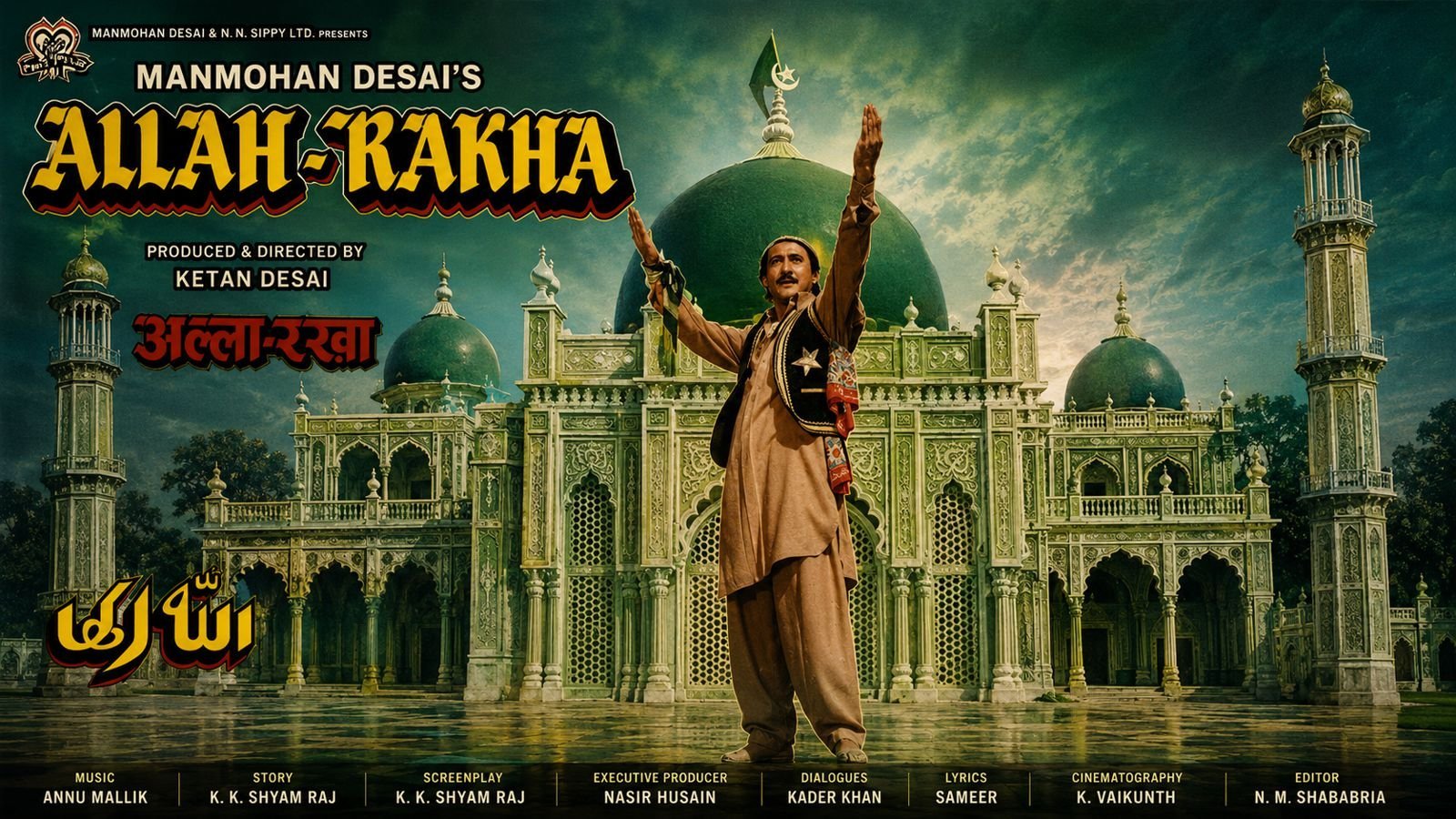
Allah Rakha (1986)
Cast: Jackie, Dimple,, Meenakshi, Waheeda Rehman, Bindu, Shammi Kapoor
Director: Ketan Desai
Music Director: Anu Malik
Synopsis: Rip roaring MKD style concoction is an unsung classic of the 80s
Reviewed by: Omar Khan
When Manmohan Desai finally stepped away from the director's chair, it fell to his son Ketan to carry the torch and continue the tried-and-tested formula that had churned out one mega-hit after another throughout the mid-to-late 1970s and into the early '80s.
Ketan Desai made his directorial debut in 1986 amid considerable expectation with Allah Rakha, starring Jackie Shroff as the hoped-for—but ultimately unrealised—new Angry Young Man for the yuppie generation.
It was never going to be an easy task.
Mard, Manmohan Desai's previous delirious explosion of melodrama, was an almost impossible act to follow, and however hard Jackie Shroff tried, he was simply no Amitabh Bachchan.
Unfortunately, Allah Rakha arrived at precisely the wrong moment.
By the late summer of 1986, Bollywood audiences had fallen under the spell of a seemingly endless wave of Southern remakes starring Jeetendra, Sridevi and Jaya Prada, accompanied by Bappi Lahiri's screeching synthesiser scores, enough matkas and dupattas to clothe half the country, and industrial-strength doses of Kader Khan and Shakti Kapoor indulging in their increasingly popular brand of gloriously brainless buffoonery.
Looking back, 1986 was a magnificent year for gloriously excessive Bollywood kitsch, with melodrama, disco and an emerging Govinda all colliding in spectacular fashion.
Sadly, Allah Rakha became one of the year's highest-profile casualties.
The failure stung all the more because it came from a banner whose name had long been synonymous with guaranteed box-office gold, interrupted only by the occasional minor stumble. This, however, was no temporary blip. It was a full-blown commercial disaster, overshadowed during a year dominated by the wildly overrated Nagina and Anupam Kher's scenery-chewing performance as Dr. Dang in Karma.
Cinema trends are wonderfully fickle.
What appears guaranteed box-office gold when a script is first written can easily become yesterday's fashion by the time the finished film reaches cinemas. Presumably everyone assumed that the Manmohan Desai formula was somehow immune to changing tastes.
It wasn't.
Yet in our household of proudly masala-bred Bollywood addicts, Allah Rakha was embraced with open arms. It was discussed with enormous affection and gradually elevated to the status of one of those glorious cult classics that somehow slipped through the cracks.
Years passed.
The film disappeared after its initial VHS release (remember those?), making it increasingly difficult to revisit.
The obvious question therefore became:
Has Allah Rakha survived the ravages of time?
The answer is a resounding...
"No."
It's aged like a fine wine.
Today it comfortably earns its place alongside Suraksha and Mard as one of Bollywood's great cult epics.
The screenplay, by Prayag Raj and K. K. Shukla, is a glorious monument to impossibly convoluted masala storytelling. Plot strands become hopelessly entangled before joyfully unravelling with crowd-pleasing inevitability. It is Bollywood formula filmmaking operating at the outer limits of imagination—fairy tales, Manmohan Desai style.
Pure genius.
The film opens with one of Bollywood's greatest B-villains, Bob Christo, effortlessly dominating the screen as the fearsome Don Senior. Within minutes he telephones the highly respected social worker Madame Banu, played with wicked relish by the incomparable Bindu, requesting a fresh supply of girls.
Social worker?
Hardly.
Pimp would seem considerably closer to the truth.
Meanwhile—and there are always at least a dozen "meanwhiles" in a Manmohan Desai film—Aruna Irani arrives at Madame Banu's doorstep wearing a burqa and carrying her infant child. Her husband has nobly accepted the blame for one of Don Senior's crimes and is languishing in prison. Rather than offering assistance, the gloriously devious Madame Banu sends the unfortunate woman straight into the lion's den.
Aruna narrowly escapes being raped by hurling herself through a window before making a desperate dash across the city.
Tragically...
her baby does not survive.
Meanwhile...
Waheeda Rehman appears as an upright lawyer who unsuccessfully attempts to prosecute Madame Banu. Her husband, a rather ineffectual police inspector played by Biswajit, is framed by Bindu, somehow ends up fathering her child and is subsequently forced into marriage.
Meanwhile...
Waheeda walks out, taking custody of her own infant.
Meanwhile...
everyone appears to be having babies simultaneously.
Meanwhile...
those babies begin changing hands with such alarming regularity that one rapidly loses track of who belongs to whom.
Ah...
Bollywood.
Eventually the children are shuffled into precisely the right places so that the next generation can inherit the narrative burden.
If all of this sounds hopelessly convoluted...
it is.
Yet anyone raised on a healthy diet of Manmohan Desai will probably find it perfectly logical.
The plot thickens still further when Karim Khan—Shammi Kapoor in magnificently bombastic form as a Pathan—is released from prison and entrusted with yet another of the switched babies. Before long he is arrested once more after killing Don Senior, who expires while dramatically swearing that his own son will someday avenge him.
Meanwhile...
Waheeda Rehman is informed that her son has died.
Only...
he hasn't.
Unfortunately nobody else knows this.
Distraught, she wanders into traffic, is promptly run over and, naturally, goes blind.
And all this...
is merely the opening act.
If you've managed to follow everything so far, congratulations—you are now fully qualified to write a Manmohan Desai screenplay.
Can the film possibly maintain this delirious pace?
Almost.
There is certainly plenty to enjoy, including Allah Rakha's unforgettable wrestling match with a mountain of muscle answering to the name of Gorilla, Shammi Kapoor's magnificently unhinged performance as a Pathan fuelled by enough red meat and testosterone to feed an army, and exploding television sets that may—or may not—constitute Manmohan Desai's subtle commentary on the power of the media.
The first third of the film is exhilarating.
Sadly, the remaining two-thirds never quite sustain those extraordinary heights. Once Jackie Shroff appears in a double role, the narrative begins to lose focus and the carefully balanced madness starts collapsing under its own weight.
Dimple Kapadia, badly miscast, proves unable to rescue proceedings.
Even so, flashes of brilliance continue to appear.
The magnificent graveyard confrontation involving Bindu, Waheeda Rehman and Meenakshi Seshadri is vintage Manmohan Desai, while Shammi Kapoor rampaging around like a rhinoceros with its tail on fire is worth the price of admission alone.
Then there is Meenakshi Seshadri, delivering a wonderfully melodramatic performance as the prostitute with a heart of gold.
Strictly speaking...
a red plastic heart.
Anu Malik's songs are energetic and perfectly serviceable, though musically they never approach the brilliance of Laxmikant-Pyarelal's unforgettable score for Amar Akbar Anthony. Acting honours are shared by the irrepressible Shammi Kapoor, the ever-reliable Bob Christo and the magnificent Bindu, but it is Meenakshi Seshadri who steals the emotional honours.
Frankly...
she was robbed of the Oscar in 1986.
Allah Rakha is utterly spellbinding until the interval. Afterwards it gradually runs out of steam, but never quite runs out of entertainment.
Flawed?
Undoubtedly.
Ridiculous?
Constantly.
But it remains one of the most gloriously insane slices of Manmohan Desai-style Bollywood hokum ever to emerge from the 1980s.
And for lovers of vintage masala cinema...
that is recommendation enough.

0 Comments
Leave a Comment