
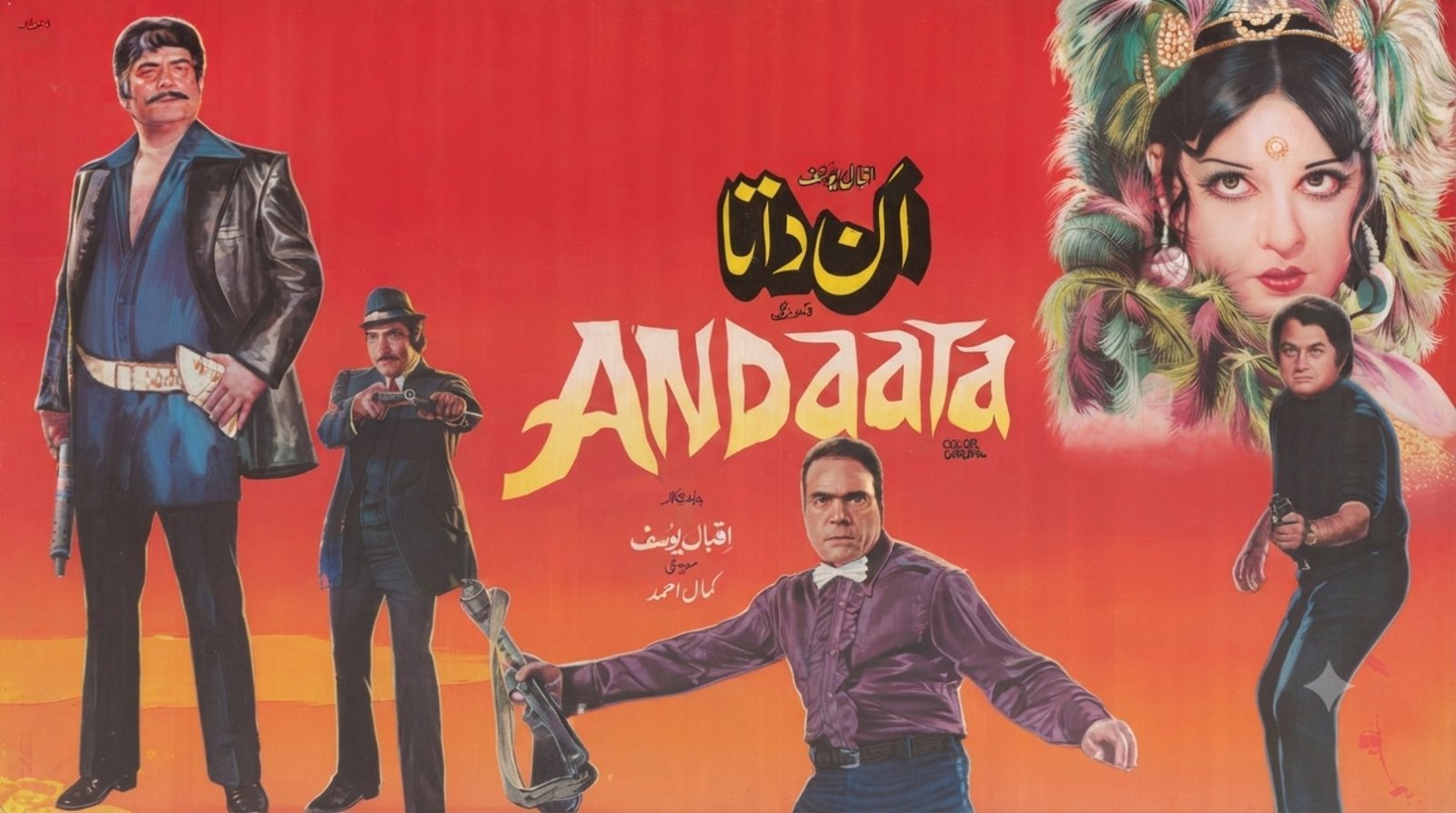
Andaata (1976)
Cast: Sudhir, Mohd Ali, Mumtaz, Sultan Rahi, Mustafa Qureshi, Adeeb, Lehri
Director: Iqbal Yusuf
Music: Kamal Ahmed
Synopsis: The Lollywood version of The Godfather is a hoot and a half! – recommended.
Reviewed by: Omar Khan
Andaata is Lollywood’s action-packed and retro-chic version of Mario Puzo’s celebrated Godfather, recently adapted for Indian audiences in Feroz Khan’s Dharmatma (1975). Now it gets the chutney-masala treatment from seasoned producer-director Iqbal Yusuf.
The film follows the saga of down on his luck and penniless Akbar (Sudhir), who has sick and hungry children to feed but no job and prospects until he is shown how to “snatch” rather than earn by his cunning friends.
Sudhir is seduced by the easy returns his new extortion racket provides. He soon gains quite a reputation in the criminal underworld, so much so that the notorious crime kingpin, Shahenshah (Talish), arrives at his doorstep to offer him a lucrative career as an accomplice gang lord, which Sudhir accepts, cementing his decline into the world of crime.
Sudhir quickly establishes himself as a big name in crime circles and builds himself a mini-empire, ensconced as Emperor and his sons handling the estate’s affairs. However, a favourite younger son (Mohammad Ali), has been stashed away in London studying and has not been given an inkling about his father’s ill-gotten wealth and power. That son finally graduates at around 55 and returns to Pakistan to join the family, who he reckons is running a respectable business. Eventually, his eyes are opened to the deeds of his father and brothers. He is suitably shocked and appalled at the source of his flashy clothes and, indeed, his education.
The movie’s turning point arrives when some vile creep approaches Sudhir to construct a fake medicine factory in his area. Sudhir (a man of some scruples) reacts angrily, chucking the fellow out. This fellow then approaches Shahenshah, who insists he will force Sudhir to open the factory at any cost. A bitter rivalry arises between the two rival crime gangs, with Shahenshah’s posse on one side and Andaata Sudhir’s crew on the other.
Meanwhile, the reluctant Mohammad Ali is slowly but surely dragged into the conflict involving his clan and eventually takes arms and his place at the head of the outfit. But only after Sudhir renounces his devotion to crime upon having half his family mowed down in the gang wars following the fight against Shahenshah.
Eventually, Sudhir realizes that crime pays only in the short run and that, finally, there can be no escaping from one’s sins. It’s the Godfather story given the Lollywood treatment and rather effectively. Andaata moves along briskly, and Iqbal Yusuf never allows proceedings on the screen to start dragging, constantly shifting gears to keep the audience interested. Also, romance, which is usually a crucial part of any desi film, has been played down considerably to keep the film firmly in the action-thriller territory.
Sudhir does well, for the most part, playing his role with restraint and not shouting and screaming as much as he was no doubt accustomed to in the Punjabi movies he acted. In the last ten to fifteen minutes, he lets his guard slip and the aggressive shouting and
Andaata posturing of the Punjabi realm comes to the fore. Mohammad Ali was hardly the man to play a fresh graduate, as he looks the same age as his father and has a gut that resembles a sumo wrestler. A balding, fat man, podgy and unfit and possessing a voice that fails to hide its age, was hardly the fellow suited to play a fresh college graduate. But then, to be fair, it is not an uncommon sight to see 55-year-old men acting in the roles of teenagers and college students in films of the sub-continent.
The ever-charismatic Sultan Rahi is cast as the “James Caan” character from Godfather. He does his job reasonably convincingly with a short fuse of a temper and a violent streak, even if his bow tie selection remains bewildering and effete for a ruthless, gangland criminal. Playing the oldest graduating student in history, Mohammad Ali attempts to appear youthful with his jovial quips and his schoolboy flirtations with the shapely dancer Nyla played by the gravelly-voiced Mumtaz. Rahi does his bit with enthusiasm, as does most of the cast. There is a solid backup cast of seasoned veterans who all do justice to their roles.
Talish, as Shahenshah, is his dependable self, and several respected veterans of Lollywood cinema ably support him. The character actors Ibrahim Nafees, the villainous Adeeb, comedian Lehri and a relatively youthful Mustafa Qureshi made their presence felt. Salma Mumtaz is Sudhir’s righteous wife, and the voice of conscience that wails away annoyingly, and a touch over dramatically, but makes sure she doesn’t go unnoticed.
There is one particularly upsetting scene, though, when, as in The Godfather, a nasty industrialist gets taught a lesson by having his favourite racehorse beheaded and chucked into the bed beside him. In Andaata, a real horse’s head was used, and it is doubtful whether the filmmakers in these parts have the ethics to ensure that the head belonged to a dead horse. The horse was probably put down to have its head appear in the film, which is a stomach-churning thought. However, one recalls the brutal massacre of a cow for Apocalypse Now. An appalling scene that has been burned into the memory forever.
Andaata was a sizeable commercial success, and it’s not difficult to see why. A solid cast heads the film, has a potent, if borrowed, storyline (with serious moral issues), and moves along rapidly, not allowing the audience to lose interest, feel restless or bored, or go out of the hall for an umpteenth tea break. Iqbal Yusuf does a creditable job of keeping the film focused and managed to mount his action sequences effectively, unfolding the story simply enough to appeal to the largely uneducated viewing audience. The director has judiciously employed the songs to break up the action sequences and avoid monotony. The costume designer went to town dolling up his gangsters in Carnaby Street’s latest fashions.
Andaata can be regarded as one of the few successful adaptations of a Hollywood film. The core elements of Copolla’s masterpiece have been cleverly and successfully remixed for local consumption. The movie, for all its quirks and oddities and song and dance sequences, does work quite well. Locals swear that this take on Mario Puzo’s famous novel rungs rings around Feroz Khan’s Dharmatma effort from Bollywood and is also superior to Coppola’s version.



0 Comments
Leave a Comment