
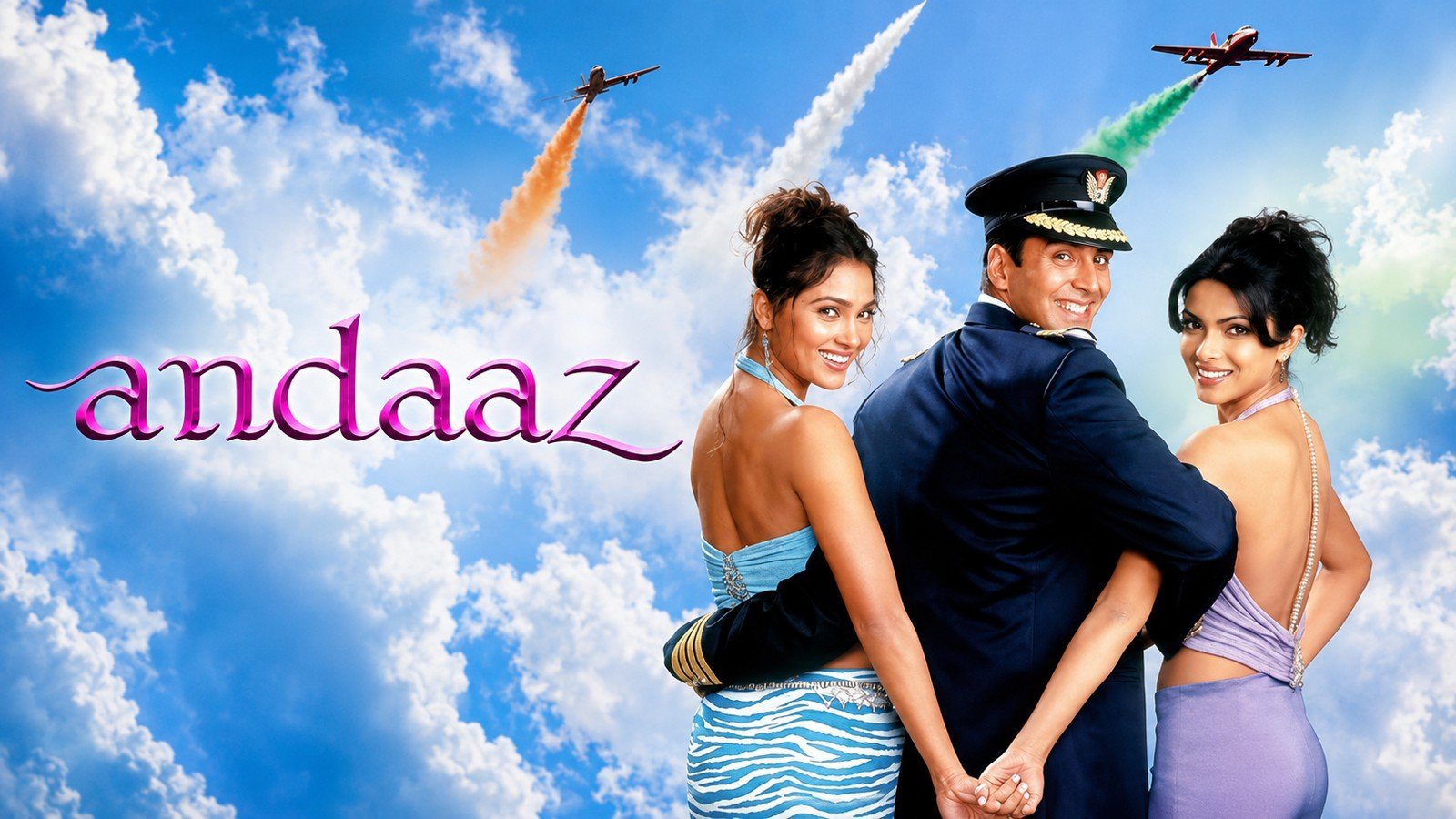
Andaaz (2003)
Cast: Akshay Kumar, Lara Dutta, Priyanka Chopra
Director: Raj Kanwar
Music Director: Nadeem Shravan
Synopsis: Pandering to the lowest common denominator this is mere formula fodder
Reviewed by: Faiz Khan
There are basically three essential ingredients missing from Andaaz: a rape scene, a gang of thoroughly nasty in-laws and, naturally, the obligatory final speech delivered with a trickle of blood dribbling from the heroine's mouth to signify the bottleful of poison she has conveniently swallowed in order to make her noble sacrifice all the more poignant.
Ah...
but then we are no longer in the 1960s.
Disguised as a thoroughly modern romance and boasting the combined attractions of Miss Universe 2000 (Lara Dutta) and Miss World 2000 (Priyanka Chopra), Andaaz nevertheless embraces almost every Bollywood cliché ever invented, producing a perfectly watchable, if rather lifeless, slice of romantic melodrama.
We are introduced to Raj and Kajal as children. Raj walks around wearing leg braces after a knee injury has shattered both his mobility and his confidence. Kajal, meanwhile, is an irrepressible tomboy who spends her time playing football with the boys and gazing wistfully at passing aeroplanes, presumably harbouring dreams of becoming an air hostess one day. Raj, for his part, enjoys flying model aircraft and, through this shared interest, the pair become inseparable friends. Encouraged by Kajal, Raj gradually overcomes his physical and emotional limitations and finally abandons the braces that had come to define him.
Fast forward ten years and Raj (Akshay Kumar) and Kajal (Lara Dutta) remain the best of friends while attending college together. After the customary light-hearted banter and several songs, Raj leaves to train as an Air Force pilot. By now it is abundantly clear that he is hopelessly in love with Kajal, although he somehow neglects to mention this rather important detail before disappearing for eighteen months.
When he eventually returns, Kajal cheerfully informs him that she has found the man of her dreams, a certain Aman Verma, but naturally seeks Raj's approval before agreeing to the marriage. Raj, displaying the sort of selflessness found only in Bollywood heroes, immediately gives his blessing while quietly suppressing his heartbreak. The tears are finally released during the wedding when he launches into yet another of Kumar Sanu's more forgettable musical laments.
Quite what Kajal sees in the astonishingly insipid Aman is anyone's guess. Perhaps it is his fleet of aeroplanes rather than his rather questionable dress sense. Whatever the attraction, she eventually discovers—rather inconveniently after the saat pheras—that Raj has loved her all along. She departs after imploring him to find happiness because, naturally, if Raj remains unhappy then she too can never truly be happy.
The second half shifts its attention to Jiya (Priyanka Chopra), whom Raj encounters after rescuing her from a drunken escapade. In what appears to have been borrowed wholesale from Dilwale Dulhania Le Jayenge and half a dozen other romances, Jiya awakens the following morning after falling into a pond to discover that Raj has thoughtfully changed her into one of his kurtas and prepared breakfast for her.
Apparently this is enough to secure her eternal devotion.
Rather than labour through every predictable encounter that follows, suffice it to say that Jiya, blissfully unconcerned by either common sense or the screenplay, eventually installs herself in Raj's household back in India. Raj, meanwhile, remains incapable of returning her affection yet somehow proposes marriage after accidentally knocking over her pooja ki thaali, unaware that she had been observing a Karwa Chauth vrat on his behalf. Overcome by guilt rather than love, matrimony suddenly seems the obvious solution.
The inevitable twist, of course, is that Jiya turns out to be the sister-in-law of the recently widowed Kajal.
Raj Kanwar has delivered the occasional enjoyable potboiler in the past—Laadla being a particularly entertaining example—but Andaaz feels less like a coherent film than a collection of borrowed ideas stitched together without any emotional conviction. It is essentially two separate love stories awkwardly joined together, with just enough melodrama thrown in during the final act to convince us that everything belongs in the same film.
The screenplay is riddled with holes. How exactly does Jiya simply wander into Raj's household and become part of the family overnight? One is expected to accept such absurdities without question. Numerous scenes appear heavily inspired by Dil To Pagal Hai, yet without the emotional intensity that made that film work. Everything feels prefabricated, carefully designed to tug at the heartstrings, but rarely succeeding in doing so.
Akshay Kumar is rather unconvincing as a college student. Shah Rukh Khan somehow managed the illusion in Kuch Kuch Hota Hai; Akshay never does. Beyond that he performs adequately, although the screenplay gives him little opportunity to create a memorable character. Raj remains little more than another cardboard Bollywood hero—quietly suffering, permanently heartbroken and emotionally paralysed.
Lara Dutta emerges with the stronger role and acquits herself admirably, bringing a welcome freshness and naturalness to the film. Priyanka Chopra also makes a favourable impression despite an initially irritating introduction. Neither actress can reasonably be blamed for the endless stream of clichéd dialogue or the increasingly implausible situations in which they find themselves.
Nadeem-Shravan's soundtrack proves surprisingly disappointing. Kumar Sanu has by this stage become such an acquired taste that every time his voice appears one is tempted to wince rather than listen. Music should be one of the great pleasures of a Hindi film, yet here it frequently becomes an endurance test. Worse still, not a single tune lingers in the memory once the credits have rolled.
Andaaz remains reasonably watchable throughout, but the second half steadily loses momentum. As the predictability mounts, so too does the audience's indifference, until mild irritation finally gives way to boredom.
Pleasant enough.
But ultimately...
rather ordinary.

0 Comments
Leave a Comment