
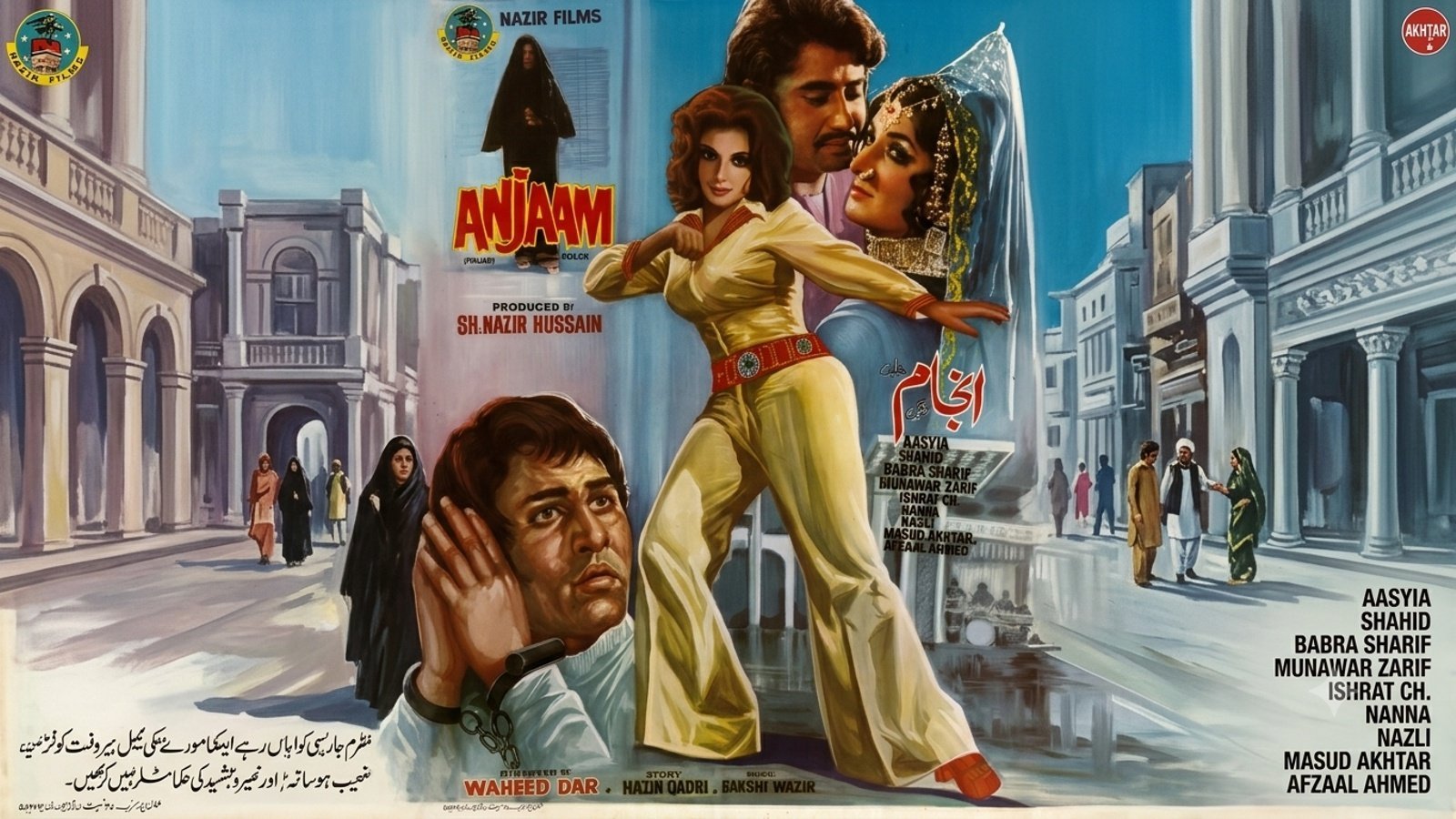
Anjam (1976)
Cast: Aasia, Shahid, Babra Sharif, Munawar Zareef, Ishrat Chaudhary, Nazli
Director: Waheed Dar
Synopsis: A sizeable Box-Office hit about those who fall foul of the righteous path.
Reviewed by: Omar Khan
Anjaam is a fable-like story that attempts to show how money is the root of all evil—but in doing so, the plot goes slightly overboard in its depiction of poverty-stricken bliss.
In the beginning, we are shown the simpleton bumpkin Munawar Zareef and his purdah-clad sister Ishrat Chaudhary, living in a mud hut in relative poverty. Conversely, their friend, Mr. Aslam (Shahid) lives a life of fast cars, boozing, nightclubs and society girls.
Shahid is caught up in all the trappings of the modern, club-going debauched lifestyle, but he appears unhappy—as though he is searching for something more. However, his girlfriend Rukshee (Nazli) proclaims her undying love for him, sensing his reluctance to tie the knot. She then attempts suicide, hoping that he will marry her, but then Shahid overhears her talking to her boss, who is also her lover, and we learn that it was all a heinous plot by the club groupies to try to cash in on his massive fortune.
Meanwhile, back in the mud hut, Munawar Zareef yearns to be like his friend Shahid—rich, footloose and fancy-free, but he feels his poverty stifling his ambitions. One night, Zareef is hit by a car driven recklessly by a drunken Babra Sharif, who takes Zareef home but forgets who he is the following day when her stupor fades. He becomes fascinated by this mysterious lady of the night, who also seems to hang out at the club frequented by Shahid and his rich buddies.
Meanwhile, a disillusioned Shahid, having nearly been duped by Nazli into marriage, retires for a break to the village where he comes across feisty village belle, Gori (Aasia), who wins his heart with her stunning beauty, down-to-earth manner and blunt charm. Most of all, he is attracted to the fact that she has no interest in his money, and refuses to marry him so long as he is merely a wealthy landowner, claiming that her suitor will be a man who earns his living with good old-fashioned sweat and toil.
Disgusted by the shallowness of life at the Club, Shahid tosses everything aside to go and join his village belle and live the life of a common labourer. He hands the keys to his home, car, and safe deposit box to his friend Zareef, who has been yearning to taste the life of a wealthy society playboy. Zareef is introduced to the wonders of alcohol and throngs of charming “society girls”, the type of girl who “is there for enjveyement but not one to get married to!”
Slowly, Zareef finds himself blinded by the bright lights of the club and the lure of liquor and “free love”, worshipping babes who hang out at the club, and he forgets that he is supposed to be responsible for the young sister at home. She is so devoted to and utterly dependent on him. Meek, mild-mannered Parveen (Ishrat Chaudhary), follows her brother from her little mud hut to the city.
It’s not long before she is encouraged to toss aside her purdah, chop off her traditional guthh (long tresses), tart herself up and become the new “Princess of the Club”.
The purdah-clad simpleton—a paragon of eastern virtue—Parveen is turned overnight into slutty Miss Lisa, who is there for “enjveyement” at the club every night.
When Shahid returns from the village, where he has trouble convincing the tribal folk to allow Aasia to marry him, he finds his friend
Anjam
Munawar Zareef on the brink of destruction, seduced by the evils of money.
Shahid reminds him about the sister he had sworn to protect but has now become the top Society Girl. Also that she is carrying the child of one of the many men who has used her for “playyeur”. Suddenly Zareef realizes the error of his ways and how his lust for money has left everything around him crumbling to dust. Will he be able to redeem his sullied sister and return to a life of simplicity and honour, or has he gone too far down the road of modern Westernized debauchery to ever turn back?
There is a terrific climax where everyone gets embroiled somehow or the other, and the good emerge victorious while the sullied and contaminated meet their only fate—doom. There can be no redemption for the woman carrying an unborn child—death being her only possible fate.
We all realize that wealth is evil, and that the mere thought of making money is repellent, one that will only lead to disaster and devastation. In this case, however, the producers of this morality tale went against their plot to some extent. They collected a small fortune as Anjaam blazed away to a silver Jubilee in all country’s major cities.
Shahid turns in an earnest performance and must have been busy during the shoot with the two women who were soon to be Mrs. Shahid in reality. Babra Sharif and Ishrat Chaudhary were soon to be married to Lollywood’s legendary prince of “romance”.
Aasia does an excellent job as the feisty village belle, while Nazli is in top form as the scheming tart Rukshee. Munawar Zareef does his bit as the sleazy club-going womaniser, but Babra has a small role and is somewhat wasted as one of the ladies of the night with a golden heart.
Ishrat Chaudhary steals the show with her transformation from Burqa-clad sis to slutty, whisky-swilling babe of the night. Ms. Chaudhary lives up to her reputation as the top Lollywood dancer of her era with a fabulous dance to Naheed Akhtar’s gloriously cheap “Ghut Bhar Pee le Laal Gulabi Paani da”. Nazli’s dance earlier in proceedings also scores highly in the cheapness stakes.



0 Comments
Leave a Comment