
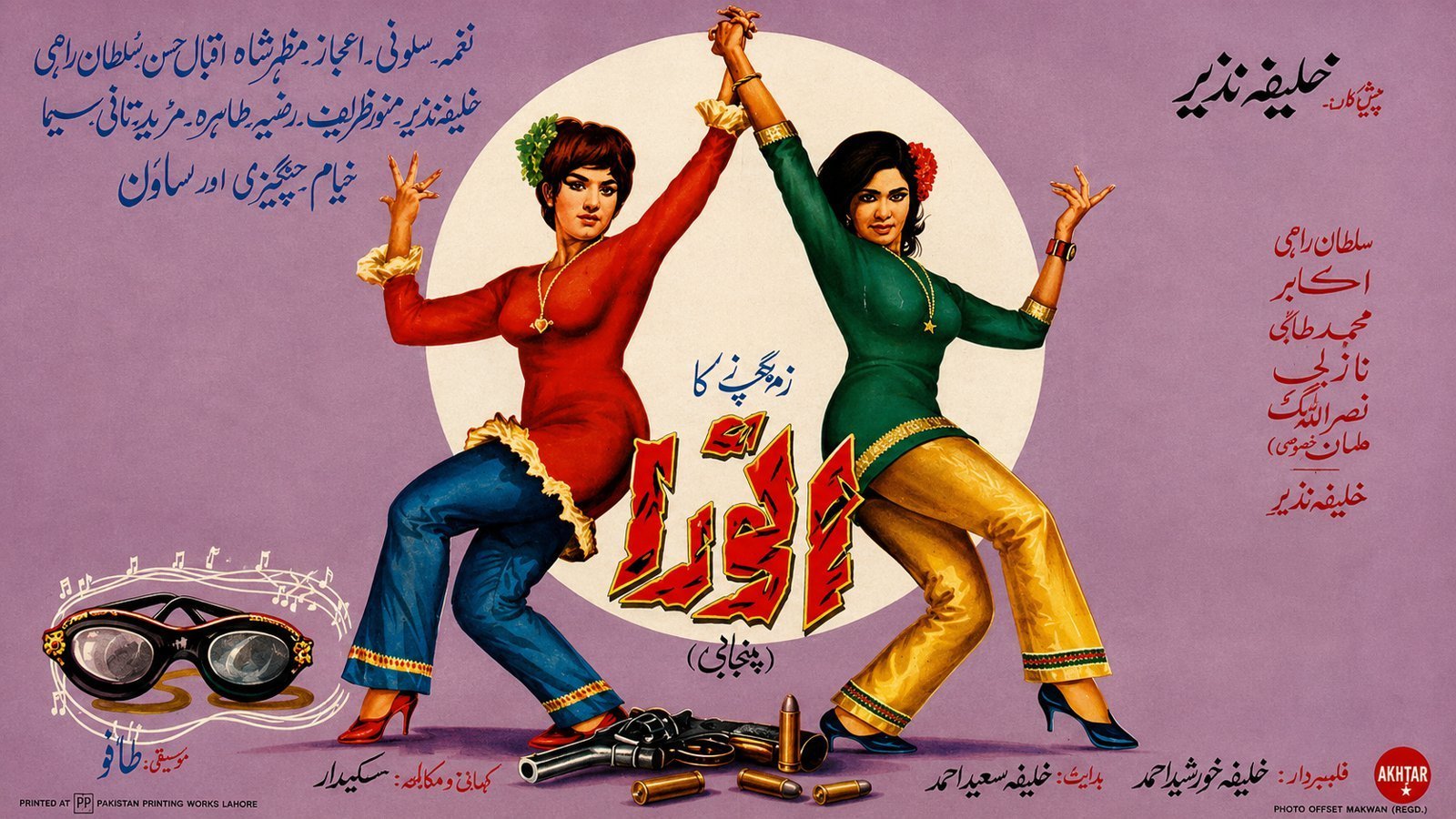
Anwara (1970)
Cast: Naghma, Ejaz, Sawan, Saloni, Munawar Zareef, Iqbal Hassan, Mazhar Shah
Director: Khalifa Nazir
Music: Tafo
Synopsis: The usual masala laced with action, spice and thrills – but this one works!
Reviewed by: Omar Khan
The Khalifa brothers, who produced and directed this typical Punjabi formula flick, hit the jackpot, scoring a massive bull’s-eye as the film went on to shatter box office records in Punjab, and made history as the only film in the Punjabi language to achieve a Platinum Jubilee (75-week theatrical run) in Karachi where the language is not that widespread.
The film follows the theme that was the flavour of the day in those times (and some would say it still is 50-plus years on).
Our story begins with the local villagers of Nurpur Pind getting excited at the prospect of the Chhota Chaudhary (the junior Landlord) arriving from the city and taking up his duties, now that the senior (Vadda Chaudhary) has passed on. There is a buzz of anticipation as Chaudhary arrives. Sadly, for some, he turns out to be a scoundrel of a man—debauched to the core, and it’s not long before gross injustices are meted out to the poor villagers, who are pretty much used to their landlords being bastards of the worst kind.
Very soon, the vile Chhota Chaudhary (legendary Punjabi villain Mazhar Shah) starts making his presence felt. His insatiable lust for local flesh results in a flurry of deaths as the corpses of young village belles begin floating down the local river with alarming regularity.
They stab themselves, leaving a frustrated Chaudhary with the cleaning up job to attend to—a job simplified by simply chucking the corpse into the river! The girls’ corpses mostly commit suicide rather than allow their honour to be sullied by the ghastly Chaudhary.
Meanwhile, one of the upstanding villagers, Anwara, and his best friend—true sons of the soil are soon snared in the evil Chaudhary’s trap. Anwara is framed for his best friend’s murder, and the following court case is rendered a farce as all the “eyewitnesses” spew a bunch of lies to help the Chaudhary get off Scot free as he always does. And so Anwara is disgraced and sentenced to years in prison, and as he is dragged off, he swears to take down the kingdom of the diabolical Chaudhary and avenge his friend’s death.
Time passes, and Anwara’s young son grows up as an earnest young man, who passes his various exams with flying colours and is soon inducted into the secret police. His first major assignment is to go to the same Nurpur pind, presided over by the murderous Chhota Chaudhary and root out the burgeoning crime in the area.
But before he heads off to the Pind, he and his sidekick Munawar Zareef should start a fling with two feisty beauties. Naghma and her friend and much frolic and banter follow, including a song where the two young ladies cannot contain their happiness and must run to the local park to break out into a frenzied synchronised dance or two.
The plot thickens as Chaudhary, and his henchmen take on the new inspector, who is none other than the son of the wrongfully disgraced Anwara. There is another earnest young man in the village who takes no-nonsense and is least fearful of Chaudhary’s tactics, Iqbal Hassan, the son of Anwara’s mate, who was murdered by Chaudhary earlier on.
The plot comes full circle as the good sons of Anwara and his mate take on the evil Chaudhary’s clan, and to complicate matters further,
Anwara
Anwara is released from jail and becomes a Dakoo (bandit) who is also on his son’s most wanted list. There are the usual fights and mayhem along the way to a barnstorming if utterly predictable, climax. Yet, somehow, the movie manages to retain its fairly zippy pace and never do proceedings slow to the dullness that one has come to expect from a 160-minute film.
What certainly helped propel the film to its enormous success was the music of the newly discovered composers, the Tafo Brothers. They truly arrived on the scene as their tune recorded by Madam Noor Jehan titled “Sun we Bilori Akh Waleya” became nothing less than a nationwide craze and, to this day, remains one of the enormous evergreen classics of Lollywood film history. A short-haired Naghma, in trendy slacks, goggles and a body-hugging polo neck top (the fashion rage in those days!) brings the house down as she attempts to seduce undercover agent Ejaz with the brisk ditty sung by Noor Jehan.
Munawar Zareef does his thing well, including the prerequisite drag scene he excelled at. However, the film doesn’t offer anything different from the formula fare being churned out by every other producer of the time. Yet somehow, the various ingredients that make up this formula clicked so perfectly together that the film was propelled to an unprecedented wave of success, riding on the craze created by Noor Jehan’s song more than anything else.
Sultan Rahi appears in one of many villainous roles he used to snag in the early ’70s. It was a few years before he would be transformed into the nation’s top screen “hero”, even though he would have already entered his 40s, proving that age hasn’t traditionally been a barrier to success in Lollywood or Bollywood. After all, Dharmendra, Dev Anand, Rajendra Kumar, Dilip Kumar, Manoj Kumar (a college student in Clerk when he was closer to 60 rather than 16), and countless others were also cavorting around the trees wooing teenagers well into their wrinkled days. Likewise, Mohammad Ali—balding and paunchy—was still a swinging hero in the ’70s and later, even playing the odd college student role at well past 40.
The Khalifa brothers tried to recreate the exact formula the following year with Asghara, but lightning never struck in the same spot as they soon realized. Anwara will go down in Lollywood history as a massive Box Office smash. She will forever be remembered for the timeless Noor Jehan song that it spawned, which remains hugely popular today.
It may not be a classic film in the accepted sense. Still, it is classic popular Lollywood fare and provides a fascinating glimpse of the style and issues that dominated Punjabi filmmaking in the late ’60s and early ’70s.
A rollicking, crowd-pleasing entertainer that has survived the ravages of time rather well and still manages to entertain. Sadly, though the themes of Lollywood films have remained relatively static, filmmaking’s style, enthusiasm and joy seem to have ebbed away over the years, and now similar fare is churned out but mechanically and soullessly.



0 Comments
Leave a Comment