
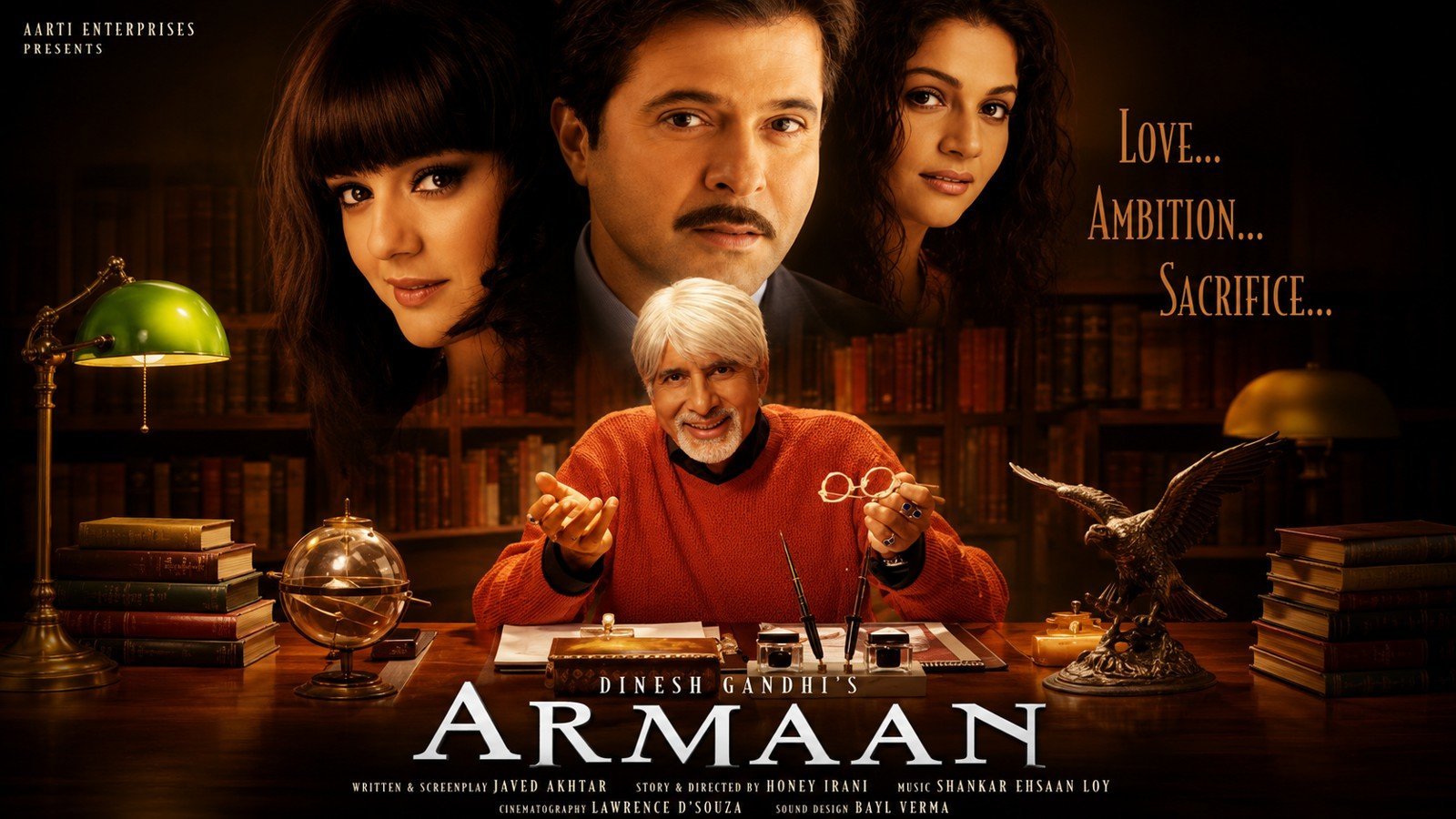
Armaan (2003)
Cast: Amitabh Bachchan, Anil Kapoor, Preity Zinta, Gracy Singh
Director: Honey Irani
Music Director: Shankar Ehsaan Loy
Synopsis: Mature, seriously presented hospital-based romance with top performers
Reviewed by: Faiz Khan
Armaan is essentially a mature love story set in a hospital. It attempts to distinguish itself from the routine Bollywood romance through a more restrained treatment and, to a considerable extent, succeeds thanks to Honey Irani's assured direction and a uniformly excellent cast.
The hospital is run by Dr Siddharth Sinha (Amitabh Bachchan), a respected physician suffering from a serious heart ailment that he keeps hidden from everyone around him. Determined to raise funds to expand the hospital, he fears that no one will invest if they discover that he is terminally ill.
His adopted son, Akash (Anil Kapoor), is a talented neurosurgeon who shares a warm and affecting relationship with his father. Siddharth never married because his prospective father-in-law insisted that he abandon his adopted son, a condition he steadfastly refused to accept.
The arrival of anaesthetist Neha (Gracy Singh) inevitably leads to romance blossoming between the two doctors, almost literally over a scalpel and an exposed brain. Destiny, however, has other plans.
A chance meeting with Soniya (Preity Zinta) alters the course of Akash's life completely. The only daughter of millionaire Gulshan Kapoor (Randhir Kapoor), Soniya storms into his world like a hurricane, leaving chaos in her wake. Spoilt beyond belief and accustomed to getting whatever she wants, she decides after a single meeting that Akash is the man she intends to marry.
Insisting on racing him in her car—a decision that should really have warned Akash about her unstable temperament—Soniya crashes and ends up in his hospital with a broken leg. During her recovery, she clings to Akash at every opportunity, much to Neha's growing frustration.
When Soniya's father offers to finance Dr Siddharth's dream hospital on one condition—that Akash marries his daughter—the story reaches its turning point. Following Siddharth's sudden death from a heart attack, Akash discovers the hospital's desperate financial situation and is forced to choose between his love for Neha and fulfilling his father's lifelong ambition.
Just as Siddharth sacrificed his own happiness for the sake of his son, Akash sacrifices Neha and marries the possessive and emotionally unstable Soniya. Predictably, married life soon turns into a nightmare as Soniya becomes increasingly obsessive and determined to drive Neha out of Akash's life altogether.
Honey Irani's film offers little that is genuinely new. In many ways it could easily have been one of the romantic melodramas of an earlier era, such as Dil Apna Aur Preet Parai, with its familiar love triangle and emotional conflicts. Nevertheless, she packages the familiar ingredients neatly, producing a film that is a cut above much of the formulaic fare Bollywood routinely churns out.
The first half is rather leisurely and lacks dramatic urgency, although many of the scenes set inside the hospital are convincingly handled and populated by characters who feel refreshingly real rather than the usual cardboard stereotypes.
The film improves considerably with the arrival of Preity Zinta's volatile Soniya. In many respects she occupies the sort of role once associated with actresses such as Nadira, Shashikala or Bindu, and she plays it with admirable conviction. Where the film is less successful is in its attempts to explore the ethical dilemmas facing doctors. The central conflict—money in exchange for marriage—is a storyline Bollywood has revisited countless times over the years and feels somewhat at odds with what is ostensibly a medical drama.
Later, Akash faces another moral test when Soniya herself requires brain surgery and he must decide whether he can operate on the woman who has made his life such a misery. Conveniently enough, the screenplay allows him to emerge with both his conscience and his happiness intact.
The film occasionally hints at greater emotional depth than it ultimately delivers, but there is nevertheless an underlying seriousness to the proceedings that helps distinguish it from many contemporary romances.
The performances are uniformly impressive. Amitabh Bachchan makes a considerable impact despite his relatively brief role, delivering another restrained and dignified performance. Anil Kapoor is equally effective and gives one of his most controlled performances in years.
Preity Zinta deserves particular praise. This is not the sort of role most leading heroines would willingly accept, yet she brings both volatility and vulnerability to Soniya, making what could easily have been a one-dimensional villainess into a genuinely tragic figure. Randhir Kapoor is also excellent as the loving but guilt-ridden father who understands his daughter's flaws yet continues to indulge her. Gracy Singh has the least demanding role as the conventional good-hearted heroine but provides an effective contrast to Soniya's instability.
Shankar-Ehsaan-Loy's music has a welcome freshness about it, even if three songs were ultimately dropped from the final cut. The absence of an obligatory item number is refreshing in itself, while Javed Akhtar contributes polished dialogue and thoughtful lyrics.
Armaan is unlikely to be remembered as one of Bollywood's great romances, but it is a sincere, well-acted and engaging drama that treats familiar material with intelligence. Worth a look, even if it is unlikely to linger long in the memory.

0 Comments
Leave a Comment