
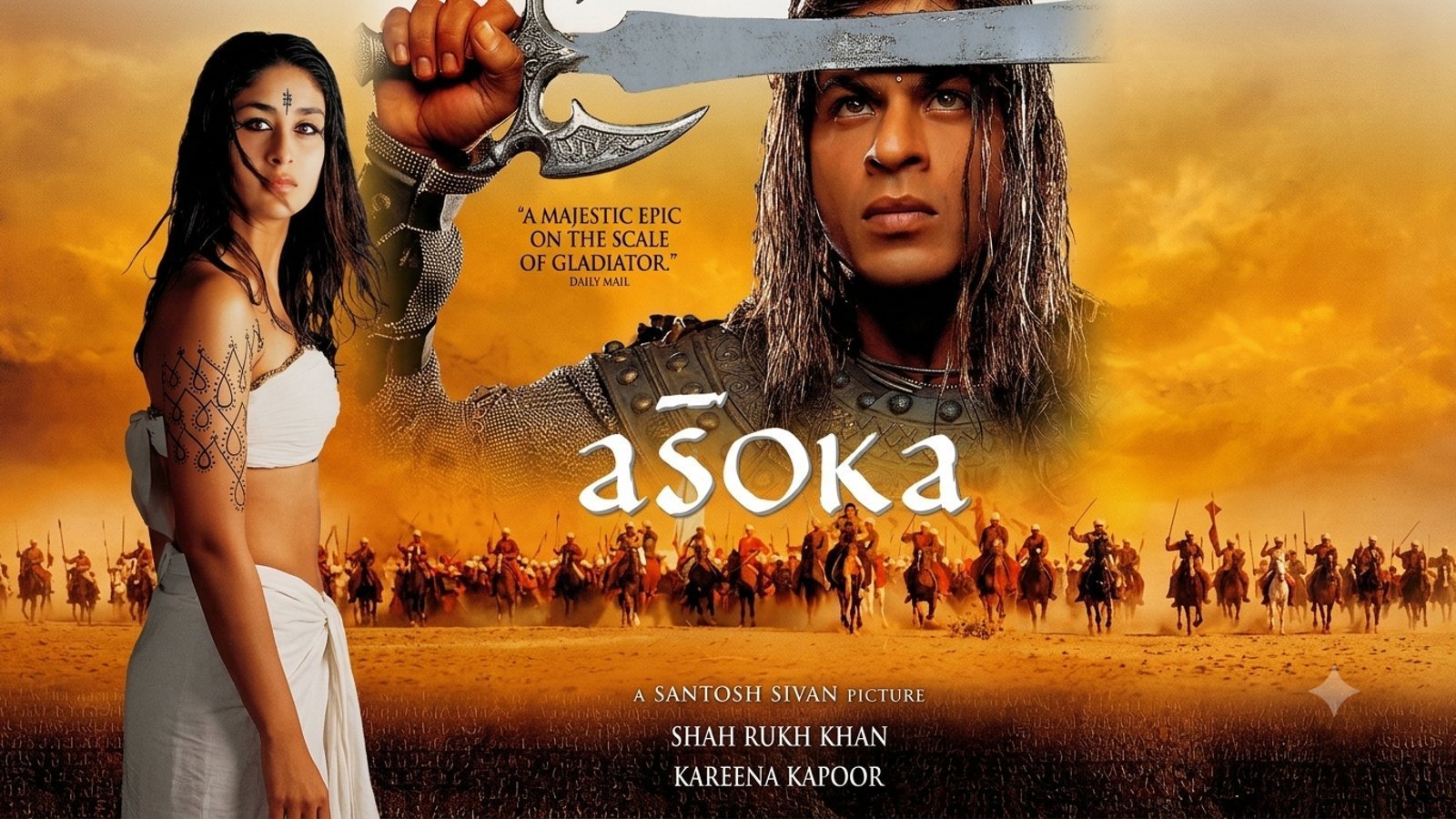
Asoka (2001)
Starring: Shahrukh Khan, Kareena Kapoor, Danny, Hrishitaa Bahl, Ajit Kumar
Director: Santosh Sivan
Music Director: Anu Malik
Synopsis: Shahrukh Khan's highly ambitious recreation of the tale of the emperor
Reviewed by: Faiz Khan
Shah Rukh Khan took a considerable gamble in producing a film as ambitious as Asoka. It attempts to blend historical fact with outright fiction, creating a sweeping romantic epic based upon one of India's most celebrated rulers. The problem is that, while it occasionally captures the spirit of Emperor Ashoka's life, it can hardly be regarded as an accurate historical account.
Asoka (Shah Rukh Khan), urged by his mother to escape the deadly intrigues of the royal court, leaves the kingdom and wanders the countryside, where he encounters the spirited Kaurwaki (Kareena Kapoor). Introducing himself simply as Pavan, an ordinary traveller, he falls in love with her, unaware that she is in fact the Princess of Kalinga, travelling in disguise with her younger brother after the brutal murder of their parents.
The pair eventually marry before Asoka is summoned home under the false pretence that his mother is gravely ill. When he returns to find Kaurwaki apparently massacred, his grief sets him upon the path that ultimately transforms him into the ruthless warrior history remembers. Political betrayal, family tragedy and an insatiable thirst for power eventually culminate in the historic Battle of Kalinga, the conflict that would forever alter his destiny.
The central dilemma facing Asoka is whether one is prepared to accept such an extensive blending of history and fiction. Taken purely as a romantic adventure, it is reasonably engaging. As a historical drama, however, it raises rather more questions than it answers.
One often hears the comparison with Titanic, another film that placed fictional characters against the backdrop of real historical events. The difference here is that Ashoka himself is the historical figure. We know a fair amount about his life, yet the screenplay introduces an entirely fictional romantic narrative that fundamentally alters our perception of the man. Perhaps I am mistaken, and there really was a Kaurwaki with whom Ashoka fell in love while concealing his identity. Somehow, I find that rather difficult to believe.
The first half concentrates almost entirely on the romance between Asoka and Kaurwaki, and herein lies one of the film's greatest weaknesses. Despite its historical setting, the relationship unfolds very much like a contemporary Bollywood love story. Kareena Kapoor's introduction, complete with revealing costumes and Anu Malik's modern musical score, feels completely at odds with both the period and the character she is supposed to portray.
The film repeatedly undermines its own historical aspirations through needless attempts to commercialise the material. Songs resemble MTV music videos rather than moments from an ancient Indian epic. The much-publicised research into Kareena's "authentic" costumes sits rather awkwardly alongside sequences such as "Aa Tayar Ho Ja", with dancers swinging from ropes in perfectly choreographed formations. Then there are the three comic guards, whose tiresome attempts at humour seem to have wandered in from an entirely different film. Even the flashback placement of "Roshni Se" feels hopelessly out of place.
None of this would matter quite so much were the drama itself more convincing. Unfortunately, the screenplay is riddled with unanswered questions and emotional shortcuts. Asoka's transformation into a ruthless conqueror occurs with surprising haste and little psychological development. Likewise, Bheem's decision to conceal the fact that Kaurwaki is still alive never rings true, while the central premise of Ashoka wandering around as an anonymous traveller without revealing his identity becomes increasingly difficult to accept.
The problem ultimately lies in the director never quite deciding what sort of film he wishes to make. Is it a historical epic? A romantic fantasy? Or simply a commercial Hindi entertainer using Ashoka as its backdrop? In trying to be all three, it never fully succeeds as any one of them.
That is not to say the film is without merit. It remains a good deal more ambitious than the average Hindi film released during the period. Santosh Sivan photographs the film magnificently, creating images of extraordinary beauty, and despite its leisurely pace it manages to sustain interest throughout.
Shah Rukh Khan, however, never entirely disappears into the role. One is always conscious of watching Shah Rukh Khan rather than Emperor Ashoka, and his performance never becomes as emotionally involving as the material requires. Kareena Kapoor looks suitably regal but the conception of her character never quite works. Among the supporting cast, Ajith Kumar and Rahul Dev emerge with the greatest credit.
Anu Malik's score is something of a disappointment. Few of the songs complement either the period or the subject matter, and the obvious attempt to contemporise the film ultimately works against it rather than for it.
In the end, Asoka is an admirable failure.
Its ambitions are considerably greater than those of the average Bollywood costume drama, but its uncertainty over whether it wishes to be history, romance or commercial entertainer prevents it from fulfilling the considerable promise it initially shows.

0 Comments
Leave a Comment